


Written by the C&G Holsters team, founded by a retired Law Enforcement Officer and Master Firearms Instructor, and staffed by active and retired LEOs, military veterans, and competitive shooters who live this compliance environment every day.
Your Gun Is Approved — But Is Your Holster?
Here's the compliance gap most officers never think about: your department signed off on your off-duty firearm, so your holster must be good to go, right? Wrong. Each agency independently sets its own off-duty holster policy, and firearm approval does not automatically extend to the holster you choose to carry it in.
This is not a minor administrative detail. According to FBI LEOKA data cited by Alien Gear Holsters, approximately 8 to 10 percent of officer fatalities involve the officer's own weapon being used against them. Holster selection is a life-safety decision, not a gear preference.
This article covers three areas every officer needs to understand: how LEOSA interacts with (but does not replace) departmental policy, what real-world holster qualification requirements look like, and why retention standards are tightening across the board.
LEOSA Gives You the Right to Carry — Not the Right to Carry Anything
The Law Enforcement Officers Safety Act (HR 218) grants active and qualified retired officers the right to carry a concealed firearm across all 50 states, regardless of local jurisdiction. It's a powerful federal protection, but it has clear limits that too many officers overlook.
LEOSA does not override your department's internal holster approval policies. According to Urban Carry Holsters, each agency sets its own off-duty carry requirements, which may include specific holster types, retention levels, and ammunition restrictions. Your federal right to carry and your department's rules about how you carry are two separate obligations.
For active officers, LEOSA eligibility requires current agency credentials. For retired officers, the requirements are more involved: you must complete an annual firearms qualification administered by your state, and you must carry proof of that qualification (a photographic ID and current certification) at all times when armed, as outlined by the U.S. Department of State.
The LEOSA Reform Act of 2025 (H.R. 2243 / S. 679) is currently moving through Congress. As described by Rob Corbett Law and backed by Senator Husted, the bill proposes simplified cross-jurisdiction compliance and would extend carry rights to school campuses and transit systems. These are meaningful expansions, but even if the Reform Act passes, it will not eliminate agency-level holster approval requirements. Your department still decides what holster rides on your belt.
Bottom line: LEOSA is your legal authority to carry. Your department's SOP is your authority to carry that specific holster. Both must be satisfied.
What Departmental Off-Duty Holster Policies Actually Look Like
There is no single national standard for off-duty holster requirements. Policy is set agency by agency, which makes it your personal responsibility to know your department's rules inside and out. Here's what several agencies require, drawn directly from their published policies.
Los Angeles Sheriff's Department (LASD): All holsters, on-duty or off-duty, must fully cover the handgun's trigger guard opening when the weapon is holstered. The LASD Weapons Training Unit maintains a posted list of approved off-duty holster specifications.
DC Metropolitan Police Department: According to General Order 901.2, all members in off-duty civilian clothing must carry their firearm in a concealed, department-approved holster. That holster can be department-issued or personally owned, but personally owned holsters must be pre-approved.
Johns Hopkins Police Department: Under Directive #403, effective January 6, 2026, only issued or authorized holsters are permitted. Officers must complete required training and demonstrate minimum proficiency before being authorized to carry any firearm on or off duty.
Edina (MN) Police Department: Per Policy 460.00, holsters are inspected by a firearms instructor at every qualification shoot. Any holster found unsafe or defective is immediately pulled from service. Non-uniformed officers must use only holsters approved by the Chief of Police.
Madison (WI) Police Department: The Madison PD SOP requires that any officer transitioning to a new primary holster requiring a different carrying method must successfully qualify with that holster before carrying it on or off duty.
The pattern across these agencies is consistent: trigger guard coverage, active retention devices, and instructor-level inspection are the most common recurring requirements. If your holster can't meet those three benchmarks, it's unlikely to pass muster at any department.
Retention Standards Are Getting Stricter — Here's Why
The operational environment is driving the change. According to the FBI's 2025 Special Report, 81.1% of firearms used to kill victim officers were handguns, the highest percentage in the 2021 to 2025 period. In 2024, 64 officers were feloniously killed in the line of duty.
The assault numbers paint an even starker picture. Agencies reported 90,178 officer assaults in 2025, a rate of 13.8 per 100 officers — the highest officer assault rate in the past 10 years. When officers are being attacked at record rates, retention is survival.
The industry response has been a clear shift from passive retention systems (friction fit, simple thumb straps) to active multi-retention systems with automatic locking capability. Many departments now prohibit open-top holsters for off-duty carry entirely and require at minimum a strap or active locking mechanism.
On the standards front, the National Institute of Justice (NIJ) has been developing a Criminal Justice Duty Holster Standard, the first attempt to create standardized retention requirements across law enforcement agencies. If adopted, this standard could reshape what qualifies as an approved holster for both on-duty and off-duty carry nationwide.
For plainclothes and off-duty officers, this creates a specific challenge: you need a holster that meets active retention standards while remaining concealable under civilian clothing. That's a narrow window, and it's why precision-fit Kydex holsters with adjustable retention have become the go-to solution for officers who need to check both boxes.
How to Get Your Personal Off-Duty Holster Approved
Start with your department's written SOP. Identify the approving authority (the Chief, a Weapons Training Unit, or a designated firearms instructor) and request the specific holster criteria in writing. Don't rely on word-of-mouth or what the last guy in the locker room told you.
Understand that many departments require you to qualify with each specific holster, not just each firearm. Precision fit and a consistent draw aren't nice-to-haves; they're the difference between passing and failing qualification. If your holster doesn't seat your firearm the same way every single time, you're going to have problems on the line.
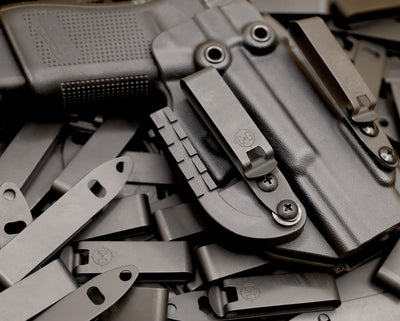
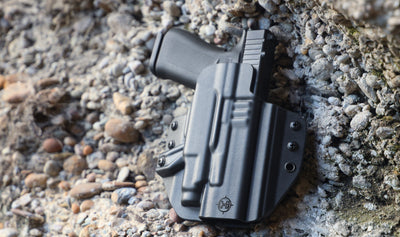
Officers running optics-ready or weapon-light-equipped handguns face an additional hurdle: department-approved holster lists often lag behind these configurations. If your setup isn't on the list, proactively seek written approval for a non-standard configuration. C&G Holsters' IWB Tactical Kydex holsters, available in both Quickship and fully custom configurations for nearly every handgun model, are built on CNC aluminum molds to the precision-fit tolerances that support consistent, repeatable qualification performance.
Document every step of the approval process. Carry your written authorization whenever you carry a personally owned holster off duty. If it's not in writing, it doesn't exist.
Carry With Confidence — and Full Compliance
Legal authority to carry and departmental holster compliance are two separate obligations. LEOSA or your state's concealed carry law gets you the right. Your department's SOP dictates the how. Both must be satisfied before you strap on a holster off duty.
Retired officers: your ongoing obligations are not suggestions. Annual qualification, proof-of-certification carry, and a holster suited to plainclothes concealment are requirements.
Treat your holster selection with the same seriousness you give your firearm selection. It is a life-safety decision with policy, legal, and tactical dimensions. Know your department's written policy. Get your holster approved before you carry it. Choose gear built to the precision standards that hold up under qualification and real-world use.
Sources
- Alien Gear Holsters: How to Choose a Duty Holster
- Urban Carry Holsters: Law Enforcement Concealed Carry Essentials
- U.S. Department of State: LEOSA FAQs
- Rob Corbett Law: LEOSA Reform Act of 2025
- Senator Husted: LEOSA Reform Act Support
- LASD Manual of Policy and Procedures – Holsters
- DC MPD General Order 901.2
- Johns Hopkins Police Department Directive #403
- Edina Police Department Policy 460.00
- Madison Police Department SOP – Police Weaponry
- FBI: Officers Killed and Assaulted in the Line of Duty, 2025 Special Report
- NIJ Duty Holster Retention Standard Fact Sheet





Leave a comment