


The Carry Statistic That Should Alarm Every Gun Owner
By: Christopher J. Burns
As of July 2026, 30.9% of American adults report carrying a concealed handgun, up from 24.3% in December 2024, according to a Crime Prevention Research Center survey. That's a 6.6 percentage-point jump in roughly 18 months.
Meanwhile, 46.8% of Americans (157.6 million people) now live in constitutional carry states where no permit or training is required to carry a firearm. Millions of new carriers are legally armed with zero mandated holster training.
The core problem is this: law enforcement has codified holster discipline into doctrine over decades. Civilian carry culture, largely, has not. This is not about gear preference. It is about a safety gap with documented, sometimes fatal, consequences.
Law Enforcement Treats the Holster as Safety Equipment, Not an Accessory
In professional law enforcement, holster discipline rests on three pillars: selection, inspection, and repetition. None are optional. As Police1.com puts it, the holster is treated as safety equipment, not uniform decoration.
The National Institute of Justice (NIJ), through the National Law Enforcement and Corrections Technology Center (NLECTC), has developed a formal Duty Holster Retention Standard establishing minimum requirements for form, fit, performance, and labeling of duty holsters. No civilian equivalent exists.
Understanding retention levels is fundamental to this standard:
- Level I: A single retention element, such as friction fit or a thumb break.
- Level II: Two security systems. This is the standard for patrol officers.
- Level III: Three separate movements required to draw. Reserved for high-threat environments.
Most uniformed officers carry Level II or Level III holsters. Most civilians carry Level I or completely unrated holsters. The gap is significant.
The institutional mindset is straightforward: a holster is a critical safety system that must be selected for the specific firearm, tested under realistic conditions, and trained with until manipulation becomes automatic. Comfort and aesthetics are secondary considerations.
Civilian carry culture still largely treats holsters as accessories — you pick one that feels good, looks right, and fits your budget. That approach would get an officer pulled from duty.
Reholstering Is More Dangerous Than the Draw, and LE Knows It
Here is a truth that surprises most civilian carriers: reholstering, not drawing, is the highest-risk moment of a carry day.
This is not theory. When law enforcement transitioned from revolvers to semi-automatic pistols, agencies saw a documented spike in negligent discharges during reholstering. According to Police and Security News, that painful lesson led directly to the reholstering protocols now standard across agencies.
A peer-reviewed analysis of 171 unintentional discharge reports from law enforcement agencies (1992 to 2016) found that 20% of low-threat discharges occurred in private residences, 17.8% in locker rooms or restrooms, and 17.8% during firearm storage and cleaning. The pattern is clear: most unintentional discharges happen during routine administrative handling, not gunfights.
The mechanical risk is well understood. A holster edge can physically drive a finger onto the trigger during reholstering, causing a discharge. This hazard is documented in training curricula and patent literature alike.
Law enforcement reholstering protocol follows a strict sequence:
- Finger straight and completely off the trigger.
- Visually confirm the holster opening.
- Clear the path of clothing, straps, or obstructions.
- Guide the firearm deliberately into the holster. No rushing.
- Reset all retention devices after the firearm is fully seated.
As Safariland's training doctrine states: "There are no prizes for the shooter who reholsters the quickest."
Civilian training content almost universally focuses on draw speed. Reholstering protocol is nearly absent from civilian-facing instruction. That is a blind spot with real consequences.
The AIWB Problem: High-Risk Carry Without High-Discipline Training
Appendix inside-the-waistband (AIWB) carry is the fastest-growing civilian carry style. It is also the highest-risk position anatomically during reholstering. The muzzle points directly toward the femoral artery and groin throughout the entire reholstering sequence. A wound to the femoral artery can be fatal in minutes.
The LE doctrine on trigger guard coverage and deliberate reholstering applies directly to AIWB carry, but it is rarely taught in civilian AIWB contexts. Most instructional content covers draw technique and positioning; the critical reholstering phase gets glossed over or skipped entirely.
The most common mistake new civilian carriers make is buying a universal or non-model-specific holster that leaves the trigger guard inadequately protected. Law enforcement mandates model-specific, retention-tested holsters for good reason. Civilians carrying AIWB should apply the same standard, because the anatomical stakes are even higher.
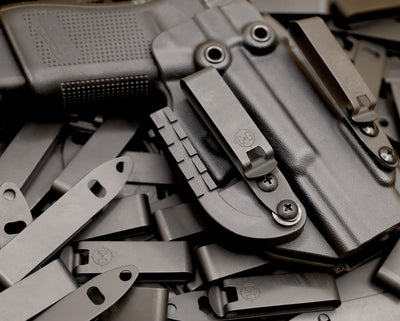
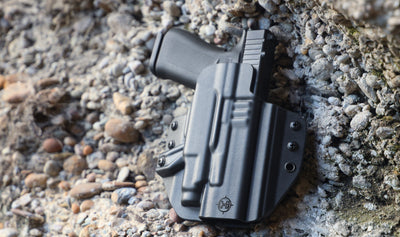
C&G Holsters' TRINITY Belt Mounted Kydex Holster System is CNC-machined from custom aluminum molds for each specific firearm model, providing the defined trigger guard coverage and consistent retention that LE doctrine demands.
There is another dimension to this problem. According to NSSF data, 28% of concealed carriers admitted to skipping carry due to holster discomfort, often leaving the gun at home entirely. Poor holster selection creates a safety gap even when the firearm stays in the safe.
The Accountability Gap: Why LE Holster Discipline Sticks and Civilian Discipline Doesn't
In law enforcement and military contexts, a negligent discharge is treated as a serious offense. Charges, termination, and prosecution are real consequences That institutional accountability creates a culture where holster discipline is non-negotiable.
Officers must qualify annually. The current standard requires an 80% scoring threshold on SQT-A1 targets across multiple shooting positions and distances, verified by an instructor, according to 2026 reporting on LE qualification standards. No comparable mandatory standard exists for civilian carriers in most states.
Holster familiarity in LE is achieved through thousands of repetitions — a mandatory training element, not something officers do at their discretion. A study of 300 negligent discharges found that a significant number were directly attributable to someone failing to use a holster at all, or failing to use a quality holster.
Civilian carriers can build equivalent accountability: seek instructor-led training, log repetitions, join a structured shooting program, and treat annual requalification as a personal standard. C&G Holsters was founded by a retired Law Enforcement Officer and Master Firearms Instructor, and our team includes U.S. Military Veterans, active LEOs, and competitive shooters. Our Firearms Instructor Program reflects the same institutional standard applied to civilian carry, because discipline should not depend on a badge.
Adopt the Standard, Even Without the Badge
Four principles from law enforcement holster doctrine that every civilian carrier should adopt immediately:
- Treat the holster as safety equipment. Select it with the same seriousness you would apply to choosing a firearm.
- Train reholstering as a separate, deliberate skill. Slow is correct. Fast is reckless.
- Use only model-specific retention holsters. Universal holsters leave trigger guards exposed.
- Build accountability through structured repetition. Log your dry-fire reps. Seek qualified instruction. Requalify annually.
157.6 million Americans live in constitutional carry states with no mandated training. The discipline gap is real, and it is growing.
The standard does not require a badge. It requires a decision to carry with the same seriousness professionals do. If you carry, carry like someone who has been trained to — because the stakes are identical whether you wear a uniform or not.
Sources
- Crime Prevention Research Center — New Survey on the Rate That People Carry Concealed Handguns (July 2026)
- Crime Prevention Research Center — Concealed Carry Permit Holders Across the United States: 2025
- Police1.com — The Role of Duty Holsters in Officer Safety and Readiness (January 2026)
- Office of Justice Programs — NIJ Duty Holster Retention Standard Fact Sheet
- Police and Security News — Getting Into Action: The Draw Stroke (December 2019)
- O'Neill et al. — Further Analysis of the Unintentional Discharge of Firearms in Law Enforcement, Applied Ergonomics (2018)
- Inside Safariland — Safe Pistol Reholstering (May 2026)
- ConcealedCarry.com — 6 Required Behaviors to Stop Negligent Discharges (May 2026)
- Modern Family Driver — 10 Mistakes Gun Owners Often Make When Carrying a Handgun (September 2025)





Leave a comment