


The Direct Answer: One Holster Does Not Reliably Fit Multiple Guns
No. A safe holster is matched to your exact firearm model, generation, weapon light model, and optic configuration. Not just your brand. Not just your caliber. Your specific setup.
Assuming compatibility based on appearance alone is a documented safety risk. A holster that looks like it fits can leave the trigger guard exposed, fail to retain the firearm under stress, or prevent a clean draw when you need it most. According to Gun Safe Security, proper fit verification is essential before carrying any firearm in any holster.
The scale of this problem is real. The NSSF reported approximately 26.2 million Americans purchased a firearm for the first time between 2020 and January 2025. Many of those new owners may not understand why a "fits most" holster is unsafe for defensive carry.
This article covers each compatibility variable: firearm model and generation, weapon light, optics, and sight-channel height. By the end, you will know exactly how to verify your own setup.
Why Firearm Model and Generation Determine Holster Fit
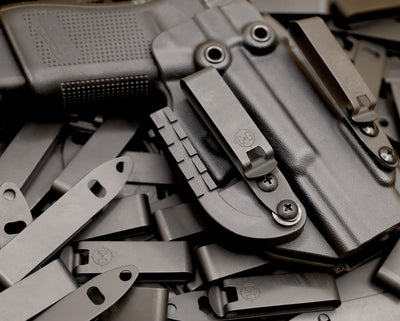
A precision Kydex holster is CNC-molded to exact dimensional tolerances. Trigger-guard geometry, slide width, rail profile, and frame bevel all determine whether a gun seats correctly and retains securely. Even small differences between generations of the same firearm can make a holster incompatible.
The SIG P365, P365X, P365XL, and P365 XMACRO share a brand name but have meaningfully different slide lengths, grip heights, and optics configurations. Each requires its own dedicated holster. The same applies to the M&P 2.0 versus the original M&P frame, and the Springfield Hellcat versus the Hellcat Pro.
Aftermarket modifications compound the issue. Ported barrels, compensators, extended controls, and frame stippling can all affect holster fit, even when the base model is listed as compatible.
Do Weapon Lights Change Holster Compatibility?
Yes, fundamentally. Light-bearing holsters retain on the weapon light itself, not the firearm frame. Remove the light, and the holster's retention mechanism has nothing to lock onto. A gun should never be carried in a light-bearing holster without the specific light it was molded for.
The light model matters, not just the brand. The Streamlight TLR-1 HL-X has a larger footprint than the standard TLR-1 and TLR-1 HL. Despite sharing the TLR-1 name, it will not fit holsters designed for those lights. The same applies to the TLR-7 HL-X: its extended head creates a larger footprint than the standard TLR-7, TLR-7A, or TLR-7X series, preventing cross-compatibility. KSG Armory's compatibility guide documents these distinctions in detail.
The micro-compact weapon-mounted light category has expanded rapidly in recent years. Purpose-built lights like the TLR-7 Sub, designed specifically for pistols like the SIG P365, Springfield Hellcat, and Glock 48, have created entirely new holster compatibility categories that did not exist three or four years ago.
This matters for a practical reason. Roughly 80% of defensive shooting incidents occur in low-light or no-light conditions, according to GunTalk. Weapon-mounted lights are increasingly standard among serious defensive carriers, which makes holster compatibility for those lights increasingly critical.
Red-Dot Optics and Suppressor-Height Sights: A Two-Part Compatibility Problem
Most holster guides cover optic clearance or sight-channel height. They rarely cover both. Optic compatibility requires two things simultaneously: enough room for the optic body and adequate sight-channel height for your front sight.
A front sight taller than the holster's sight channel will drag against the holster or prevent the pistol from seating properly, even when the red dot body has plenty of room. According to Safariland, a borderline sight height of 0.4375 inches (7/16 inch) can cause drag during the draw stroke in non-optic-ready holsters.
Suppressor-height sights stand approximately 0.100 to 0.150 inches taller than standard Glock sights, as documented by Scopesfield. These taller sights are commonly paired with red dots to allow backup iron sight co-witnessing through the optic window. That means the holster must accommodate both the optic body and the taller sight profile simultaneously.
Optic-ready holsters typically offer 0.50 to 0.60 inches of sight-channel clearance to handle both requirements. As more pistols ship from the factory with optics-cut slides and suppressor-height sights, this clearance must be treated as a baseline requirement, not a premium feature.
Similar-Looking Firearms Do Not Share a Compatible Holster
Two pistols from the same manufacturer that look nearly identical on a shelf can have meaningfully different dimensions. The SIG P365 family is the clearest example: the P365, P365X, P365XL, and P365 XMACRO differ in slide length, grip height, and optics configuration. Each is a separate holster category.
The same principle applies outside the SIG lineup. The M&P 2.0 frame differs from the original M&P frame. The Springfield Hellcat and Hellcat Pro are not interchangeable for holster purposes. Non-Glock owners face the same generation-specific nuances that Glock owners do.
Universal or multi-gun holsters accommodate multiple models by compromising retention precision. As GunAmmoAndGear explains, that trade-off may be acceptable for range use, but it is a genuine safety risk for defensive carry where full trigger-guard coverage and consistent retention are non-negotiable.
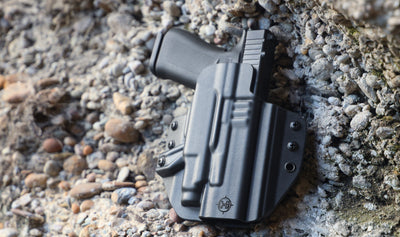
Modern EDC setups reflect this reality. A fully integrated carry system now routinely combines an optics-ready handgun, red dot sight, weapon-mounted light, spare magazine, gun belt, and purpose-built holster. Holster compatibility is a system-level question, not a single-product question. For carriers running a full tactical setup with light and optic, the OWB TACTICAL Kydex Holster | CUSTOM | C&G Holsters is CNC-machined to the exact firearm, light, and optic combination the customer specifies — that is what model-specific precision looks like in practice.
How to Find the Right C&G Holster for Your Exact Setup
Before you order, run through this compatibility checklist:
- Identify your exact firearm model and generation. "Glock 19" is not specific enough. "Glock 19 Gen5 MOS" is.
- Confirm your weapon light model, including sub-variant. "TLR-7" and "TLR-7 HL-X" are not the same holster.
- Confirm your optic model and whether you run suppressor-height sights. Both affect holster fit independently.
- Note any aftermarket modifications that change the gun's profile: compensators, ported barrels, extended controls, frame work.
C&G Holsters was founded by a retired Law Enforcement Officer and Master Firearms Instructor who built the first holsters in his garage. Now in its 6th generation of holster designs, every holster is CNC-machined from custom molds and fit-tested on the actual firearm configuration before it ships.
C&G covers nearly every major handgun model on the market, with both Quickship (ships within 5 business days) and fully Custom Kydex options for less common or modified configurations. The team behind C&G includes U.S. Military Veterans, Law Enforcement Officers, and competitive shooters. If you are unsure about your setup, reach out and get guidance from people who carry for a living.
Match your exact firearm model, generation, weapon light, and optic to a compatible C&G Holster before ordering.
Holster Compatibility FAQs
Q: Can I use my Gen4 Glock holster with a Gen5 Glock?
No. The Gen5's wider slide and ambidextrous controls physically prevent proper fit and retention in a Gen3 or Gen4 holster.
Q: Can I carry my gun in a light-bearing holster without the light attached?
No. Light-bearing holsters retain on the light, not the frame. Without the specific light, the firearm is not properly retained.
Q: Will any TLR-7 holster fit my TLR-7 HL-X?
No. The TLR-7 HL-X has an extended head and larger footprint than the standard TLR-7 series and requires its own dedicated holster mold.
Q: My red dot fits in the holster. Why won't the gun seat fully?
Your suppressor-height front sight is likely taller than the holster's sight channel. Optic clearance and sight-channel height are two separate requirements that must both be met.
Q: Are universal holsters safe for concealed carry?
Universal holsters compromise retention precision by design. They may be acceptable for range use but are not recommended for defensive carry where full trigger-guard coverage and consistent retention are non-negotiable.
Q: How do I know if C&G makes a holster for my exact setup?
Use C&G's model selector with your exact firearm model, generation, light sub-variant, and optic. Or contact the team directly for guidance on custom configurations.
Safety Note: Always Verify Fit Before You Carry
Always verify fit and full trigger-guard coverage with your specific unloaded firearm in the exact configuration you intend to carry: light attached, optic mounted, sights in place.
Never assume compatibility based on appearance alone. This is a documented safety risk, not a theoretical one. Follow the holster manufacturer's fit-verification instructions before carrying the firearm for the first time in any holster.
Every C&G Holster is fit-tested before it ships, but the end user must still verify fit with their specific configuration. Aftermarket modifications or component swaps can change the outcome.
Precision fit is not a feature. It is a responsibility to yourself and everyone you carry to protect. For all that you hold close, get it right.
Sources
- Gun Safe Security — How Do I Know If A Holster Fits My Firearm?
- Reason.com — Survey: More Americans Are Carrying Concealed Guns (2026)
- KSG Armory — Guide to Weapon Mounted Light Holster Compatibility
- GunTalk — Pistol Weapon-Mounted Lights: The Complete Guide
- Safariland — Red Dot Sight (RDS) and Suppressor Height Sight Holster Clearance
- GunAmmoAndGear — Gun Holsters Explained: Types, Carry Positions, Materials & How to Choose





Leave a comment