


Why Your Standard Holster Fails the Moment You Add a Weapon Light
A rail-mounted light like the Streamlight TLR-7A adds approximately 1.5 inches to your pistol's length and 0.8 inches to its height. Your existing holster physically cannot accommodate that extra material. It was not molded for it. It will not flex to fit it. The gun could potentially rattle around with zero retention.
Standard holsters base retention on the pistol frame and trigger guard. They have no geometry to grip the light body, leaving the firearm loose or impossible to holster safely. The mistake that catches people going the other direction is equally dangerous: carrying a bare pistol in a light-bearing holster. As Gunner's Alley explains, the holster is molded to the pistol-plus-light combination, so removing the light destroys retention entirely.
This is the most common and most dangerous error new WML adopters make: assuming any holster will adapt. It will not. Roughly 80% of defensive shooting incidents occur in low-light or no-light conditions, according to GunTalk. A weapon light is not optional equipment for serious carriers. The right holster to carry it is non-negotiable.
How Light-Bearing Holster Retention Actually Works
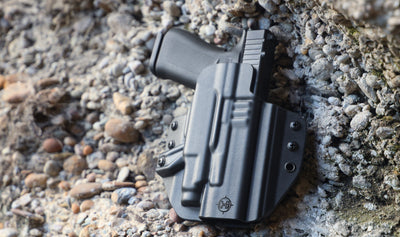
A purpose-built light-bearing holster indexes on the light's body and bezel, not the pistol frame. The specific light model must always be present for the holster to function correctly. This is why swapping light models (moving from a TLR-7 to a TLR-1, for example) requires a completely different holster. The retention geometry changes with every light profile.
Retention screws apply friction at precise contact points on the light housing. The carrier adjusts these screws to dial in draw resistance for their specific role: lighter for competition speed, firmer for duty or daily carry. An audible locking click confirms full seating of the pistol-plus-light unit. Without that click, you cannot verify secure retention by feel alone.
This is where manufacturing precision separates a safe holster from a liability. CNC precision tolerancing to .003-inch accuracy ensures the holster shell matches the exact contours of the pistol-and-light combination, producing consistent draw resistance every time. That is not a marketing number. It is an engineering specification that determines whether your draw is repeatable under stress or a guessing game.
It is also worth understanding the difference between passive retention (friction-based, which covers most concealed carry applications) and active retention (thumb-release mechanisms common on duty holsters). Your carry role and environment dictate which is appropriate. Plainclothes concealed carry typically calls for passive retention. Uniformed duty or open carry often demands active retention for weapon security during physical confrontations.
Carry Position Trade-Offs for Full-Size Pistols With a Light Attached
Full-size pistols with WMLs are increasingly carried concealed. With 29 states now allowing constitutional carry, as reported by NRA-ILA, more Americans are carrying daily. The myth that you must downsize to carry with a light is false. You need the right holster and the right position.
AIWB (appendix carry) positions the gun along the beltline under the widest part of the torso. According to GritR Sports, this makes it the most effective position for concealing a full-size light-bearing pistol. With AIWB, the grip is the primary printing culprit, not the light. Holster accessories that rotate the grip inward solve this problem directly, covered in the next section.
Strong-side IWB at 3 to 4 o'clock is a viable alternative for larger body types or those who cannot tolerate AIWB. The light adds bulk toward the rear hip, which can print under untucked shirts. A forward cant (FBI tilt) helps here by tucking the muzzle and light forward, reducing that rear-hip outline.
OWB carry with a light-bearing holster offers the fastest access and most secure retention. It is ideal for duty, range, and open-carry contexts where concealment is not the priority. For law enforcement and competitive shooters, OWB remains the standard for good reason: speed and weapon security under movement.
Your body type, wardrobe, and mission dictate position. The holster must be built for that specific position and that specific pistol-light combination. No shortcuts.
Solving the Printing Problem: Wings, and Wedges Explained
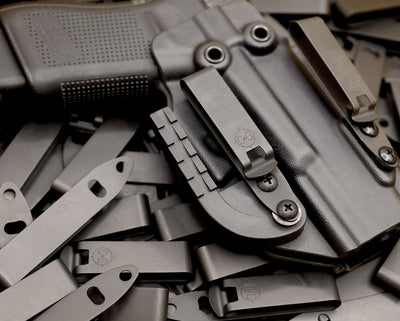
A holster claw or wing attaches to the holster body and presses against the inside of the belt. This leverages belt pressure to rotate the grip inward toward the body, directly reducing the visible outline under clothing. It is a simple mechanical principle, but it makes the difference between a concealed pistol and one that announces itself through every shirt you own.
A wedge (foam or Kydex) positioned at the muzzle end of the holster tilts the grip further into the body and improves comfort during AIWB carry. These accessories are not afterthoughts. They are engineered solutions to the specific geometry problem created by carrying a full-size pistol with a light in the appendix position.
The IWB ALPHA Tactical Kydex Holster includes a built-in ergonomic wedge and a Light Wing concealment attachment as standard features, not paid upgrades. It directly addresses the printing challenge that defeats most light-bearing carry setups. Carriers can choose from Quickship (5-day turnaround) or fully custom color configurations.
Belt quality is the multiplier that makes all of this work. 1.75-inch metal belt clips paired with a rigid gun belt maximize the leverage these accessories generate. A flimsy belt collapses under the weight of a full-size pistol with a light, and no wing or wedge can compensate for that. The entire system, from holster to belt, must work together as designed.
The Commitment Requirement: Building a Light-Bearing Carry Discipline
Choosing a light-bearing holster is a system commitment. You must always carry with the light attached, every time, without exception, or retention is compromised. Our team of veterans and law enforcement professionals will tell you this plainly: there is no "sometimes" with a light-bearing setup.
Build the habit with a pre-carry checklist. Confirm the light is seated, charged, and locked into the holster before the pistol is holstered. This takes five seconds and eliminates the most preventable failure point in light-bearing carry.
Dry-fire and draw practice must be conducted with the light attached. Practicing without it trains muscle memory to a draw that does not match your actual carry configuration. Law enforcement and executive protection professionals have operated under this discipline for decades, as noted by ConcealedCarry.com. Serious civilian carriers must adopt the same standard.
Maintenance matters too. Inspect retention screws, light battery, and holster shell on a regular schedule. Antimicrobial, moisture-resistant Kydex and corrosion-resistant hardware reduce degradation in daily carry environments, but they do not eliminate the need for periodic checks.
What to Look for in a Light-Bearing Holster: Key Design Features
Gun-and-light-specific molding is the non-negotiable baseline. Universal holsters cannot provide the precise retention geometry required for safe light-bearing carry. If a holster claims to fit "most lights," walk away. Your life depends on exact fit.
Full trigger guard coverage is mandatory. The holster must completely enclose the trigger guard with no gaps that could allow foreign objects to contact the trigger. This is a safety fundamental, not a feature to compare on a spec sheet.
A tall sight channel accommodates suppressor-height sights, and an open-bottom design clears threaded barrels and most compensators. These features matter as more carriers run fully configured pistols. Optic compatibility for RMR and red dot sights ensures the holster works with a fully modernized setup, not just iron-sight configurations. These design elements in our ALPHA Tactical line reflect direct feedback from law enforcement and competitive shooter users, refined through six generations of holster design.
Adjustable retention screws allow the carrier to tune draw resistance to their specific role. American-made Kydex construction by veterans and law enforcement professionals, not overseas polymer, ensures material consistency and accountability. With over 4,200 customer reviews validating real-world performance across hundreds of gun models, the proof is in the field, not the factory.
According to DataIntelo, Kydex and polymer holsters account for nearly 42% of new product launches in the holster market, driven by lightweight construction and retention stability that exceeds leather models by over 20%. The material has earned its dominance for a reason.
Carrying a Full-Size Light-Bearing Pistol: The Standard Has Changed
Weapon-mounted lights have crossed from law enforcement standard to mainstream civilian carry. The holster market is catching up, most products still fall short of purpose-built precision. The right light-bearing holster eliminates the three core problems simultaneously: fit, retention, and concealment. Not as compromises, but as engineered solutions.
Serious carriers in 2026 build integrated EDC systems: optics-ready pistol, WML, purpose-built holster, rigid gun belt, and spare magazine. The holster is the linchpin that makes the system function. If your current setup does not include a light, a light-bearing holster, and the accessories to conceal both, you are carrying behind the threat curve.
As our founder, a retired Law Enforcement Officer and Master Firearms Instructor, has said from the beginning: the standard set by law enforcement and military professionals is now accessible to every serious civilian carrier. The only question is whether your gear meets it.
Sources
- Gunner's Alley – Weapon Mounted Lights and Lasers
- GunTalk – The Complete Guide to Pistol Weapon-Mounted Lights
- NRA-ILA – CPRC Concealed Carry Report
- GritR Sports – Carrying a Full-Size Pistol as CCW
- ConcealedCarry.com – Weapon-Mounted Lights and Concealed Carry
- DataIntelo – Holster Market Outlook 2025–2034





Leave a comment