


You Bought the Light. You Bought the Holster. They Don't Fit.
It's the most common mistake we see: a shooter buys a quality weapon-mounted light, orders a holster for their pistol, and discovers the two won't work together. Money wasted. Worse, safety compromised.
Over 60% of violent encounters happen between 8 PM and 5 AM, when your eyes alone aren't enough. A weapon-mounted light isn't optional gear for serious carriers — it's a baseline requirement. Running a WML is now standard practice for defensive carry, not a niche choice reserved for duty guns.
But the light is only half the equation. You need a holster built for your exact gun-and-light combination. This guide gives you a step-by-step compatibility framework so you never waste money or put yourself at risk with a mismatched rig.
Why a Standard Holster Cannot Safely Fit a Light-Equipped Pistol
A holster molded for a bare pistol will not safely accommodate that same pistol with a weapon light attached. The geometry changes. The retention fails. The trigger guard coverage becomes inadequate. Your draw speed suffers, and the holster becomes a liability instead of a tool.
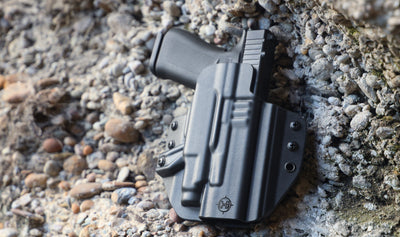
Light-bearing Kydex holsters must be molded for the exact firearm and the specific weapon light model together. Not one or the other. Both, as a single unit. Light-bearing holsters key their retention off the weapon light body itself, not just the gun frame. The light becomes part of the retention system.
That's exactly why universal light-bearing holsters fall short. They try to accommodate multiple light models with a single shell, producing sloppy retention, excessive printing, and a holster that shifts under movement. When the gun needs to stay planted, a universal holster lets you down.
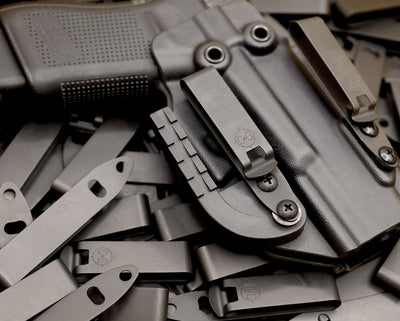
Our founder, a retired Law Enforcement Officer and Master Firearms Instructor, has tested this across decades of duty carry and training. Custom-molded Kydex, shaped around the specific gun-and-light pairing using CNC aluminum molds, is the only approach that delivers consistent retention over time. That's why we build every light-bearing holster around verified dimensional data for each combination.
The "Same Brand, Different Model" Trap: Why Exact Model Numbers Matter
Experienced shooters get burned here just as often as new buyers. The Streamlight TLR-7 family is the clearest example. The TLR-7 Sub, TLR-7 X, and TLR-7 HL-X are dimensionally distinct from one another. They require different holster molds despite all carrying the "TLR-7" name.
The TLR-1 HL-X trap is even more common. Buyers assume it will fit in a holster designed for the standard TLR-1 or TLR-1 HL. It won't. The HL-X has different external dimensions, and this incompatibility has been confirmed through verified dimensional testing, not marketing claims.
The mistake happens because people assume a shared brand name means shared dimensions. It doesn't. Streamlight, SureFire, and other manufacturers iterate on their designs constantly, and each iteration can change the external footprint enough to break holster compatibility.
The rule is simple: always verify the exact model number before ordering a light-bearing holster. Not the brand. Not the series name. The full, specific model designation. A holster built for one light model is not automatically compatible with another, even within the same product family.
The Olight Ecosystem Lock-In Problem
Olight's proprietary rail mount system on several of their models creates a unique problem. It locks users into Olight-specific holsters, cutting them off from the broader Kydex holster ecosystem. For serious carriers who want options, flexibility, and access to proven custom holster makers, this is a significant drawback.
Research holster ecosystem support before you buy a weapon light, not after. This is a pre-purchase decision. If your light choice limits your holster options to a handful of makers, you've boxed yourself in before you even start carrying.
Matching Your Light to Your Carry Position: A Compatibility Checklist
Before you order, work through this checklist in order:
- Gun model (exact, including generation)
- Exact light model number
- Carry position (IWB, OWB, AIWB, chest rig)
- Optic cut needed (yes/no)
- Compensator present (yes/no, plus brand)
- Hand orientation (right or left)
OWB and duty carry: The SureFire X300 remains the industry standard for duty holsters. Nearly every quality holster maker supports it first, and it dominates law enforcement agency procurement nationwide. If you're building a duty rig, the X300 gives you the widest holster selection and the most proven track record.
AIWB carry: More carriers have moved to appendix inside-the-waistband carry over the past two years than in any previous comparable period. Better holster engineering, concealment claws, and wedge systems have made AIWB viable for a wider range of body types, and demand for AIWB-specific light-bearing holsters has surged accordingly.
Micro-compact carry: The Streamlight TLR-7 Sub is the gold standard for subcompact pistols like the Sig P365, Glock 43X MOS, Springfield Hellcat, and S&W Shield Plus. It delivers 500 lumens and 5,000 candela in a package purpose-built for subcompact rail systems, with strong support across the Kydex holster ecosystem.
WML compatibility is also expanding beyond traditional IWB and OWB formats into chest holsters and competition rigs. The market is responding to real demand from shooters who need light-bearing options across every carry style. Keep in mind: two pistols running the same light with similar footprints may share one holster, but this must never be assumed without verified fitment testing.
Compensators, Optic Cuts, and Sweat Guards: The Variables Most Guides Ignore
Running a compensator on a light-equipped pistol adds another fitment variable that most buyer guides skip entirely. If your gun has a comp, include the compensator brand in your order notes. Different comps have different external profiles, and a holster that fits one may not fit another.
Then there's the dual-accessory challenge. Pistols equipped with both a red dot optic and a WML require holsters with an optic cut and a light-bearing shell. This dual-compatibility scenario is increasingly common, but most guides don't address it. If your setup includes both accessories, confirm that your holster accounts for both.
Sweat guard height is another trade-off that changes with light-equipped guns. Larger lights like the TLR-1, X300, and PL350 increase the overall length of the firearm-and-light combination. A mid-length sweat guard often works better than a full-height guard for both comfort and a clean draw stroke.
Each added variable (light, compensator, optic) compounds the fitment challenge. That's precisely why our custom Kydex ordering process includes fields for compensator brand, optic cut, and exact light model. Our 6th-generation holster designs, shaped on CNC aluminum molds by a team of veterans, LEOs, and competitive shooters, are built to handle these compounding variables with precision.
How to Order a Light-Bearing Holster You Can Trust
Your pre-order checklist, plain and simple:
- Confirm your exact pistol model (including generation or variant)
- Confirm your exact light model number (not just the brand or series)
- Confirm your carry position
- Note optic cut requirement
- Note compensator brand if applicable
- Confirm hand orientation
American-made, CNC-molded Kydex holsters are preferred by LEO and military buyers for good reason: precision fit, consistent retention, and domestic quality control at every step. Our team of U.S. Military Veterans, Law Enforcement Officers, and competitive shooters carries light-equipped pistols daily. The holsters we build reflect that lived experience.
Hold to this principle: train how you carry. Your range setup and your carry setup should be identical. That means your holster must accommodate the light you actually run, not a stripped-down version of your gun. Don't sacrifice retention and safety for the convenience of a cheap universal alternative. A precision-fit light-bearing holster is a life-safety investment.
Get the Right Rig the First Time
The light and the holster must be matched to each other, not just to the gun. That's the core message of this guide.
The three biggest mistakes we see: assuming a standard holster fits a light-equipped gun, assuming same-brand lights share holster compatibility, and choosing a universal holster over a custom-molded fit. Each one costs money. Each one can cost more than money when it matters most.
For those who carry to protect what matters most, precision fit is not optional. It is the standard. That's what we build for, every single day. Faith, Family, and Service. For all that you hold close.





Leave a comment