


Your Holster Isn't Printing. Your Belt Is.
You bought the right holster. You picked the right gun. You're wearing the right shirt. And your grip is still printing through your cover garment like a neon sign. Before you blame the holster or swap to a smaller firearm, look at your waist. The most common concealment failure isn't the holster, the gun, or the shirt. It's the belt.
According to a CPRC/McLaughlin & Associates survey from May 2026, 29.8% of likely U.S. voters now carry a concealed handgun at least occasionally, up from 24.3% in late 2024. That's millions of new carriers, and a large number of them are making this exact mistake: treating the gun belt and the holster as two separate purchases instead of one system.
Three variables determine whether your IWB setup actually conceals: belt stiffness, belt width, and belt sizing. Get any one of them wrong, and no holster on earth will save you. This is the explanation most content skips entirely.
How a Holster Wing Actually Works, and Why the Belt Is the Fulcrum
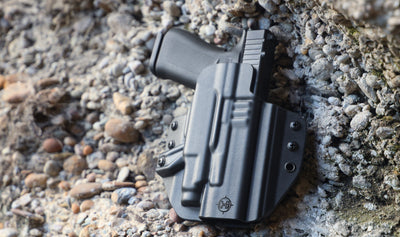
A holster wing (sometimes called a concealment claw or anti-print wing) is a small polymer or metal tab that extends from the holster body and presses against the inside of your belt. That pressure creates a lever action, rotating the pistol grip inward toward your body. The result, when everything works correctly, is a grip that tucks flat against your torso instead of poking outward under your shirt.
Here's the part most people miss: the belt is the fulcrum. As our founder, a retired Law Enforcement Officer and Master Firearms Instructor, puts it plainly — without a rigid belt providing consistent inward pressure, the wing has nothing to push against. It just sits there doing nothing. Belt stiffness directly determines how effectively the wing can function.
The wing is not the only concealment accessory available. A holster wedge works from the opposite side. Where the wing uses belt-side force to rotate the grip inward, the wedge uses body-side force near the muzzle to change the holster's angle. Many carriers use both for maximum concealment.
The critical point: a holster wing will not fix a bad belt. A wedge will not fix a poorly fitted holster. Neither accessory compensates for the wrong belt. The belt is the silent third component. Wing plus wedge plus rigid belt equals the full concealment system.
This matters even more with full-size platforms. If you're carrying a Glock 17, Sig P320, or M&P 2.0, a stiffer belt isn't optional. Heavier guns demand more belt support to keep the wing and wedge system functioning as designed. According to a holster wedge guide from CloudsterPillow, full-size carry guns specifically require increased belt rigidity to maintain proper holster orientation.
Why a Department Store Belt Fails Every Time
A standard fashion belt is built to hold up your pants. That's it. It lacks the rigidity and load-bearing capacity to support the weight of a loaded firearm. The result is predictable: the holster sags, tilts, and shifts during movement. Your draw stroke changes every time you reach for it. As Alien Gear Holsters notes, this sagging and rolling also compromises safe reholstering, because the holster mouth isn't where you expect it to be. That's not just a concealment problem. It's a safety problem.
A proper gun belt is constructed with a dual-layer leather or polymer core. This construction distributes weight evenly across your waist, maintains consistent holster orientation, and resists deformation under load. Every one of those factors directly affects whether your wing or wedge can do its job.
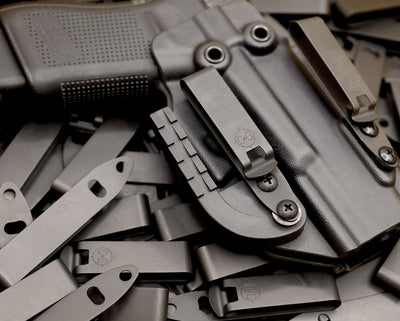
Dual-clip IWB holster designs help by distributing weight across a wider section of belt. But they only work as intended when the belt itself is rigid enough to hold position. A floppy belt with two clips is still a floppy belt. The clips just give you two points of failure instead of one.
Draw stroke consistency depends on the holster sitting in the same place, at the same angle, every single time. A belt that moves under load makes a repeatable draw impossible. You're training muscle memory against a moving target.
Belt Width and Sizing: The Two Specs Most Carriers Get Wrong
Belt width is not a style preference. It's a functional specification. According to Rifle Configurator, 1.5 inches is the standard gun belt width that fits virtually all IWB holster clips. A belt narrower than the clip opening allows the holster to slide and rotate freely. No wing or wedge can compensate for that movement.
A 1.75-inch belt provides more stiffness and is preferred for full-size carry guns, but there's a trade-off: wider belts may not fit through the belt loops on dress pants or slimmer casual pants. Know your wardrobe before you buy.
Sizing is where even experienced carriers get tripped up. For IWB carry, the rule is simple: your pant size plus 4 inches. That accounts for the added thickness of the holster sitting inside the waistband. A belt that fits your pants perfectly will be too short the moment you add a holster. As LAS Concealment explains, this is one of the most overlooked aspects of IWB setup.
Micro-adjustable ratchet-style belts remove the guesswork. Instead of the 5 to 7 hole positions on a traditional belt, ratchet systems like the Kore Essentials options in our Gun Belts collection (alongside our EDC 1.75" Belt and Tactical 1.75" Belt) offer 40-plus quarter-inch adjustment positions. That precision matters when a quarter inch determines whether your holster sits snug or shifts throughout the day.
The bottom line: when the holster clip is wider than the belt, the holster rotates freely. That rotation causes printing. Match your belt width to your holster clip spec, size up for IWB, and choose stiffness appropriate to your gun's weight.
Inner Belt vs. Outer Belt: When You Need Both
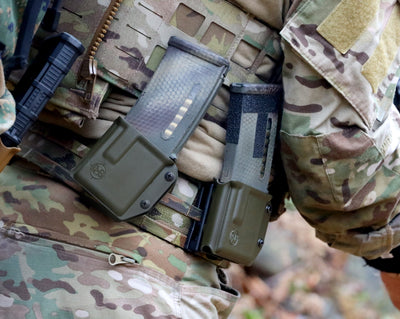
An inner belt is a lightweight belt with outward-facing Velcro (typically hook side) that threads through your pant loops and serves as the foundation layer. An outer belt, usually stiffer and equipped with OWB holster or magazine pouches, attaches directly to the inner belt's Velcro surface. Together, they form a modular system.
Why should an IWB carrier care? If you also run a range setup, train in classes, or work in a duty capacity, the same inner belt that supports your IWB holster during daily carry can accept an outer belt with OWB gear for range or duty use. One foundation, two configurations.
Most content treats inner/outer belt systems as a tactical or LEO-only concern. That's shortsighted. Competitive shooters and armed civilians who maintain both an EDC rig and a range setup benefit equally from this approach.
For everyday IWB carry with a compact or mid-size gun, a single rigid EDC belt is sufficient. The inner/outer system becomes worth the investment when you're running a full-size duty gun, crossing over between EDC and range configurations, or working in law enforcement. This kind of system-level thinking comes from our founder's background as a retired LEO and Master Firearms Instructor. It's the same approach that shapes every product we build, because the people on our team (U.S. Military Veterans, LEOs, and competitive shooters) actually run these setups daily.
Build the System Right the First Time
The concealment system has three parts: a rigid gun belt (the foundation), a holster wing (grip rotation), and a holster wedge (muzzle angle). All three must work together. Remove any one, and the other two underperform. For a deeper breakdown of how the wing and wedge interact, read our claw and wedge article.
Your sizing checklist: match belt width to your holster clip spec (1.5" is the standard, 1.75" for full-size guns), apply the pant size plus 4 inches rule for IWB, and choose belt stiffness appropriate to your firearm's weight.
With 29 states now allowing Constitutional Carry and 46.8% of Americans living in states where no permit is required, there's a growing wave of first-time carriers buying holsters without understanding the belt's role. If you've been carrying for years on a department store belt and wondering why your setup never feels right, now you know.
We build holsters and belts as one system because that's how they actually work. American-made, veteran and LEO staffed, 6th-generation holster design, over 4,200 customer reviews. The gun belt is half the holster. Treat it that way.
Sources
- CPRC: Concealed Carry Hits Nearly 30% (May 2026 Survey)
- What Is a Holster Claw? How It Works & Why IWB Carriers Need One (Warriorland)
- Holster Claw vs Wedge: What's the Difference for Concealed Carry? (CYA Supply Co.)
- Holster Wedge Guide: Fix IWB Printing & Pain (CloudsterPillow)
- How to Concealed Carry IWB (Alien Gear Holsters)
- Best Gun Belt for Concealed Carry 2026: Top 7 EDC Belts Ranked (Rifle Configurator)
- How to Choose a Gun Belt for Concealed Carry (LAS Concealment)
- Concealed Carry Permit Holders Across the United States: 2025 (CPRC Report, SSRN)





Leave a comment