


Why Most AIWB Setups Are Running at Default and Failing
Most carriers pull an appendix holster out of the box, clip it on at factory settings, and never adjust a single thing. When it prints through a t-shirt or digs into their thigh after thirty minutes in a truck seat, they blame appendix carry itself. That's the wrong conclusion.
Over 70% of concealed carriers prefer AIWB for its draw speed advantage, yet seated discomfort remains the number-one complaint. Both problems trace back to unconfigured ride height, not a flawed carry position.
This guide goes past the basics: the sequential setup process (ride height first, wedge second, wing third), the critical distinction between grip printing and beltline printing, seated draw mechanics, and a clear framework for deciding whether a sidecar is right for you. A standard IWB holster repurposed for the appendix position produces more printing, more discomfort, and a less safe reholster. AIWB requires a purpose-built shell. Changing all three variables at once makes it impossible to isolate what helped, so we walk through them one at a time.
Step 1: Set Ride Height Before You Touch Anything Else
Our founder, a retired Law Enforcement Officer and Master Firearms Instructor, has said this for years: ride height is the single adjustment that fixes the most problems. Start by raising the holster until the grip clears the beltline and your knuckles aren't dragging on the belt during a draw stroke. That's your baseline.
Now sit down. If the muzzle digs into your thigh crease, drop the holster one setting. Seated discomfort is a ride height problem first, not a holster design flaw. A well-tuned AIWB holster sits with the rear of the slide roughly even with the beltline, the grip canted 5 to 10 degrees toward the strong side, and the muzzle angled slightly forward.
Before you do anything else, check your belt. A quality, rigid gun belt is the foundation of every AIWB setup. According to Gun Carrier, a flimsy belt causes the holster to shift throughout the day, making the draw inconsistent and comfort deteriorating by afternoon. This is one of the most common reasons carriers incorrectly conclude that appendix carry doesn't work for them.
Most printing problems come from holsters that ship at default settings and never get adjusted. According to Rifle Configurator, this single step resolves the majority of AIWB complaints. Lock in your ride height, confirm it works both standing and seated, then move on.
Step 2: Add the Wedge (It's Not the Same Job as the Claw)
The wedge pushes the muzzle end of the holster away from your body, which tilts the grip inward. This addresses muzzle-end pressure and beltline printing. It does not fix grip printing. That's a different problem with a different tool.
What the wedge does exceptionally well is distribute holster pressure across a wider surface area, directly reducing seated discomfort. According to Gun Carrier's 2026 holster review, most experienced AIWB carriers run both a wing and a wedge, but they solve different problems. The wing hides the grip. The wedge saves the thigh.
Add the wedge only after ride height is locked in. Sit down, stand up, walk around, and confirm seated comfort before moving to the wing. If you change both at the same time, you won't know which adjustment actually helped.
One non-negotiable point: soft or collapsible holsters cannot hold a wedge in a consistent position. Full rigid Kydex with complete trigger guard coverage is required for AIWB. Without it, wedge geometry shifts with every movement and your setup is never the same twice.
Step 3: Add the Wing (and Why Yours Might Be Doing Nothing)
The wing presses against the inside of the belt to rotate the grip inward, tucking it against your body. It addresses grip printing specifically, not muzzle-end or beltline printing. If your problem is the muzzle digging in, the wing isn't the fix.
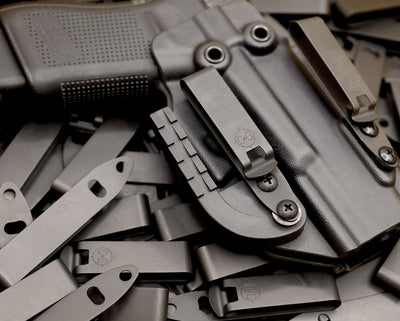
Here's the detail most guides miss: on a fixed wing, raising ride height or adding cant lifts the wing off the belt. The concealment effect quietly disappears, and you're left wondering why the wing doesn't work. This is the most overlooked AIWB setup failure. Some holsters solve this with a wing that slides on its own axis, maintaining belt contact across the full cant range. That's the design feature to look for when evaluating any appendix carry holster.
Add the wing last, after ride height and wedge are confirmed. Put the holster on, check that the wing is making firm contact with the belt, then evaluate printing in a mirror. If there's a gap between the wing and the belt, your wing is decorative, not functional.
Most experienced carriers end up running both the wing and wedge together once each has been individually confirmed. The sequence matters: ride height, wedge, wing. In that order.
When a Sidecar Is Worth It, and When It Isn't
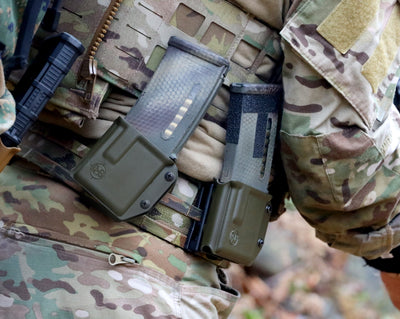
A sidecar integrates the holster and a spare magazine carrier into one unit. The magazine carrier acts as a lever that pushes the grip into the body, genuinely improving concealment. It's a real mechanical advantage, not a marketing claim.
Who benefits: carriers who want integrated mag access, run a lighter or average build, and spend most of their day standing or moving. If you're on your feet and need that spare magazine at the ready, a sidecar makes sense.
Who should skip the sidecar: carriers with larger builds where the magazine carrier fights the body when bending or sitting; anyone spending eight or more hours a day at a desk; carriers who find bathroom logistics with a two-piece unit unacceptable. According to USA Gun Shop, a separate magazine pouch carried opposite the appendix is a common, lower-bulk alternative for those who find the sidecar adds too much complexity.
For those who do run a sidecar, the MOD1 Appendix Sidecar Kydex Holster System is purpose-built to address the sidecar's known drawbacks. CNC-machined from custom aluminum molds developed over six generations of holster design, it delivers consistent retention across a broad range of gun models and is available in both Quickship and fully custom configurations. With over 4,200 customer reviews validating real-world performance, it's the benchmark to evaluate against when deciding if a sidecar fits your carry lifestyle.
The honest answer: the sidecar is a tool, not a universal upgrade. The right call depends on body type, daily routine, and how much complexity you're willing to manage.
Seated Draw, Vehicle Carry, and the Drills Most Guides Skip
AIWB's biggest real-world advantage over strong-side carry shows up in vehicles. As Ammoland explains, as long as the seatbelt runs along the holster clips and the shirt is pulled from under the belt, the draw stroke is identical to standing. Strong-side carry is significantly impeded by a seatbelt; appendix carry is not.
For the seated draw: the support hand clears the cover garment while the strong hand drives the webbing high into the grip. Draw straight up until the muzzle clears the holster, then rotate forward. Never sweep the body. For closed-front garments, the Hackathorn Rip (as described by Athlon Outdoors) is the standard: the support hand grabs the shirt at the appendix area and pulls it as high as possible while the gun hand takes drawing grasp.
Our veteran and LEO staff will tell you the same thing they tell every new carrier: practice from a seated position. It's a far more realistic drill than standing square to a target. Most CCW holders cannot reliably draw and engage at five yards in under three seconds. Skilled AIWB carriers have documented sub-1-second draws, but that requires verified reps and proper configuration.
Reholstering is where negligent discharges happen. Reholster slowly, finger indexed along the frame, eyes on the holster. Never by feel under a garment. Beginners should build verified dry-fire reps and complete a structured training course before carrying appendix daily. C&G's Firearms Instructor Program exists specifically to support this kind of structured skill development.
2027 Baseline Standards: Lights, Optics, and Model-Specific Fit
Optic-ready cuts are now the default expectation. According to Popular EDC, if a holster charges extra for an optic cut, it's behind the curve. Light-bearing AIWB holsters accommodating the Streamlight TLR-7A and SureFire X300 are standard across major lineups, not a premium niche.
Adding a weapon light changes the holster's footprint and ride height requirements. Account for this when re-running the setup sequence from Step 1.
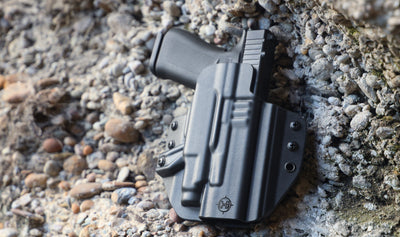
Universal holsters are not acceptable for AIWB. The holster must be molded specifically for the exact gun model to ensure full trigger guard coverage and consistent retention. Body-type-specific AIWB engineering has been a defining trend through 2025 and 2026, dismantling the myth that appendix carry only works for thin people. Purpose-built geometry, adjustable ride height, and wedge systems make AIWB viable across a wider range of builds than ever before.
Configure It Right, Carry It Confidently
The sequence: ride height, then wedge, then wing. One variable at a time. If bulk and seated complexity are acceptable trade-offs for integrated mag access and improved concealment leverage, run the sidecar. If not, run a standalone holster with a separate mag carrier.
Sub-1-second draws are documented for skilled AIWB carriers, but that performance is only achievable with a properly configured, model-specific, rigid Kydex holster on a quality belt. Founded by a retired LEO and Master Firearms Instructor, built by U.S. Military Veterans and competitive shooters, 100% American-made. The standard isn't set by defaults. It's set by carriers who configure their gear and train with it.
Sources
- Gun Carrier — Appendix Carry 2026 Ultimate Guide to Comfort & Speed
- Rifle Configurator — Best Appendix Carry Holster 2026
- Gun Carrier — Best New Appendix Carry Holster Designs of Spring 2026
- USA Gun Shop — Appendix Carry (AIWB) Guide
- Ammoland — Appendix Carry: Is It Right for You?
- Athlon Outdoors — Massad Ayoob's Concealed Carry Tips and Techniques
- Popular EDC — Best Appendix Carry Holsters of 2026





Leave a comment