


Your Carry Angle Is the Problem, Not Your Holster
Here's a truth most carriers learn the hard way: printing isn't a gear problem. It's a geometry problem. The grip of your pistol sticks out because of the angle it sits at relative to your body, not because your holster is poorly made or your gun is too big.
Most people who notice printing immediately start shopping for a smaller firearm or a thinner holster. That's the wrong fix. Two small attachments, a claw and a wedge, can solve what an entirely new holster cannot. They change the angle, and the angle is what matters.
With 20.88 million concealed carry permit holders in the U.S. and 29 constitutional carry states pushing the actual number of daily carriers even higher, more people than ever need to understand how these two accessories work mechanically. This article covers the physics, the placement, and the practical steps to reduce printing at any IWB carry position.
What Is a Holster Claw (and Why Does It Have So Many Names)?
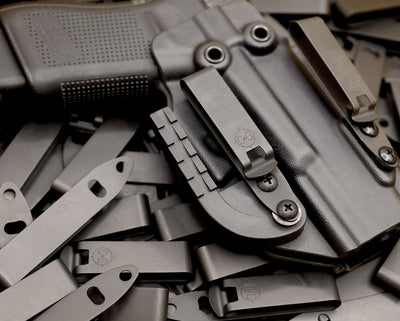
A holster claw is an L-shaped attachment, typically constructed from high-strength plastic polymer, that mounts near the trigger guard of an IWB holster using one or two metal screws. When you slide the holster inside your waistband and cinch your belt, the claw catches against the backside of the belt. That belt pressure acts as a lever, rotating the grip of the firearm inward toward your body.
You'll hear this part called a "claw," a "wing," a "mod wing," a "concealment wing," or a "belt claw" depending on the manufacturer. They all describe the same functional mechanism. The modern claw format traces back to Raven Concealment Systems, which introduced it as an accessory for their VG2 Vanguard holster line.
One common misconception: the claw adds bulk. It doesn't. It actually reduces the effective profile of your setup by changing the angle at which the gun sits. The claw trades outward grip protrusion for inward rotation, a net reduction in visible footprint under a cover garment.
What Is a Holster Wedge and How Does It Work?
A holster wedge is a foam or molded pad that attaches to the body-facing side of an IWB or AIWB holster, typically near the muzzle end. Where the claw works against the belt, the wedge works against your body.
The principle behind it is sometimes called the Keel Principle. Think of the wedge as a fulcrum at the base of the holster. When the muzzle end presses against your body through the wedge, it pushes the muzzle slightly outward. That outward push at the bottom creates an inward rotation at the top, tucking the grip closer to your torso. Simple lever physics applied to concealment.
Wedge placement matters significantly. Positioning the wedge toward the slide side produces more grip tuck. Positioning it toward the grip side produces more slide tuck, which is particularly useful when concealing an optic or a weapon-mounted light that adds height or width above the beltline.
Wedges aren't limited to pistol holsters. They're compatible with any IWB-mounted accessory: magazine carriers, knife sheaths, and other belt gear that tends to tip over the beltline and print through clothing.
The Full Mechanical Sequence: How Claw and Wedge Work Together
Used individually, the claw and wedge each reduce printing. Used together, they form a system that addresses printing from opposite directions. Here's the full mechanical sequence:
- Belt tension presses against the claw's L-shaped surface.
- The claw acts as a lever, using that belt pressure to rotate the grip inward toward the body.
- Simultaneously, the wedge acts as a fulcrum at the muzzle end, pressing against the body and pushing the muzzle outward.
- The combined effect: the grip tucks in from the top (claw) while being reinforced from the bottom (wedge), producing a consistent, deep grip tuck that holds under movement.
Each compensates for what the other cannot do alone. The claw can only rotate the grip as far as belt tension allows. The wedge can only push the muzzle as far as body contact permits. Together, they create a balanced system.
One critical variable: belt stiffness. A floppy dress belt or a thin nylon strap won't generate enough tension for the claw to do its job. A rigid gun belt is not optional here; it's a prerequisite. Without it, the claw becomes a decorative piece of plastic.
Claw sizing also matters. A larger claw with more surface area creates more leverage and more grip rotation. A smaller claw produces less rotation but may be more comfortable for certain body types. Wing-style claws that contact a broader area of the belt tend to produce more consistent rotation than narrow point-contact designs.
AIWB vs. Strong-Side IWB: Does Carry Position Change How You Set Up the Claw?
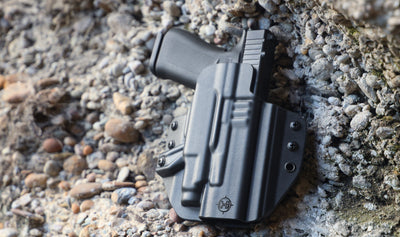
Appendix carry (AIWB) is where the claw is most effective. At the 12 to 1 o'clock position, the grip is the widest and most visible component of the firearm. The claw's inward rotation directly addresses the primary printing vector.
At strong-side IWB (3 to 5 o'clock), the leverage angle changes. The belt wraps differently around your torso at those positions, and the claw's contact point shifts. Wedge placement must also be reconsidered: the body's curvature at the kidney area (5 o'clock) creates a different contact surface than the relatively flat plane of the abdomen.
Here's a scenario our founder, a retired LEO and Master Firearms Instructor, has seen repeatedly: a carrier installs a claw and printing actually gets worse. This typically happens with aggressive cant angles or certain body types where the claw over-rotates the grip into a position that pushes the slide outward instead. The fix is usually reducing cant, switching to a smaller claw, or repositioning the wedge to counterbalance the rotation.
For light-bearing holsters, the added width and geometry of a weapon-mounted light changes claw leverage dynamics entirely. The claw and holster must be purpose-built around that specific light configuration to maintain effective concealment. A generic claw on a light-bearing holster often underperforms.
Choosing the Right Setup for Your Body Type and Carry Style
Body shape directly affects how the claw and wedge perform. Slim builds often need less wedge thickness because there's less soft tissue for the muzzle end to press against. Larger midsections may require a thicker wedge and a different mounting position to achieve the same grip tuck. Pronounced hip bones can create a natural pivot point that changes how the claw's leverage translates to rotation.
Women carriers deserve specific attention here. According to CPRC's 2025 data, concealed carry permit numbers are growing 106.1% faster for women than for men. Hip geometry, waistline differences, and clothing fit all change claw and wedge setup. Women often benefit from a slightly thicker wedge and a claw with moderate (not maximum) rotation to accommodate different garment draping.
Optic-equipped pistols add another variable. A red dot sight creates a new printing vector above the beltline that the claw alone can't address. Slide-side wedge placement can partially compensate by increasing grip tuck, but the holster itself needs to account for the optic's added height. C&G Holsters' IWB Tactical Alpha collection is engineered with these geometry principles built in, CNC-machined from custom aluminum molds for a consistent draw, and available in both Quickship and fully custom configurations.
A note on DIY wedges: cutting your own from adhesive-backed foam is a legitimate way to experiment with placement and thickness. Improvised foam compresses unevenly over time and loses its geometry. A purpose-built molded wedge provides consistent performance and durability that a piece of yoga mat cannot reliably replicate over months of daily carry.
Set It Up Right: Practical Steps to Dial In Your Claw and Wedge
Getting this right is iterative, not instant. Here's the process:
- Start with a rigid gun belt. Before you touch the claw or wedge, confirm your belt provides adequate tension. If you can easily slide your hand between the belt and your body with the holster in place, the belt is too loose or too flexible.
- Mount the claw under the trigger guard. Position it so the L-shaped arm contacts the belt when holstered. Before tightening the screws fully, test grip rotation by pressing the holster against the belt and observing how much the grip moves inward.
- Add the wedge at the muzzle end. Start with slide-side placement if grip printing is your primary concern. Try grip-side placement if you're concealing an optic or light. The wedge should contact your body firmly but not painfully.
- Dress test. Put on your actual cover garment (not just a t-shirt if you normally wear a button-down). Check for printing at the grip, the slide, and the optic height if applicable. Move naturally: bend, sit, reach overhead.
- Adjust iteratively. Small changes produce noticeable differences. A few millimeters of wedge repositioning or a quarter-turn on the claw screws can meaningfully change concealment. Don't try to get it perfect on the first attempt.
One thing to remember: the claw requires no change to your carry position. Your gun stays exactly where it was. Only the angle changes. That's the entire point.
Two Attachments. One Invisible Carry Setup.
Printing is a geometry problem. The claw uses belt tension to rotate the grip inward from the outside. The wedge uses body contact to push the muzzle outward from the inside. Together, they change the angle of your firearm without changing where or what you carry.
With 46.8% of Americans now living in constitutional carry states, effective concealment is more relevant to more people than at any point in recent history. Innovation in this space continues: a recent USPTO patent (#12535294) for improved printing prevention systems signals that the industry recognizes current claw designs still have room to grow in adjustability and fit.
At C&G Holsters, our equipment is built by retired law enforcement officers, military veterans, and competitive shooters who carry daily. Every holster we make reflects that lived experience. If you're serious about concealment, start with the geometry. The claw and wedge will handle the rest.
Sources
- CPRC's Latest Report Outlines the Robust State of Concealed Carry in America — NRA-ILA
- What Is a Concealed Holster Claw? — Harry's Holsters
- Holster Claw vs Wedge Explained — Lindahl Holsters
- What Is a Wedge? Do I Need a Wedge? — PHLster
- Holster Claw vs Wedge: What's the Difference for Concealed Carry? — CYA Supply
- What Is a Holster Claw? — Warriorland
- 2026 Firearms & Holster Industry Trends — Indy Concealment
- CCW Update: 46.8% Live in Constitutional Carry States — Ammoland
- Concealed Carry Permit Holders Across the United States: 2025 — CPRC via SSRN
- Printing Prevention Systems — USPTO Patent #12535294





Jätä kommentti