


If you're stepping into the world of light-bearing holsters for the first time, one of the biggest decisions you'll face is carry position: outside the waistband or inside. Both our OWB Tactical and IWB Tactical collections are CNC-machined from custom aluminum molds, built right here in America, and designed to securely retain your firearm and weapon-mounted light as a complete system. The question isn't which one is "better" in the abstract. It's which one fits the way you carry, train, and live.
At a Glance
| Dimension | OWB Tactical | IWB Tactical |
|---|---|---|
| Carry Position | Outside the waistband, mounted on belt | Inside the waistband, tucked between body and pants |
| Concealability | Limited; best for open carry, duty, and range use | Superior; keeps most of the firearm below the beltline |
| Draw Speed | Fast, unrestricted draw stroke | Slightly slower under concealment garments |
| Comfort (Extended Wear) | Excellent; less body contact and pressure | Good with a proper belt, but added WML bulk is noticeable |
| Training Suitability | Ideal for building consistent draw muscle memory | Better for practicing concealed-carry specific drills |
| Light Compatibility | Molded for specific firearm + WML combos | Molded for specific firearm + WML combos |
| Material | Kydex | Kydex |
| Options | Custom color configs and Quickship (approx. 5-day) available | Custom color configs and Quickship (approx. 5-day) available |
| Best For | Duty carry, range training, open carry, home defense | Concealed carry with a weapon-mounted light |
Why a Light-Bearing Holster Matters
Before we compare carry positions, let's address the "why" behind both of these collections. A weapon-mounted light (WML) is no longer a niche upgrade. Compact models from Streamlight, SureFire, and Holosun have made WMLs a core part of modern everyday and tactical carry. Most defensive encounters happen in low-light conditions: early mornings, late evenings, dimly lit parking structures, and indoor spaces. A WML gives you positive target identification when it counts most.
Here's the critical detail new shooters need to understand: a holster built for a bare gun will not safely retain a gun with a light attached. Light-bearing holsters are specifically molded for the firearm and the mounted light together. Every holster in both our OWB Tactical and IWB Tactical lines is precision-machined for a specific weapon system, not a generic shell. That's what gives you a consistent, repeatable draw every single time.
Concealability
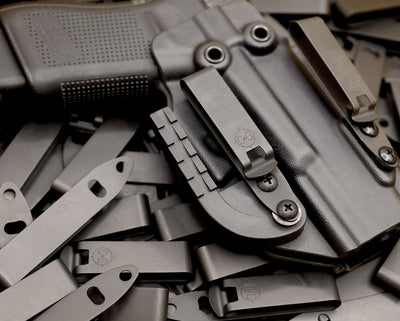
Winner: IWB Tactical. This one isn't close. If your primary goal is keeping your light-equipped firearm hidden under a cover garment, IWB is the only realistic option. The holster sits between your body and your waistband, tucking the grip and the light below the beltline. That said, be honest with yourself about the trade-off: a light-bearing IWB setup is bulkier than a standard IWB holster. You'll likely need to size up your pants slightly, invest in a rigid gun belt, and pay attention to ride height and cant. It works, but it requires some wardrobe planning.
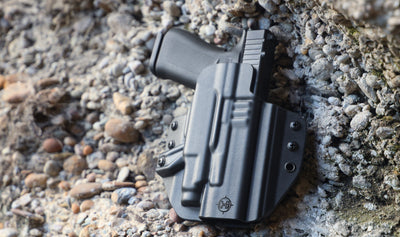
OWB Tactical holsters ride entirely outside the pants. While some people conceal an OWB rig under a jacket or untucked shirt, it's not what this collection is optimized for. If concealment is secondary to access and comfort, OWB shines. If concealment is the mission, go IWB.
Draw Speed and Accessibility
Winner: OWB Tactical. An outside-the-waistband holster gives you an unrestricted draw stroke with no garment to clear from above and no friction against the body on the way out. OWB holsters with passive retention can deliver a consistent sub-2-second draw, a benchmark that matters for law enforcement readiness and home defense scenarios. The draw is also easier when wearing gloves, plate carriers, or heavy outerwear.
IWB tactical holsters aren't slow by any means. Appendix IWB carry, for example, can average 0.3 to 0.7 seconds faster than strong-side hip carry under concealment. But you're still clearing a cover garment and pulling against the waistband. For pure speed and consistency, OWB has the edge.
Comfort During Extended Wear
Winner: OWB Tactical. Because OWB holsters sit on the outside of the belt, there's greater separation between the holster and your body. Less pressure, less heat buildup, and less friction against the skin. Police officers, military personnel, and competitive shooters gravitate toward OWB for exactly this reason; when you're wearing a holster for an 8- or 12-hour shift, comfort isn't a luxury.
IWB tactical holsters are comfortable with the right setup (a stiff belt and proper positioning make a big difference), but the added bulk of a weapon-mounted light means more material pressing against your hip or abdomen. For short outings and daily concealed carry, most people adapt quickly. For all-day range sessions or extended duty wear, OWB is the more forgiving choice.
Training Suitability
Winner: OWB Tactical. If you're new to light-bearing setups, we strongly recommend starting your training with an OWB holster. The stability of an outside-the-waistband mount lets you build consistent muscle memory for your draw without the added variable of clearing a garment. You can focus entirely on grip, draw stroke, presentation, and re-holstering. Once those fundamentals are locked in, transitioning to IWB carry becomes much smoother.
That doesn't mean IWB has no training value. If you carry concealed daily, you absolutely need to train with your IWB rig so your range practice mirrors your real-world carry. But for foundational skill-building, OWB is the standard for a reason.
Build Quality and Customization
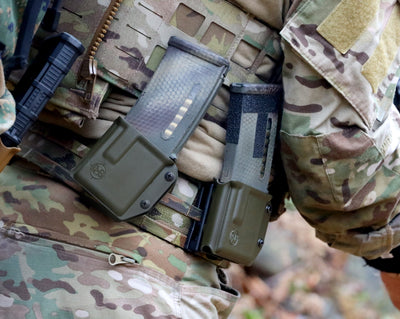
Winner: Tie. Both collections share the same DNA. Every holster is CNC-machined from custom aluminum molds using American-sourced Kydex. Both lines are available in Quickship configurations (approximately 5-day turnaround) and fully custom color options. Both accommodate a wide range of firearm and WML combinations. Both include magazine holder combo options for shooters who want a matched set. The craftsmanship is identical; the difference is purely in carry position and intended use case.
Who Each Holster Is Built For
The OWB Tactical collection is purpose-built for duty carry, range training, open carry, home defense, and competitive shooting. If you're a law enforcement officer equipping your duty belt, a firearms instructor running classes, or a new shooter building fundamentals with a light-equipped pistol, this is where you start.
The IWB Tactical collection is built for concealed carriers who refuse to leave their weapon-mounted light at home. If you're a civilian with a carry permit (or living in one of the 29 constitutional carry states), an off-duty officer, or an executive protection professional who needs discretion, IWB Tactical lets you carry a full weapon system under everyday clothing.
The Verdict
For most buyers, especially those new to light-bearing holsters, we recommend starting with the OWB Tactical collection. It's the better platform for training, offers faster access, and provides superior comfort during extended wear. It's the holster you'll reach for at the range, on duty, and at home. Once your draw fundamentals are solid and you're ready to carry concealed with a WML, the IWB Tactical collection is the natural next step.
If concealed carry is your only use case and you already have solid draw mechanics, go straight to the IWB Tactical. Just make sure you pair it with a quality gun belt and spend time at the range training from concealment.
The honest answer? Most serious shooters end up owning both. One for training and duty, one for daily concealed carry. Both are built to the same standard, by the same team of veterans, LEOs, and competitive shooters, right here in America. The only wrong choice is carrying a light-equipped firearm in a holster that wasn't built for it.





Leave a comment