


Why .080" Became the Industry Standard (Hint: It's Not About Performance)
The vast majority of mass-market and mid-tier holster manufacturers use .080" Kydex for both IWB and OWB applications. Walk into any gun shop, scroll any online retailer, and you'll find .080" listed on spec sheet after spec sheet. But most brands won't tell you this wasn't an engineering decision. It was a financial one.
According to Harry's Holsters, a manufacturer saves approximately 25% on material cost by switching from .080" to .060" Kydex. That same cost-cutting logic explains why .080" became the default in the first place. It's the thinnest gauge that still passes basic consumer scrutiny, not the gauge that performs best under real-world conditions.
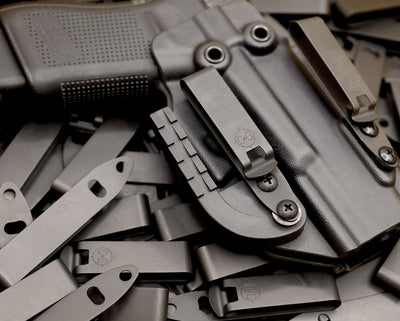
Consider the irony: Kydex was originally developed in 1965 by Rohm and Haas for aircraft interiors, according to Wikipedia. It was engineered for demanding aerospace environments, not designed around the question "what's the cheapest viable option?" Yet high-volume brands routinely pair thin Kydex with generic injection-molded clips and crushable rubber washers to squeeze every cent out of production. The standard was set by accountants, not engineers. That's the dirty secret the holster industry rarely discusses openly.
What the Numbers Actually Mean: A Material Science Breakdown
Kydex is an acrylic-polyvinyl chloride thermoplastic composite with a Rockwell R hardness of 90 and a flexural modulus of 2,800 MPa (400,000 psi). It was engineered to be rigid, not flexible. Today it's manufactured by Sekisui Kydex, LLC out of Bloomsburg, Pennsylvania, and it's available in sheet thicknesses ranging from .029" to .500" across 28 distinct grades. The holster industry's fixation on .080" ignores the full performance spectrum of this material.
Going from .080" to .093" is only a 16% increase in thickness. According to Ronin's Grips, that modest jump significantly enhances structural integrity and resistance to deformation under belt pressure. The concealability trade-off? Going from .060" to .093" adds only 1/16 of an inch of total holster thickness across both panels, as noted in Pistol Forum discussions. For most carriers, that difference is undetectable under a cover garment.
Thinner Kydex (.060"–.080") is measurably more susceptible to flexing, cracking, and deformation under stress or fluctuating temperatures, per TACRIG's material guide. Thicker Kydex (.093"–.125") provides greater rigidity, long-term retention consistency, and resistance to the structural failures showing up in online communities like Reddit's r/CCW. Those cracked holster photos aren't anomalies. They're the predictable result of building to a cost target instead of a performance target.
The Temperature Problem Nobody Talks About
In high-heat environments, such as a car interior in summer, .080" Kydex can soften enough to allow retention to loosen or the holster body to deform. Retention calibrated at room temperature on a .080" holster may be meaningfully different after a full day in a hot vehicle or after a winter patrol shift in subzero conditions.
In extreme cold, thinner Kydex becomes more brittle and prone to stress fractures, especially at hardware mounting holes. This is an underreported safety issue. A holster that loses retention integrity due to temperature isn't just an inconvenience. It's a liability.
Thicker material (.093"–.125") has greater thermal mass and structural rigidity, making it far more resistant to temperature-driven deformation. Competitor content almost never addresses this failure mode, leaving buyers without critical safety information before purchase. If you carry daily through summer heat and winter cold, material thickness isn't a spec-sheet detail. It's a safety variable.
Retention Hardware: Springs vs. Rubber — Why It Matters as Much as Thickness
Material thickness is only half the equation. Retention hardware determines how consistently and safely your firearm is secured over thousands of draw cycles. This is where the gap between engineering-first brands and high-volume manufacturers becomes impossible to ignore.
Many high-volume brands rely on rubber-based retention components. Alien Gear Holsters, for example, uses crushable rubber washers as part of its retention shell attachment mechanism. These rubber grommets compress and degrade over time, meaning retention loosens gradually without any clear signal to the user. You won't notice the change until the holster no longer holds your firearm the way it did on day one.
C&G Holsters took a fundamentally different approach. Our proprietary Omega Retention System uses custom-designed springs, not rubber, delivering an audible locking click upon holstering and consistent, adjustable retention that doesn't degrade over time. Custom-engineered spring retention paired with thicker Kydex creates a compounding durability advantage: the shell holds its shape, and the retention mechanism holds its tension. For law enforcement, military, and serious concealed carriers, this combination is a safety standard, not a luxury.
Thickness by Use Case: What You Actually Need for Your Carry Role
Not all carry contexts demand the same material spec, but most buyers are never given a use-case framework to make an informed decision. Here's how thickness maps to real-world application:
- Concealed carry civilians: .093" provides the ideal balance of rigidity, retention consistency, and concealability. Calling .080" a "standard" doesn't make it optimal. It's a compromise.
- Competitive shooters: .093"–.125" is preferred for structural rigidity under high-repetition draw cycles and resistance to deformation from aggressive reholstering.
- Law enforcement and duty carry: .125" is the appropriate spec for holsters subjected to daily physical stress, environmental exposure, and mission-critical retention requirements. The duty holsters market is projected to grow to $803 million by 2034, and institutional procurement is increasingly shifting toward verifiable material standards.
- Executive protection and military: Procurement teams are demanding CNC tolerance data and documented material specs. .080" holsters rarely meet these benchmarks.
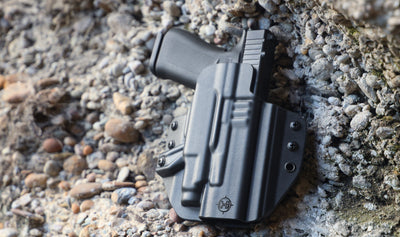
C&G's TRINITY belt-mounted holster system is constructed with .125" Kydex, the thickest standard holster-grade material available, and is CNC-engineered to a precision tolerance of .003" for consistent fit across every unit. For Glock 43/X/MOS carriers who want that same engineering-first approach in a concealable IWB format, the COVERT/ALPHA Quickship holster delivers .093" Kydex with the Omega Retention System and ships in five days.
The C&G Standard: Why We Refuse to Build to .080"
C&G Holsters was founded by a retired Law Enforcement Officer and Master Firearms Instructor. The material and engineering decisions behind every holster we make reflect real-world duty experience, not cost-optimization spreadsheets.
Every C&G holster is CNC-machined from custom aluminum molds to a precision tolerance of .003", ensuring consistent fit and draw performance across every unit produced. We use .093"–.125" Kydex across our product line, a deliberate departure from the industry's .080" default, paired with our custom-designed spring retention system. No rubber. No degradation. No guesswork.
All materials are locally sourced and 100% American-made. Every holster is built by U.S. Military Veterans, LEOs, and competitive shooters who carry daily. The people building your holster are the same people who depend on holsters to do their jobs and protect their families.
Our 6th-generation holster design reflects continuous engineering iteration, not a product frozen at the cheapest viable spec. With over 4,200 customer reviews and broad gun-model compatibility, the performance difference between C&G's material standard and the industry default is documented by the people who carry our holsters every single day.
The Verdict: Does .080" Measure Up?
For casual range use with minimal environmental stress, .080" Kydex is functional. Functional is not the same as optimal.
For daily concealed carry, duty use, competition, or any high-stakes application, .080" represents a cost-driven compromise that the buyer pays for in long-term durability and retention consistency. The math is straightforward: a 16% increase in thickness delivers significantly greater structural integrity with a negligible concealability trade-off. There is no engineering argument for .080" as a performance standard.
The industry adopted .080" because it saves manufacturers money, not because it serves the carrier better. Knowing this changes how you should evaluate every holster purchase. The global gun holsters market is projected to reach $4.1 billion by 2033. That's a lot of holsters being sold. The question is whether the one on your belt was built to a standard or built to a margin.
When you buy a holster, you're buying the engineering philosophy behind it. C&G Holsters builds every product to the standard its founders would trust on duty. That standard starts with material thickness, continues through custom spring retention, and is verified by CNC precision on every single unit. We refuse to cut corners because the people who carry our holsters can't afford corners to be cut.
Sources
- Harry's Holsters – Kydex Holsters
- Wikipedia – Kydex
- Ronin's Grips – Top 10 Kydex Holster Brands Based on 2025 Data
- Pistol Forum – Ideal AIWB Kydex Thickness
- TACRIG – Best Holster Material Guide (June 2025)
- Alien Gear Holsters – Injection-Molded vs. Kydex Holsters
- Intel Market Research – Duty Holsters Market Outlook 2026–2034
- C&G Holsters – TRINITY Belt Mounted Kydex Holster System
- Verified Market Reports – Gun Holsters Market





Hinterlassen Sie einen Kommentar