


Why Your Holster Has to Keep Up With Your Optic
Your zero is confirmed. Your optic is mounted. Your pistol runs clean. But if your holster wasn't built for that optic, you've introduced a dangerous incompatibility into your carry setup.
This is a real problem, not a hypothetical one. A 2025 NLEFIA survey found that 85% of law enforcement agencies now authorize red dot sights on duty pistols, and 92% of instructor respondents personally carry one. Optics-ready pistols are the standard, with nearly every major manufacturer shipping factory MOS, OSP, or RXP configurations.
Yet the holster ecosystem has lagged behind. A holster that doesn't fit your optic can snag on re-holster, compromise retention, or slow your draw when fractions of a second count. This guide provides a step-by-step compatibility framework, built from our founder's decades of experience as a retired Law Enforcement Officer and Master Firearms Instructor, to make sure your holster matches your optic the first time.
Step 1 — Know Your Optic Footprint Before You Buy Anything
Our founder has drilled this into every member of the C&G team: confirm your optic footprint before you start shopping for a holster. The footprint determines the physical dimensions of the optic's base, and it dictates the holster cut you need. Get this wrong, and nothing else matters.
In 2026, there are five primary red dot footprint families: RMR, RMSc/Shield (Holosun K), DeltaPoint Pro, ACRO (Aimpoint/Steiner MPS), and Holosun EPS. None of these are universally interchangeable. Each requires a specific holster cut to ensure proper clearance and retention.
Here's a mistake we see constantly: the Holosun 507C uses the RMR footprint, while the Holosun 507K uses the RMSc/K footprint. Same brand, similar model number, completely different holster requirements. According to Athena Precision, this confusion is one of the most common sources of incompatible holster purchases.
Adapter plates add another variable that most guides ignore entirely. A plate-mounted optic sits higher on the slide, changing the clearance your holster needs to provide. Glock's factory MOS plate system has a documented reputation for shifting under sustained recoil, which is why serious shooters upgrade to precision aftermarket plates from companies like C&H Precision. With Glock's 2025 Gen 6 A-Cut system (developed in partnership with Aimpoint), the holster compatibility landscape is shifting again. If you're running a Gen 6, verify that your holster accommodates the A-Cut profile specifically.
Step 2 — Open Emitter vs. Enclosed Emitter: The Clearance Difference That Matters
Open-emitter optics (RMR, Holosun 507C, SRO) expose the emitter window on the front of the sight. Enclosed-emitter optics (Aimpoint ACRO, Steiner MPS, Holosun EPS, EPS Carry) fully enclose the emitter in a tube-style housing. The difference in physical profile is significant, with direct consequences for your holster.
Enclosed emitters sit taller and wider on the slide. A standard optic cut designed for an RMR will not reliably clear an ACRO or EPS without modification. Period. According to VOTATU, enclosed emitters are dominating the premium carry segment in 2026 because of their superior resistance to dust, sweat, and debris. That means more shooters are running optics that demand deeper, wider holster cuts.
Using a holster with insufficient clearance for an enclosed emitter creates a snag point during re-holstering. Under stress, that snag can cost you critical time or, worse, cause a negligent discharge. This is a safety issue, not a preference.
One more factor most guides skip: suppressor-height backup iron sights (SHBIS). If you co-witness through your optic with taller irons, those sights add to the overall slide-top profile and may require additional holster clearance. The "universal optic cut" myth falls apart here. No single cut addresses the clearance variables created by enclosed emitters, adapter plates, and SHBIS simultaneously.
Step 3 — Match Your Carry Style to the Right Holster Platform
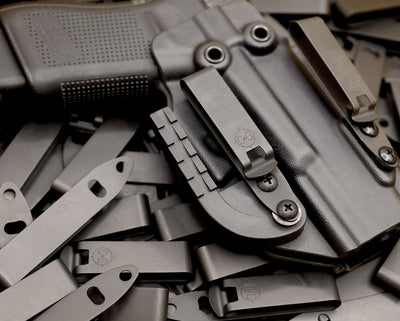
AIWB/IWB: As of spring 2026, AIWB holsters now ship with factory-integrated claws, foam wedges, and optic-ready cuts as standard features, even at entry-level price points. A taller enclosed emitter interacts with the concealment claw and wedge geometry, which can affect printing control and your draw stroke. If you're running an ACRO or EPS in an AIWB rig, the holster needs to be molded for that specific combination, not just marked "optic compatible."
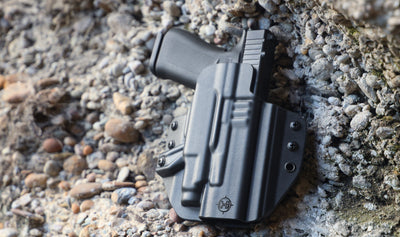
OWB Duty Carry: With 63% of agencies planning RDS adoption within the next three years and many officers purchasing their own optics out of pocket, the demand for OWB optic-cut holsters with Level II/III retention has never been higher. This audience is underserved by most holster content, but it's the community we built this company to support.
Competitive Shooting: Over 65% of competitive shooting professionals in the U.S. now use red dot-integrated platforms, according to Congruence Market Insights. USPSA Carry Optics division shooters need Kydex holsters that meet rulebook requirements while accommodating their specific optic footprint.
One practical note: a holster with an optic cut will fit your pistol with or without a red dot installed, making it a future-proof investment if you plan to add an optic down the road. At C&G Holsters, we offer both Quickship (5-business-day turnaround) and fully custom Kydex options, all precision-molded using CNC aluminum molds. Every optic-cut holster is model-specific, covering IWB, AIWB, and OWB carry for the full range of platforms discussed above. Our team of U.S. Military Veterans, active and retired LEOs, and competitive shooters carries optics-equipped pistols daily. We build what we carry.
Step 4 — Retention, Re-Holstering, and the Precision-Fit Difference
Adding a red dot changes your pistol's center of gravity and slide profile. That shift can affect the passive retention tension in a Kydex holster, meaning the "click" you rely on may need recalibration for the optic-equipped configuration.
Re-holstering is where imprecise holster cuts become genuinely dangerous. An optic cut that's machined too tight or slightly off-spec can catch the optic body during re-holster, creating a snag under stress. A five-year study ending December 31, 2024, documented 35 officer-involved shootings with RDS-equipped pistols. This gear is being used in real life-safety scenarios. The holster has to perform flawlessly every single time.
This is where precision-molded, model-specific optic cuts separate themselves from "universal optic cut" budget holsters. A CNC-machined holster built for your exact pistol and optic combination delivers consistent retention and clean re-holstering. A generic cut is a gamble.
Carry-grade red dots are built to withstand 10,000+ recoil cycles, temperature extremes, and hundreds of draw cycles without zero shift. Your holster needs to match that standard. Kydex's moisture resistance, dimensional stability, and non-reactive surface make it the right material for all-weather optics-ready carry. It won't warp, rot, or absorb sweat the way leather does.
Your Optics-Ready Holster Compatibility Checklist
Before you purchase an optics-ready Kydex holster, run through every item on this list. Skipping a step is how compatibility mistakes happen.
- Confirm your exact optic model and its footprint family. Is it RMR, RMSc/K, DeltaPoint Pro, ACRO, or EPS? The model number alone isn't enough; verify the footprint.
- Determine if you're using an adapter plate. If so, account for the added height in your holster clearance requirement. A plate-mounted optic sits higher than a direct-mill mount.
- Identify whether your optic is open-emitter or enclosed-emitter. Verify that the holster cut is rated for that specific profile. An RMR cut will not clear an ACRO.
- Confirm whether you run suppressor-height backup iron sights. SHBIS add to the slide-top profile and may require additional holster clearance beyond the optic cut itself.
- Select your carry platform (AIWB, IWB, OWB). Confirm the holster's retention system is calibrated for the optic-equipped pistol's weight and profile, not just the bare slide.
- Verify the holster is model-specific, not universal. It should be machined for your exact pistol, optic, and weapon light combination.
- Test re-holstering slowly and deliberately before carrying. Confirm zero snag on the optic body at the holster mouth. If it catches, it's the wrong holster.
Carry With Confidence — Get the Fit Right the First Time
Optics-ready carry is the standard in 2026. The only question is whether your holster was built to match. Start with the footprint, verify your emitter type and clearance requirements, and confirm that your holster is precision-molded for your exact setup.
This decision is coming for nearly everyone who carries on duty. With 63% of law enforcement agencies planning to adopt red dot sights within three years, and the global red dot market projected to grow from $740 million to over $1.2 billion by 2032, the shift is accelerating fast.
A holster is not a commodity purchase when lives depend on the draw. Precision fit, correct optic clearance, and verified retention are non-negotiable. At C&G Holsters, every holster we build reflects that belief. Our team of veterans, law enforcement professionals, and competitive shooters builds what they carry, for all that you hold close.
Verify your holster-optic compatibility today, or explore our model-specific optic-cut Kydex holsters built for the way you actually carry.
Sources
- Astute Analytica / GlobeNewswire — Riflescopes and Red Dot Sight Market to Reach US$ 102.3 Billion by 2033
- Guns and Gadgets Daily — Red Dot Footprint Guide: Match a Pistol Optic (2026)
- Athena Precision — The Ultimate Guide to Red Dot Footprint Compatibility
- Gun Talk — Pistol Red Dot Sights & Footprints: The Complete Guide
- VOTATU — Why Enclosed Red Dot Sights Are Dominating the Handgun Market in 2026
- Gun Carrier — Appendix Carry Holster: 2026 Ultimate Guide to Comfort & Speed
- Congruence Market Insights — Red Dot Sights Market Trends
- Astute Analytica — Riflescopes & Red Dot Sight Market Size, Share
- Gun Carrier — Best Pistol Red Dot Sights for Concealed Carry 2026





Hinterlassen Sie einen Kommentar