


By: Christopher J. Burns
Why the FN Reflex Line Demands a Smarter Holster Choice
The FN Reflex XL delivers Glock 19 capacity (15+1 flush, 18+1 extended) in a package just 1.08 inches wide. That's a remarkable achievement, but only the right holster unlocks that advantage for real-world carry.
FN America introduced the Reflex in 2023 as its first micro-compact handgun: a 9mm with a 3.3-inch cold hammer-forged barrel, 6.2 inches overall length, and just 18.4 ounces unloaded. The Reflex XL MRD, announced January 2025, stretches to a 3.8-inch barrel and 20 ounces, adding only about 1.6 ounces and half an inch over the standard model.
What sets both apart from every other striker-fired micro-compact on the market is an internal hammer-fired single-action-only (SAO) trigger system. That affects trigger feel, safety profile, and carry considerations in ways most holster guides ignore entirely.
The micro-compact 9mm category didn't exist before 2018. According to American Firearms, nearly 20 active models are in production as of September 2026. With that many options, holster selection has become more nuanced than ever. This guide covers all four carry modes (IWB, OWB, AIWB, and light-bearing) for both the standard Reflex and the Reflex XL in one definitive resource.
Reflex vs. Reflex XL: What Changes for Carry
The numbers side by side: the standard Reflex runs a 3.3-inch barrel, 6.2-inch overall length, 1-inch width, and 18.4 ounces. The Reflex XL bumps to a 3.8-inch barrel, 6.75 inches overall, 1.08-inch width, and 20 ounces. That half-inch and 1.6 ounces are modest on paper but meaningful in a holster.
The Reflex XL follows a proven industry pattern. SIG did it with the P365 XL. Springfield did it with the Hellcat Pro. Glock did it with the 43X. Manufacturers upsize micro-compacts by roughly half an inch to unlock full-grip ergonomics and higher capacity without sacrificing meaningful concealability. The Reflex XL fits squarely in that lineage.
Ergonomic upgrades exclusive to the XL include two interchangeable grip backstraps, a palm swell, an enhanced trigger guard undercut, and an extended beavertail. These improve shooting comfort, but the backstrap size directly affects holster fit and retention. The large backstrap adds width at the grip base, changing how a precision-molded Kydex shell grips the pistol. Settle this detail before ordering.
On capacity: the standard Reflex holds 11+1 flush or 15+1 with the extended magazine. The Reflex XL holds 15+1 flush or 18+1 extended. For maximum concealment and pocket-friendly dimensions, the standard Reflex is the call. For a true duty-capable round count in a concealable frame, the XL is the answer.
The XL's grip stands nearly one inch taller than the standard model. According to On Target Magazine, this is a non-issue for appendix carry but may require more deliberate concealment for strong-side setups. MSRP sits at $614 for the standard Reflex and $719 for the Reflex XL MRD, per Shooting Illustrated. Both are mid-range in the micro-compact segment, which makes investing in a quality holster proportional to the pistol's value.
IWB Carry: The Everyday Standard for the Reflex Family
Inside-the-waistband carry remains the dominant concealed carry method in the United States, and for good reason. With 21.46 million active concealed carry permits in 2024, demand for slim, reliable IWB solutions has never been higher.
For strong-side IWB (3 to 5 o'clock), both the standard Reflex and the Reflex XL perform well. The Reflex's 1-inch width and the XL's 1.08-inch width both print minimally under a cover garment. These are genuinely thin pistols, and they disappear at the hip with a proper holster and a basic untucked shirt.
The Reflex XL's taller grip is where strong-side IWB gets more demanding. You need deliberate cant (typically 10 to 15 degrees forward) and a holster with adjustable retention to manage grip exposure. Without these, the grip can peek above the beltline during bending or reaching movements.
Holster material matters here more than most shooters realize. Precision-molded Kydex, CNC-machined to exact firearm dimensions, outperforms generic or budget alternatives for consistent draw and retention. The Reflex's unique SAO trigger profile and internal hammer housing have specific geometry that demands tight tolerances. A holster that doesn't account for these features won't retain the pistol reliably.
A note for left-handed shooters: southpaw IWB options for the Reflex XL are limited across the market. Look specifically for brands offering true mirror-image molds, not converted right-hand designs. A flipped right-hand holster puts retention pressure in the wrong places and compromises draw consistency.
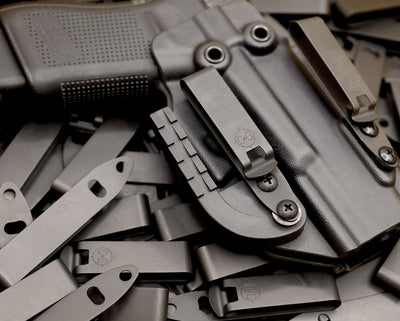
Our FN America Reflex collection includes IWB COVERT and ALPHA Kydex holsters for both models, available in Quickship (5-day) and fully custom configurations. Built to our GEN6 standards, launched January 2025, and CNC-machined from custom aluminum molds, they deliver a consistent, repeatable draw every time.
Appendix Carry (AIWB): Where the Reflex XL Excels
Appendix inside-the-waistband carry is the fastest-growing carry method heading into late 2026, and the Reflex XL's slim 1.08-inch width makes it particularly well-suited for the position.
The counterintuitive part: the taller grip that complicates strong-side carry is a non-issue at appendix. At the 12 to 1 o'clock position, the grip tucks naturally into the body's contour rather than canting outward. For most body types, the Reflex XL actually conceals better at appendix than at 4 o'clock.
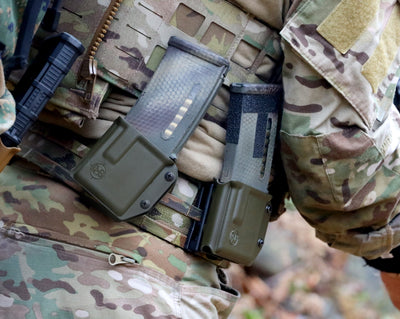
A sidecar or appendix system design, where a dedicated mag carrier is integrated into the holster body, improves balance, reduces printing, and speeds reloads. This matters for a pistol with the Reflex XL's 18-round extended capacity. The added weight of a spare magazine on the opposite side of the holster counterbalances the pistol and keeps the entire rig from shifting during movement.
The Reflex's internal hammer-fired SAO trigger deserves attention in AIWB safety discussions. The trigger pull averages 4.5 to 5.5 pounds out of the box, though Guns.com's long-term review measured it dropping to roughly 3.4 pounds after 2,000 rounds. A quality holster with full trigger guard coverage is non-negotiable for any AIWB setup, especially for a trigger that lightens with use.
One practical note: backstrap size selection on the Reflex XL affects AIWB holster fit. The large backstrap adds width at the grip base and can change retention tension. Confirm your backstrap choice before ordering a fitted holster. Ride height and cant adjustability are also non-negotiable for AIWB. Look for holsters with hardware that allows fine-tuning for your body type and draw preference.
OWB Carry: Range, Duty, and Open Carry Applications
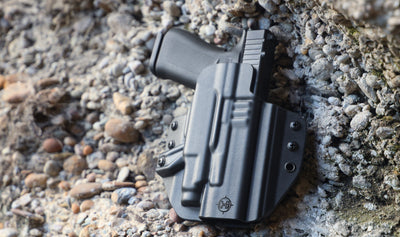
Outside-the-waistband carry is the preferred mode for range instructors, law enforcement on duty, and open carry contexts. It's an audience we serve directly at C&G, founded by a retired Law Enforcement Officer and Master Firearms Instructor who understands what duty-grade gear demands.
The Reflex's 3.3-inch barrel and the XL's 3.8-inch barrel both sit in a length range that works well with OWB pancake-style holsters. Neither produces excessive muzzle extension below the beltline, keeping the overall profile compact even in an outside-the-waistband configuration.
For duty and range OWB use, the key performance criteria shift away from concealability. Retention level, draw speed, and the ability to re-holster one-handed become primary. Firearms instructors running drills need a holster they can re-holster without looking down; law enforcement officers need retention that resists a grab attempt while still allowing a clean, fast draw under stress.
Chest-mount OWB configurations for the Reflex XL are an underserved option worth mentioning. For range instructors or backcountry carry, a chest holster keeps the pistol accessible while clearing the beltline for gear. Look for mounting hardware that accommodates the XL's 1.08-inch width and any attached optic.
OWB can also work for concealment with the right cover garment. The Reflex and Reflex XL's slim profiles help, but holster cant and a body-hugging design are critical to keeping the pistol from printing. Precision-molded OWB Kydex outperforms generic paddle holsters here. The Reflex's unique dimensions, particularly the internal hammer housing, require exact mold tolerances for proper retention. This is the quality gap that separates purpose-built holsters from universal fits.
Light-Bearing Carry: The TLR-7 Sub and What You Need to Know
Light-bearing EDC is a growing segment, and the FN Reflex XL's accessory rail opens it to weapon light carry. The compatibility details are specific, and they're widely misunderstood.
The critical buying detail: the Reflex XL's rail is compatible with lights designed for the Glock 43X MOS accessory rail. That means the Streamlight TLR-7 Sub must be the "GL" (Glock) version, not the standard TLR-7 Sub. This distinction, confirmed by Four Brothers Inc. and FN's own documentation, is the single most common purchasing mistake in this category.
Why does this matter for holster selection? A holster molded for the standard TLR-7 Sub will not fit correctly with the GL version. The mounting lug geometry differs enough that retention, draw, and re-holstering are all compromised. This is a practical mistake that costs shooters money and time.
An important distinction most roundup articles miss: the standard FN Reflex (non-XL) does not have an accessory rail. Light-bearing carry is exclusive to the Reflex XL.
When shopping for a light-bearing IWB holster for the Reflex XL with TLR-7 Sub GL, look for three things: mold specificity to the exact light model, adjustable retention at both the firearm and light body, and a sweat guard that clears the optic if you're running an MRD. Generic "light-bearing" holsters claiming to fit multiple light models rarely deliver the retention consistency you need for daily carry.
Optics-Ready Carry: Running an MRD on the Reflex XL
Optics-ready pistols are now expected out of the box by most carry buyers in 2026. The Reflex XL MRD's direct-mount system uses two raised posts with no adapter plate required, a genuine differentiator that reduces overall height and improves co-witness options.
Compatible footprints include the Shield RMSc and the Holosun 507K/407K, both of which mount directly without adapters. This is a meaningful advantage over competitors that require aftermarket plates, which add height, introduce a potential failure point, and change the holster fit equation.
Holster compatibility with a mounted optic requires more than a generic "optics-ready" cut. The holster must be cut for the specific MRD footprint and the Reflex XL's direct-mount geometry. A cut that's too wide allows lateral movement; too narrow and you'll drag the optic during the draw.
Running both an MRD and a TLR-7 Sub GL simultaneously on the Reflex XL is absolutely possible, but it requires a holster specifically molded for that combined configuration. Two separate holster features (optic cut and light-bearing) don't automatically work together. The combined profile is unique and must be accounted for in the mold.
The Reflex XL earned an 88% positive sentiment rating and a #9 ranking in a comprehensive micro-compact market analysis, with optics integration cited as a key driver of buyer satisfaction. Before ordering any optics-cut holster, confirm your MRD model and backstrap size. These two variables directly affect fit and retention on precision-molded Kydex.
Choosing the Right Holster: A Decision Framework for Reflex Owners
The summary: IWB is the everyday standard for civilian concealed carry. AIWB is the performance-focused choice for shooters who prioritize speed and deep concealment. OWB serves range work, duty carry, and instructor use. Light-bearing IWB covers home defense and low-light EDC for Reflex XL owners.
Regardless of carry mode, Reflex XL owners must select their backstrap before ordering a fitted holster. The large backstrap changes the grip profile enough to affect retention on precision-molded Kydex. Order the holster for the backstrap you actually shoot with, not the one installed from the factory.
The micro-compact market's growth from zero to nearly 20 models since 2018 has flooded the holster market with generic Kydex options. Precision CNC-machined holsters built to exact model specifications are worth the investment for a $614 to $719 pistol. A $30 generic holster that doesn't retain properly or allows trigger access isn't saving you money; it's creating risk.
American-made, veteran-staffed manufacturing matters as a trust signal. At C&G, our team includes U.S. Military Veterans, LEOs, and competitive shooters, and our 4,200+ verified customer reviews reflect real-world performance across a broad range of firearms. For a duty-grade or EDC holster, provenance and quality control aren't marketing language. They're the difference between gear that works under stress and gear that doesn't.
For most carry setups, a Quickship option with 5-day delivery in standard black Kydex covers the need. Custom color configurations are available for those matching gear to unit colors or personal preference. The right holster is the one built specifically for your Reflex or Reflex XL, your carry position, your light (if any), and your optic (if any). Generic fits cost more in the long run.
Sources
- FN America Official Press Release: FN Reflex XL MRD Launch
- Shooting Illustrated: First Look FN Reflex XL MRD
- On Target Magazine: FN Reflex XL MRD Review
- Mordor Intelligence: Small Arms Market Size & Share Analysis
- Guns.com: FN Reflex MRD 9mm Long-Term 2K Round Review
- Four Brothers Inc.: FN Reflex XL & TLR-7 Sub IWB Holster
- Ronin's Grips: US 9mm Micro-Compact Pistol Market Analysis





Hinterlassen Sie einen Kommentar