


Carrying a Gun Doesn't Make You a Holster Expert
Ten years of daily carry builds trigger discipline and situational awareness. It does not build holster engineering expertise. There is a meaningful difference between wearing a firearm as a lifestyle accessory and treating it as a life-safety tool that demands an engineered support system.
The holster market reflects this gap. According to Ronin's Grips, the industry has split into two camps: engineering-first manufacturers investing in premium materials and precision tooling, and high-volume brands racing to the bottom on material cost. With the global holster market valued at $2.8 billion and roughly 29.8% of Americans now carrying concealed, poor holster selection is a public safety issue at scale.
This article lays out a technical vetting framework built from the perspective of people who use firearms as professional tools, not range props. Our founder, a retired Law Enforcement Officer and Master Firearms Instructor, developed these standards from decades of operational experience.
Standard 1: Kydex Thickness — The Number That Tells You Everything
Four standard Kydex thicknesses exist in the holster industry: 0.060", 0.080", 0.093", and 0.125". The thickness a manufacturer chooses tells you exactly where their priorities sit. Most holster makers default to 0.080" as the industry standard. Budget brands go thinner.
The cost-cutting math is straightforward: switching from 0.080" to 0.060" reduces material cost by approximately 25%. That savings comes directly at the expense of durability and retention integrity. The end user absorbs the risk so the manufacturer can protect margins.
Kydex is an acrylic-polyvinyl chloride composite with a Rockwell R hardness of 90 and a flexural modulus of 2,800 MPa. That rigidity only holds if the sheet is thick enough to resist deformation under real-world stress. A 0.093" shell represents a 16% thickness increase over the 0.080" standard, meaningfully enhancing structural integrity, mouth rigidity, and long-term retention consistency.
If a manufacturer won't publish their Kydex thickness, that silence is the answer.
Standard 2: Mold Method — CNC Precision vs. Foam That Degrades
Foam-press molding is the most common budget manufacturing method, and it is the most inconsistent. Foam degrades in density with each press cycle. Holster #3 and holster #98 from the same foam block will have measurably different retention and fit characteristics. That is not a quality control problem. It is a design philosophy problem.
CNC-machined proprietary molds work differently. Designed in CAD using 3D scans of actual firearms, these molds capture slide serrations, accessory rail dimensions, and trigger guard angles down to thousandths of an inch. Every unit comes out geometrically identical. Talon Retention Systems and other precision manufacturers recognize CNC-machined molds as the gold standard for consistency, eliminating slop, rattle, and unpredictable retention.
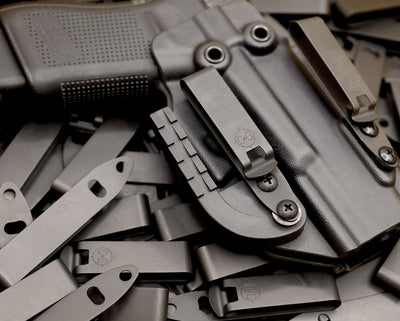
A holster that fits differently on unit #50 than unit #1 cannot deliver a repeatable draw stroke. At C&G Holsters, we use custom CNC-machined aluminum molds as the manufacturing baseline. That is what makes a consistent, repeatable draw possible across every single holster we ship.
Standard 3: Full Trigger Guard Coverage — The Primary Safety Characteristic
Full trigger guard coverage is the single most important safety feature of any carry holster. Not comfort. Not concealability. Wikipedia's holster entry identifies trigger guard protection as "one of the most important functions of a holster," and holsters designed specifically for a firearm model perform best in this respect.
The failure mode of soft-walled or collapsible holsters is straightforward: material can flex inward under pressure during reholstering, creating contact with the trigger. Over a five-year period, unintentional firearm discharges caused 2,491 deaths nationwide, more than one per day. That number is not abstract. It represents preventable failures in which holster design is a contributing factor.
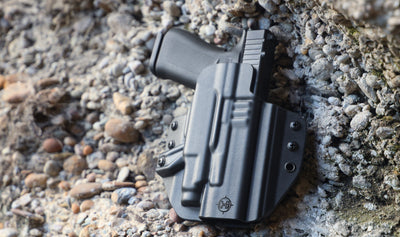
Holsters built from actual gun geometry, where the mold conforms precisely to the trigger guard's angle and depth, deliver full enclosure with no gaps. Our SIG Sauer P365-XMACRO holster collection, including IWB COVERT/ALPHA and OWB COVERT Kydex options, is CNC-molded to the exact geometry of that pistol, providing complete trigger guard coverage with zero slop or rattle.
Standard 4: Retention Classification — Know What Level Your Mission Demands
The National Institute of Justice developed a duty holster retention standard specifically because no existing standards for holster weapon-retention capability existed. Weapon security is a documented law enforcement safety concern, and the NIJ formalized the framework the industry now uses.
The four retention levels break down as follows: Level I uses friction or a thumb break for low-threat environments. Level II employs two security systems and serves as the standard for patrol. Level III adds a third mechanism for corrections and high-contact duty. Level IV covers specialized tactical and transport operations. Each level addresses a specific threat profile.
In a documented Illinois case, an officer using a friction-only holster, lost their sidearm and sustained injury. That is not a hypothetical. It is a consequence of mismatched retention.
The engineering tension is real: holsters must simultaneously resist inadvertent loss during high physical exertion and unauthorized access, while enabling a fast draw under intense psychological pressure. That balance must be engineered, not assumed. Match your retention level to your actual operational environment, not to what looks tactical on social media.
Standard 5: Holster Mouth Rigidity — The Reholstering Safety Test
As concealed carry adoption pushes past 29.8% of Americans, holster mouth collapse is becoming a serious safety concern. A collapsible holster mouth requires two hands to reholster safely. In a real-world scenario, that second hand may be occupied, injured, or unavailable.
Material thickness directly determines mouth rigidity. Thicker Kydex (0.093" and above) maintains its open geometry after the draw, enabling safe one-handed reholstering without looking down. Thinner material flexes, folds, and creates exactly the kind of trigger contact risk discussed in Standard 3.
Any buyer can perform this test: draw the firearm and attempt to reholster one-handed without looking down. If the mouth collapses, the holster fails. This is the standard that separates holsters designed for occasional range sessions from those engineered for 24/7 operational carry.
Standard 6: Generational Design Iteration — Why GEN Number Matters
Generational design iteration means each version incorporates real-world feedback from operators, instructors, and law enforcement into measurable engineering refinements. It is not a cosmetic refresh. It is a disciplined cycle of identifying failure modes and engineering them out.
Compare a GEN1 or stagnant design against a GEN6 platform. Six iterations of refinement in retention geometry, hardware placement, cant adjustment, and material selection represent thousands of hours of field-validated engineering. Our GEN6 holster design is the product of continuous innovation driven by our founder, a retired LEO and Master Firearms Instructor, not a marketing team.
Generational iteration is only possible when a manufacturer treats holster design as a safety-critical engineering discipline, not a commodity production run. Ask the vetting question: can the manufacturer explain what changed between their design generations and why? If they cannot, "GEN" is a marketing label, not an engineering milestone.
Standard 7: Who Actually Built It — Staff Credentials and American Manufacturing
The people designing and building a holster determine its real-world performance ceiling. A team of veterans, LEOs, and competitive shooters designs for failure modes they have personally encountered. That lived experience is not something a focus group can replicate.
American-made manufacturing matters beyond patriotism. Domestic CNC production means traceable material sourcing, consistent Kydex provenance, and no unknown offshore substitutions in sheet thickness or composite formulation. According to Intel Market Research, nearly 22% of holster manufacturers launched modular platforms between 2023 and 2025. Modularity built on unknown materials and unverified mold methods is not an upgrade. It is a risk multiplier.
Our team at C&G Holsters is staffed by U.S. Military Veterans, LEOs, and competitive shooters. Our founder built this company on the principle that the people making the holster should be willing to stake their own safety on it in the field. That is the credibility baseline every buyer should demand.
The Vetting Checklist: 7 Questions Before You Buy
Before you purchase your next holster, ask the manufacturer these seven questions:
- What Kydex thickness do you use, and will you publish it?
- Are your molds CNC-machined from CAD-designed 3D scans, or foam-pressed?
- Does the holster provide full, rigid trigger guard coverage for my specific firearm model?
- What retention level does this holster meet, and which standard are you referencing?
- Can I reholster one-handed without the mouth collapsing?
- What generation is your current design, and what changed from the previous one?
- Who designed and built this holster, and would they carry it on duty?
Daily carry experience is not holster engineering expertise. The ability to ask these questions is what separates informed buyers from people who end up with range toys. The premium holster segment grew 14% last year because serious carriers are increasingly demanding engineering-first products.
C&G Holsters was built to meet these standards: over 4,200 verified customer reviews, 100% American-made with locally sourced materials, GEN6 design, and Quickship availability. The holster your life depends on should be built by people whose lives have depended on one.
Sources
- Top 10 Kydex Holster Brands Based on 2025 Data – Ronin's Grips
- Holster Market Size, Share & Forecast Report 2025 to 2034 – DataIntelo
- North America Tactical & Outdoor Self-Defense Equipment Market – GM Insights
- Kydex Thickness Explained – BLC Holsters
- Kydex Holsters – Harry's Holsters
- Kydex – Wikipedia
- CNC Precision Holster Molds – Talon Retention Systems
- Handgun Holster – Wikipedia
- Concealed Carry Accidental Discharge – XInsurance
- NIJ Duty Holster Retention Standard Fact Sheet – OJP / National Institute of Justice
- The Role of Duty Holsters in Officer Safety and Readiness – Police1
- Auto Retention Holster – USPTO Patent 10634452
- Concealed Carry Holsters Market Outlook 2026-2034 – Intel Market Research





Jätä kommentti