


Your Primary Holster Is Plan A — What's Plan B?
Nobody calls a spare tire paranoid. It's just good planning. The same logic applies to carrying a backup gun. Over 35 million Americans carry firearms outside the home regularly, and a peer-reviewed study published in JAMA Network Open in March 2025 estimated 489,000 annual defensive gun uses involving a discharged firearm. The stakes are real.
Most carriers get this wrong: a backup gun only adds value when the secondary holster integrates with your primary rig as a unified system. Two separate purchases thrown together on a belt is not a plan. It's clutter. This article walks through the four decisions every dual-carrier must make: gun selection, carry position, holster compatibility, and training protocol.
Who Actually Carries a Backup Gun — And Why It Matters to You
Law enforcement figured this out decades ago. Most agencies allow officers to carry more than one handgun on duty and off duty, especially as single-officer patrol became the standard across the country. According to Police1, departments that authorize backup guns typically require officers to qualify with the backup weapon and carry it in an approved holster. That's not a suggestion; it's a training and accountability standard.
Civilians can learn from that standard. Undercover officers, plainclothes detectives, executive protection professionals, and armed security all face the same deep concealment challenges that everyday concealed carriers deal with. The gear solutions overlap more than most people realize.
The landscape for civilian dual-carry is expanding. According to the Crime Prevention Research Center's 2025 report, 29 states now allow constitutional carry, covering 67.7% of U.S. land mass. That's reduced the bureaucratic friction for anyone exploring a layered carry setup. Meanwhile, 20.88 million Americans hold concealed carry permits, and actual carry rates continue to climb. The pool of people seriously considering a secondary firearm is larger than ever.
Choosing a Backup Gun That Complements Your Primary
This is the decision that matters most, and it comes down to one principle: manual of arms. Your backup gun should mirror your primary's trigger, safety mechanism, and magazine release. Under stress, your brain doesn't have bandwidth to switch between two different operating systems. Cognitive load kills speed, and speed keeps you alive.
Glock dominates law enforcement duty pistol adoption at roughly 65% of agencies, according to USA Gun Shop. That makes the Glock 43X the natural backup choice for the majority of officers, because it shares the exact manual of arms with Glock 17, 19, and 45 duty pistols.
The 43X is also the dominant crossover gun between law enforcement and civilian concealed carry. As Ronin's Grips noted, it's the standard-bearer for administrative, detective, and deep concealment roles. The specs back that up: 1.10-inch width, 3.39-inch barrel, 10+1 capacity, and 18.7 ounces unloaded. Drop in Shield Arms 15-round flush-fit magazines, and you're carrying 15+1 rounds in a backup gun. That reframes the old assumption that a BUG means fewer rounds. In some configurations, it carries nearly as many as a primary pistol.
Match your caliber to your primary gun. Shared ammunition simplifies logistics and training. Smaller-frame guns demand more deliberateness to shoot accurately under stress, so the training investment is real.
Other proven options exist in this category: the SIG P365, S&W Bodyguard, and J-frame revolvers all have loyal followings. For anyone already running a Glock as their primary, though, the shared manual of arms gives the 43X a decisive advantage no other platform can match.
Carry Positions for a Secondary Gun — Integrating Into Your Existing Rig
Here's the integration problem most articles skip entirely: belt real estate. When you're running a primary holster, a backup holster, and a magazine carrier simultaneously, cant conflicts and printing management become real engineering challenges. Our founder, a retired LEO and Master Firearms Instructor, has always emphasized that carry position for a BUG is not a standalone decision. It's a function of what's already on your belt.
Appendix carry (AIWB) keeps the backup firearm in your frontal workspace. It remains accessible when you're seated in a vehicle, where strong-side IWB becomes difficult to reach. This is the preferred position for EP professionals and plainclothes officers who spend significant time behind the wheel.
Ankle carry offers deep concealment but requires kneeling or bending to draw, making it the slowest option. Wear the holster on the inside of your non-dominant ankle. It's best suited for seated environments like vehicle patrol, where you can access it without standing.
Pocket carry (weak side) is extremely discreet and comfortable. It provides easy access from a seated position, but it only works with certain pant types and requires a dedicated pocket holster to keep the firearm oriented correctly.
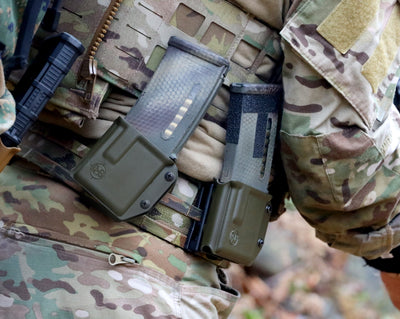
Vest or body armor carry places a quality holster on the support side of a vest, keeping the BUG secure and drawable from any position, even while moving. This is the preferred method for uniformed officers.
The practical rule: position your backup holster on the support side to preserve strong-side real estate for the primary and magazine carrier. Evaluate cant angles on both holsters to prevent clip conflicts.
The Holster System Perspective: Material, Retention, and Compatibility
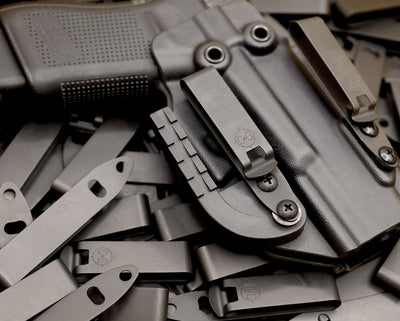
Treat your primary and backup holsters as an integrated system. That means matching Kydex material, belt clip type, and draw-stroke mechanics rather than mixing materials and clip standards across two rigs. The ecosystem approach is not about brand loyalty; it's about consistency under pressure.
There's a growing consensus among LE trainers and firearms instructors: Kydex holsters with full trigger guard coverage and positive retention are the only appropriate choice for backup carry, especially in ankle and appendix positions. Soft material holsters collapse after the draw, obstructing re-holstering and creating a safety hazard when you need to secure the weapon quickly.
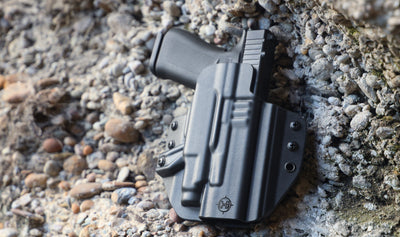
We designed the C&G ALPHA IWB Kydex Holster for exactly this role. For the Glock 43X specifically, it's purpose-built for deep concealment and undercover carry. CNC-machined from custom aluminum molds, it delivers a consistent, repeatable draw every time, with a minimal footprint that disappears under business attire or a suit jacket. Plainclothes officers and EP professionals have been running this exact setup because it solves the concealment problem without sacrificing retention. The GLOCK 43/X/MOS IWB COVERT/ALPHA Kydex Holster ships within five days through our Quickship program, is 100% American-made, and is compatible with the Glock 43, 43X, and MOS variants.
Clip selection matters more than most carriers realize. A low-profile clip on the backup holster reduces printing and prevents interference with the primary holster's clip when both sit on the same belt. Evaluate the cant angle on your backup holster against your primary's cant to confirm both draw strokes remain natural and non-conflicting.
Training for the Backup Draw — The Step Most Carriers Skip
Owning a backup gun without training the draw is a liability, not an asset. The BUG draw must be practiced from every carry position you actually use.
Ankle draw: Requires dropping to one knee. Practice from standing, seated, and ground positions. This is the slowest draw in your toolkit, and it only becomes viable through repetition.
AIWB backup draw: This is the fastest access position for a secondary gun. Practice accessing the BUG while your primary hand is occupied or injured. That's the exact scenario that makes a backup gun necessary in the first place.
Law enforcement agencies require officers to qualify with their backup weapon. Civilians should hold themselves to the same standard. If you wouldn't carry a primary gun you haven't trained with, the same rule applies to your BUG.
The highest-value training investment for backup gun integration is dry-fire practice in your actual carry clothes. The garments you wear affect draw speed, clearance, and concealment. Train in what you carry in.
Build the System, Not Just the Gear List
The framework is straightforward: select a BUG that shares the manual of arms with your primary. Match caliber. Choose a carry position that integrates with your existing belt setup. Select a Kydex holster that complements your primary rig's material and clip standard. Train the draw from every position you carry in.
Every holster we build at C&G is designed by U.S. Military Veterans, LEOs, and competitive shooters who personally run these setups. We're not a catalog company guessing at what carriers need. We build the tools we use ourselves, CNC-machined with American-made precision.
Evaluate your current primary rig. Identify the gap in your Plan B. Build your secondary setup with the same intentionality you brought to your primary holster choice. That's how you turn a backup gun from a piece of extra gear into a system that actually works.
Sources
- Defensive Gun Use Statistics — Ammo.com
- Backup Gun Carry and Training Options for Police Officers — Police1
- CPRC's Latest Report Outlines the Robust State of Concealed Carry in America — NRA-ILA
- Specialist Firearms for Law Enforcement: The Complete Guide — USA Gun Shop
- Top 10 Duty Pistols Purchased by Law Enforcement in 2025 — Ronin's Grips





Jätä kommentti