


The Most Dangerous Moment on Your Range Is the Holster
The most dangerous moment on any live-fire range is not the shot. It is the re-holster. As Primer Peak notes, instructors widely recognize that holstering is where negligent discharges most commonly occur, particularly when the trigger finger is not fully indexed before the muzzle enters the holster.
A Concealed Carry Inc. study of 300 negligent discharges over 24 months found that a significant proportion occurred during "administrative handling" — the moments when a gun is removed from or returned to the holster. The CDC reports approximately 16,000 accidental firearm injuries each year in the United States. Your pre-range holster evaluation is the single highest-leverage safety intervention available to you.
This article provides a tiered, pass/fail instructor checklist built on real-world regulatory and institutional standards. This is not personal preference. When a student's holster fails to meet training requirements at the Federal Law Enforcement Training Centers (FLETC), replacement gear is provided. Holster evaluation is an operational standard at the federal level. It should be one on your range, too.
Why Instructors Bear Responsibility for Student Holster Approval
Holster evaluation is not optional. It is a codified instructor duty across multiple state training frameworks.
Florida's official Firearms Training Manual Instructor's Guide mandates that students use the same holster during range qualification that they will use during actual licensed activity, and that instructors verify equipment compatibility with the firearm. New York State's minimum standards for concealed carry live-fire training explicitly require instructor evaluation of safe drawing, target acquisition, and re-holstering as proficiency benchmarks.
The Massachusetts MPTC Annual Firearms Training Standards (effective July 2024, updated July 2025) require every sworn officer to qualify annually with each individual authorized firearm. Holster-firearm compatibility must be verified per weapon, not generically. Pennsylvania's MPOETC 2025 Firearms Qualification Course requires all draws to begin from a snapped or concealed holster with 360-degree threat scanning after each firing stage.
For independent instructors and range operators, the liability gap is real. If you permit a student to use a substandard holster on a live-fire range and something goes wrong, you own that exposure. Document your evaluation process. Recognize that standards differ by student population: LE qualification, civilian CCW courses, and competition shooter contexts each carry distinct requirements.
Disqualifying Defects: Holsters That Must Be Rejected Before Live-Fire
A disqualifying defect is a condition that creates an immediate, non-correctable safety hazard. These holsters must be removed from the range entirely. No adjustment fixes them.
Disqualifier 1: Holster exits with the gun. According to Concealed Carry Inc.'s Holster Safety Checklist, this is classified as a "Rule 3 Failure" in professional training contexts. The result is an unsecured firearm with an exposed trigger. Test every student holster with a firm draw stroke before live-fire begins.
Disqualifier 2: Trigger-finger release retention devices. Holsters requiring the trigger finger to deactivate active retention (SERPA-style mechanisms) are explicitly prohibited at certified range facilities and codified as disqualifiers in formal draw certification programs, as documented by The Range STL. The FLETC Holster Study specifically examined the psychomotor problems created by trigger-finger manipulation holsters. The science backs the ban.
Disqualifier 3: Collapsing or soft holsters. A holster that does not remain open and rigid after the draw requires two hands to re-holster. That means the support hand or body gets muzzle-swept. Soft leather, nylon, and collapsing holsters fail this requirement under real-world instructor standards.
Disqualifier 4: Trigger guard not fully covered or compressible. A soft holster that can be compressed inward by external pressure can allow trigger contact even if it nominally covers the trigger guard. Material rigidity is a safety-critical specification, not a preference.
Build a pre-class communication framework around these disqualifiers. Send students a prohibited holster list before they arrive. Range-day rejection should be a last resort, not the first intervention. Facilities like Hard Focus Firearms Training publish their banned holster types (shoulder, behind-the-back, crossdraw, ankle, and SERPA-style) directly on their FAQ page. That is the model to follow.
Correctable Issues: What Instructors Can Approve With Conditions
A correctable issue is a holster condition that can be addressed on range day with adjustment, repositioning, or student coaching. These are not automatic disqualifiers.
Correctable Issue 1: Retention too loose. Test by inverting the holstered firearm. If the gun falls free, retention must be adjusted before live-fire proceeds. Many Kydex holsters allow retention screw adjustment on the spot with a Phillips head or hex key.
Correctable Issue 2: Ride height or cant suboptimal. IDPA competition rules cap OWB holster protrusion at no more than 3 inches from the body (measured at the top of the belt) and limit cant to no more than 15 degrees muzzle-rear. These are measurable benchmarks instructors can apply on the line.
Correctable Issue 3: Belt incompatibility. A holster on an undersized or soft belt can shift during the draw, creating retention and re-holstering problems. Holster and belt compatibility is a recognized pre-range check in professional training environments. If the belt cannot support the holster, the student needs a different belt before proceeding.
Correctable Issue 4: AIWB-specific geometry concerns. Appendix inside-the-waistband carry is the fastest-growing concealed carry position, yet many facilities still lack standardized AIWB evaluation criteria. Check muzzle direction relative to the femoral artery, re-holstering angle, and wedge/claw compatibility. Some ranges restrict or prohibit AIWB entirely. Know your facility's rules and communicate them before live-fire.
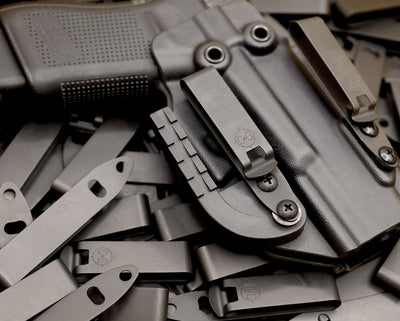
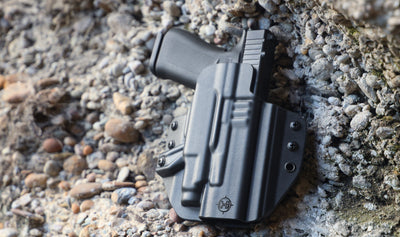
C&G Holsters' COVERT/ALPHA Kydex Holster line, available in both OWB and IWB configurations with Quickship and custom options, is an example of the rigid, shape-retaining Kydex construction that passes the re-holstering rigidity test and the retention adjustment standard. Instructors advising students on compliant gear have a clear benchmark to reference.
Configuration Checks: Lights, Optics, and Non-Dominant-Hand Draws
Light-bearing and optic-equipped pistol configurations are increasingly common in both LE and civilian training. A holster approved for a base pistol may not safely fit the same pistol with a weapon light or optic attached. Verify fit for the exact configuration the student will carry.
Confirm that the weapon light does not contact the trigger guard area of the holster in a way that creates pressure on the trigger during holstering. For red-dot-optic pistols, confirm the holster accommodates the optic without canting the muzzle or creating an unsafe draw angle.
Advanced training curricula increasingly include support-side and non-dominant-hand draw drills. Evaluate whether the student's holster design permits a safe, one-handed re-holster from the support side. Not every holster does.
The FBI Law Enforcement Bulletin notes that the standard handgun draw stroke consists of multiple discrete motor movements, including undoing the holster's retention features. Instructors must evaluate whether the holster's retention design supports the full psychomotor skill chain for every configuration being trained. A holster that works for a right-handed strong-side draw may become a safety problem when accessed from the support side under stress.
The Pre-Range Holster Evaluation Workflow: A Step-by-Step Protocol
Step 1: Pre-class communication. Send students a prohibited holster list before course day. Specify banned types (shoulder, crossdraw, ankle, behind-the-back, trigger-finger-release retention) and required characteristics (rigid material, full trigger guard coverage, belt-compatible mounting).
Step 2: Equipment check-in. Conduct holster inspection before students enter the live-fire area. Check holster-firearm fit, belt compatibility, retention function, and material rigidity as a group station. This is where you catch correctable issues and disqualifiers alike.
Step 3: Draw stroke test. Have each student perform a dry draw stroke. Observe whether the holster exits with the gun, whether the holster remains open after the draw, and whether re-holstering can be completed one-handed without muzzle-sweeping the support hand.
Step 4: Safety rules reminder. LAPD Tactical Concept No. 17 (November 2025) states that firearms safety rules apply at all times: on the range, in the field, and off-duty. Violations can result in injury or death. Frame holster standards as an extension of the four rules, not a bureaucratic hurdle.
Step 5: Documentation. Record which students' holsters were inspected, approved, conditionally approved, or rejected. This protects the instructor and range operator and creates a professional standard of care. Written records matter if a liability question ever arises.
Step 6: Replacement gear protocol. Following the FLETC model, keep a supply of compliant loaner holsters available so a failed holster inspection does not end a student's training day. A student who drove two hours to your course should leave trained, not turned away, if the problem is solvable.
Set the Standard Before the First Round Is Fired
The instructor's pre-range holster evaluation is not a preference or a formality. It is a documented, institutionally supported safety standard backed by FLETC, state POST agencies, and professional training organizations across the country.
A RAND Corporation review (updated January 2026) identified research measuring the effect of concealed-carry training hour requirements on accidental shootings and negligent discharges per capita, finding that training requirements have measurable effects on ND rates. Your holster evaluation is part of that training standard.
Build your holster evaluation checklist into your course documentation. Communicate it before range day. Enforce it consistently. That is what separates a professional training environment from a liability.
C&G Holsters was founded by a retired Law Enforcement Officer and Master Firearms Instructor precisely because holster standards matter. Our team includes U.S. Military Veterans, LEOs, and competitive shooters who have lived these standards on real ranges and in real operations. The standard you set on your range reflects the standard your students carry into the field. Make it count.
Sources
- Primer Peak: Instructor Tips: Safety and Wellbeing on the Range (March 2026)
- Concealed Carry Inc.: 6 Required Behaviors to Stop Negligent Discharges (updated May 2026)
- Guns.com: The Human Factor in Involuntary Discharges (March 2024)
- FLETC: Active Shooter Threat Training Program
- Florida Firearms Training Manual: Instructor's Guide (FDACS)
- New York State: Minimum Standards for Concealed Carry Firearm Safety Training
- Massachusetts MPTC Annual Firearms Training Standards (Version 3.1)
- Pennsylvania MPOETC 2025 Firearms Qualification Course
- Concealed Carry Inc.: Holster Safety Checklist (updated June 2025)
- The Range STL: Holster Draw Certification
- FLETC Holster Study (Public Reading Room)
- Warriorland: Trigger Protection, Retention Level, and Ride Height (April 2026)
- Hard Focus Firearms Training: Range FAQ & Holster Policy
- Trouble Defense: Appendix Carry Safety
- Airsoft Shot Timer: USPSA, IPSC & IDPA Holster Rules 2026
- LAPD Tactical Concept No. 17: Firearm Safety (November 2025)
- FBI Law Enforcement Bulletin: Focus on Training
- RAND Corporation: Effects of Firearm Safety Training Requirements (updated January 2026)





Jätä kommentti