


Why Holster Terminology Actually Matters
By: Christopher J. Burns
Most printing problems and poor draw strokes don't trace back to a bad holster. They trace back to a misunderstood term. A carrier who confuses a wing with a retention device is making a setup mistake with real safety consequences. Someone who adjusts cant without accounting for ride height ends up fighting their holster all day instead of carrying comfortably.
Cant, ride height, wing, and wedge aren't isolated features. They're a system. Getting one wrong throws off everything else. This guide covers every major holster term so you can read any product page, configure any setup, and know exactly what you're buying and why.
Carry Positions: IWB, OWB, and AIWB Explained
Think of carry positions using a clock-position system: 12 o'clock is straight in front of your body, 3 o'clock is your strong-side hip, and 4 to 5 o'clock is behind the hip. This reference frame makes every carry method easier to understand.
IWB (Inside the Waistband)
IWB places the holster between your body and your waistband, typically at the 3 to 5 o'clock position. It's the most common concealed carry method, especially popular in hot-climate states like Florida and Texas where a thin untucked shirt has to do all the concealing. IWB strikes a solid balance between concealment and draw speed, with average draw times of 1.2 to 1.5 seconds.
OWB (Outside the Waistband)
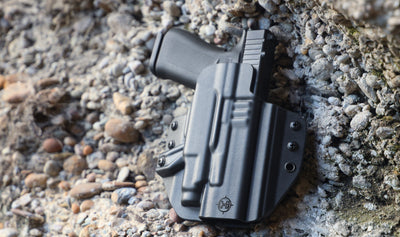
OWB is the oldest carry method. The holster sits on the outside of the belt, standard for duty use, open carry, and range work. It offers the fastest average draw at 0.8 to 1.1 seconds, but it's the least concealable option. You'll need a jacket, vest, or cover garment to hide an OWB rig.
AIWB (Appendix Inside the Waistband)
AIWB positions the firearm at 12 to 2 o'clock, in front of the hip. It's the fastest concealed draw position at 1.0 to 1.3 seconds and provides the deepest concealment when seated or driving. The tradeoff: AIWB demands a rigid, non-collapsible holster mouth for safe reholstering. A floppy holster opening at the appendix position is a non-starter.
With 29 states now operating under Constitutional Carry laws and roughly 20 million Americans carrying concealed, first-time carriers are encountering these terms with no formal training. Knowing your carry position is step one.
Key Holster Features: Wing, Wedge, Cant, Ride Height & Retention
This is where most confusion lives, and where getting it wrong costs you the most. Our founder, a retired Law Enforcement Officer and Master Firearms Instructor, has spent years correcting these misunderstandings on the range. These aren't textbook definitions. They're field-tested distinctions.
Claw (Concealment Wing / Anti-Print Wing)
A holster claw is an attachment that uses belt pressure as a lever to rotate the firearm's grip inward toward the body. It reduces printing. It does not retain the firearm. Conflating these two functions is one of the most common and most dangerous setup mistakes we see. Retention is handled separately by the holster shell and retention screws.
Wedge
A holster wedge is a curved piece of foam or leather attached to the back of the holster body. It uses body pressure (not belt pressure) to tilt the muzzle end inward, improving comfort and grip angle. The claw works horizontally against the belt. The wedge works vertically against the torso. Different forces, different axes, complementary results.
Claw + Wedge: The System
Using a claw and wedge together is the most effective combination for deep concealment, especially for AIWB carry with a full-size pistol. The claw manages the sideways grip angle; the wedge manages the vertical tilt. Treat them as a system, not as either/or options. Most glossary guides miss this entirely.
Cant
Cant is the angle at which the firearm sits relative to vertical. Zero cant means straight up and down. The FBI cant is approximately 15 degrees forward, the industry standard for strong-side carry. That 15-degree angle matches the natural arc of your arm during a draw stroke. Most concealed carry holsters default to this angle for good reason.
Ride Height
Ride height is the vertical position of the firearm relative to the beltline. High ride draws faster but risks more printing. Low ride conceals better but slows the draw. Mid ride is the most common balance point for everyday carry.
Here's what most guides get wrong: ride height and cant must be tuned together. Adjusting one without the other throws off your draw stroke geometry. They're not independent variables.
Retention
Retention refers to how securely the firearm is held and how much force is required to draw it. Modern Kydex holsters use adjustable retention screws near the trigger guard so you can dial in draw resistance to your exact preference. This is distinct from passive friction fit. New carriers frequently leave retention at factory settings without realizing they can (and should) customize it to match their draw strength and carry requirements.
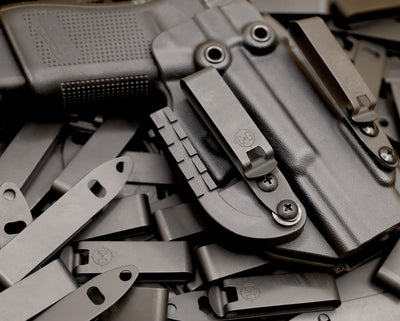
For existing IWB holster owners looking to address cant stability, ride height consistency, and claw function in a single upgrade, the IWB ALPHA Upgrade Kit combines metal clips with an integrated concealment wing, covering multiple variables in one attachment.
Holster Styles and System Configurations
Sidecar Holster
A sidecar holster is an AIWB configuration with an integrated magazine carrier attached directly to the holster body. You draw the firearm and access a spare magazine from the same front-of-waistband platform. Despite being the dominant AIWB setup for competition and duty use, sidecar configurations are almost entirely absent from competitor glossary content.
Light-Bearing Holster
A light-bearing holster is molded specifically around a pistol with a weapon-mounted light already attached. The light must be physically mounted on the firearm for the holster to fit correctly. Ordering a standard holster for a light-equipped pistol is one of the most common and costly buyer mistakes in the market. If you run a WML, you need a holster built for that specific gun-and-light combination.
Open-Bottom Holster
An open-bottom holster allows the muzzle to extend past the holster body, accommodating threaded barrels, compensators, and suppressor-height sights. Without this feature, a pistol with a comp or threaded barrel simply won't seat properly in a standard shell.
Fit and Compatibility Terms Every Buyer Must Know
Optics-Ready Holster
An optics-ready holster features a dedicated optic cut (RMR cut or MOS cut) that allows the holster to accommodate a red dot sight on the pistol slide without obstructing retention or draw. In 2026, with the Glock MOS, SIG P320 RXP, and Springfield Hellcat Pro as mainstream carry platforms, an optic cut is a baseline expectation, not a premium upgrade. A standard holster will not properly seat a red-dot-equipped pistol.
Model-Specific Fit
A model-specific holster is molded to the exact dimensions of one firearm, providing precise retention at the trigger guard and muzzle. "Fits most" or universal holsters rely on generic geometry and consistently underperform in trigger guard coverage, retention consistency, and draw repeatability. This is exactly why C&G holsters are CNC-machined from custom aluminum molds by a team of veterans, LEOs, and competitive shooters. Precision at the mold level is what makes a model-specific Kydex holster from an American manufacturer fundamentally different from a mass-produced universal option.
Passive vs. Adjustable Retention
Passive retention is the friction or mechanical lock built into the Kydex shell itself. Adjustable retention means you can tighten or loosen a screw near the trigger guard to customize draw force. New carriers frequently don't know what "adjustable retention" means in practice and default to factory settings that may not match their draw strength or duty requirements. Take the time to adjust it.
Put the Terms to Work: Build a Setup That Carries Right
A holster is a system. Cant, ride height, claw, wedge, and retention all interact. Getting one wrong means the whole setup works against you. Here's a quick-reference recap:
- Claw = grip rotation via belt pressure
- Wedge = muzzle tilt via body pressure
- Cant = grip angle relative to vertical
- Ride height = firearm position relative to belt
- Retention = draw force (adjustable via screws)
- Optic cut = red dot clearance
- Open bottom = barrel/comp clearance
The terminology gap is real. According to the CPRC 2025 Report, roughly 20.88 million Americans hold active concealed carry permits, and 29 states now have permitless carry. Most first-time carriers are setting up holsters without ever taking a formal class. Knowing these terms is the foundation of a safe, effective carry system.
Use this glossary as a reference when reading product pages, configuring a new holster, or helping a new shooter get set up correctly. The right terminology leads to the right setup, and the right setup is one you'll actually carry every day.
Want a holster without the custom wait? Browse our QUICKSHIP holsters, ready to ship.
Sources
- What is a Holster Claw? — DARA Holsters
- Holster Claw vs Wedge: What's the Difference — CYA Supply
- The Keel Principle: AIWB Comfort (Wedge + Claw) — Cloudster Pillow
- The 15-Degree Difference: Holster Cant and Ride Height — Eclipse Holsters
- Holster Adjustments Explained — Hilliker Holster Co.
- Best Concealed Carry Holsters: IWB, OWB, AIWB Tested — American Firearms
- How Constitutional Carry Is Reshaping America — Concealed Carry Inc.
- Holster Industry Terms Explained — JustHolsterIt
- 2026 Kydex Holster Technology — Warriorland
- Kydex Holsters: The Definitive Guide — Pinnacle Concealment
- Concealed Carry Permit Holders 2025 — Crime Prevention Research Center (CPRC)





Jätä kommentti