


Your Holster Is Printing — And Repositioning Won't Fix It
You notice the outline of your grip pressing through your shirt, so you shift the holster forward. Then backward. Then you try a different clock position entirely. The printing doesn't stop, and now you're uncomfortable too.
The problem isn't where you carry. It's holster geometry.
According to GunsAmerica, roughly 30.9% of likely voters now carry a concealed handgun at least occasionally, up from 24.3% in late 2024. That's millions of new carriers entering the fold, many without formal training on concealment optimization. The mechanical solution isn't a new carry position. It's two attachments that work on completely different axes of rotation: the concealment wing and the holster wedge. By the end of this article, you'll understand the physics behind both, why they work together as a system, and how to choose the right setup for your holster.
What Is a Holster Wing and How Does It Work?
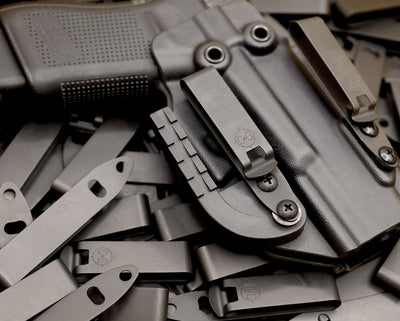
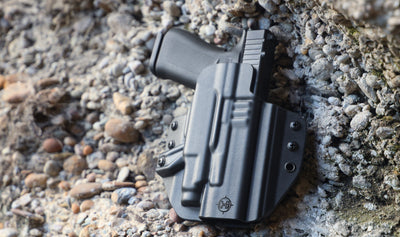
A concealment wing (also called a holster wing or mod wing) is a rigid attachment that mounts near the trigger guard on the belt-facing side of an IWB holster. It's not a retention device. It doesn't change your carry position. It is purely a concealment tool that works as part of the holster-and-belt system.
Here's the mechanics: when you thread your belt over the holster, the wing presses against the inside of the belt. That pressure creates leverage that rotates the firearm's grip horizontally inward, pushing it closer to your torso. The grip is almost always the part that prints, and the claw addresses it directly by tucking it in on the horizontal plane.
One critical variable most carrier-facing content ignores is rigidity. A thicker, stiffer wing that does not flex under belt pressure generates significantly more rotational torque than thinner, flexible alternatives. If the wing bends when the belt pushes against it, the leverage is lost. The same principle applies to the belt itself. A soft, flexible belt gives the wing nothing solid to press against, producing minimal torque. A rigid gun belt is non-negotiable.
The practical payoff is real. A properly designed wing can make full-size pistols viable for everyday concealed carry under lighter garments, as noted by Hilliker Holster Co., by rotating the grip close enough to the body that it no longer pushes fabric outward.
What Is a Holster Wedge and How Does It Work?
A holster wedge is a shaped foam or polymer pad placed on the body-facing side of an IWB holster, typically near the muzzle end. Think of it as a fulcrum. When the wedge presses against your body, it pushes the muzzle slightly outward, which forces the grip to rotate inward on the vertical plane.
This is a different axis of rotation than the wing. The wing works horizontally (grip inward toward the torso via belt pressure). The wedge works vertically (muzzle out, grip in via body pressure). They are not interchangeable. They are complementary, as explained by Cloudster Pillow.
Beyond concealment, the wedge redistributes pressure across a broader contact area. For law enforcement officers and professionals on extended shifts, that pressure redistribution translates to all-day wearability, especially during seated carry where the muzzle can dig into the thigh or groin area.
Wedges work with any IWB position: appendix, strong-side, or kidney. They're especially effective for AIWB carry, where muzzle angle and comfort are the primary concerns. According to Vedder Holsters, the combination of muzzle tilt and pressure relief makes the wedge a go-to for appendix carriers who need to sit, drive, and move comfortably throughout the day.
Why You Need Both: The Wing and Wedge Work on Different Planes
The core insight: the wing rotates the grip inward on the horizontal plane. The wedge rotates the muzzle outward on the vertical plane. Together, they address both axes of printing simultaneously.
Using only a wing leaves vertical printing unaddressed. The grip may tuck in, but the muzzle angle can still push the bottom of the holster outward. Using only a wedge handles muzzle tilt but leaves horizontal grip flare wide open. The combination closes both gaps without changing your carry position.
Optimal concealment is a three-part system: a quality rigid belt, a properly designed wing, and a correctly positioned wedge. Each component enables the others. Remove the rigid belt and the claw can't generate torque. Remove the wedge and the vertical axis goes unmanaged. Remove the claw and the grip still flares out under your shirt.
Most online content treats wings and wedges as competing options or interchangeable accessories. They aren't. They are mechanically distinct tools that solve different problems, and serious carriers use both.
Single-Axis vs. Dual-Axis Wing Design: Why Most Wings Only Solve Half the Problem
Most wings on the market operate on a single axis. They press against the belt to rotate the grip inward on the horizontal plane, and that's where their engineering stops. It's a useful function, but it only addresses one dimension of printing.
The C&G Darkwing and Lightwing are different. Co-developed with Dark Star Gear, both are engineered to rotate the holster into the body on two different axes simultaneously. That dual-axis rotation is not found in standard single-plane wings anywhere else on the market.
Darkwing (for Standard, Non-Light-Bearing COVERT Holsters)
The Darkwing mounts between the dustcover and trigger guard. It's thicker than competing wings, which means it does not flex under belt pressure. That rigidity translates directly to more torque on the grip. Its angled wing geometry also introduces a slight muzzle tilt, tucking the grip end more effectively than flat-profile designs. This is a product of our 6th-generation holster design process, where every iteration refines the engineering based on real-world feedback from our team of U.S. Military Veterans, LEOs, and competitive shooters.
Lightwing (for TACTICAL Light-Bearing Holsters)
The Lightwing mounts below the weapon-mounted light near the trigger guard. It features an angled lever that provides a light outward kick on the muzzle in addition to rotating the grip inward. It acts on both the grip axis and the muzzle axis simultaneously, making it especially effective for concealing the bulkier profile of a WML-equipped pistol.
Compatibility Warning
This matters: using the wrong wing on the wrong holster can cause premature cracking and holster damage. The Darkwing is for non-light-bearing holsters. The Lightwing is for light-bearing holsters. Never mix them. We'd rather you buy the right part once than replace a damaged holster.
If you're looking for the most direct path to dual-axis concealment without buying a new holster, the ALPHA Upgrade Kit bundles the Darkwing or Lightwing with 1.75-inch CNG or 1.5-inch DCC metal belt clips as a complete concealment upgrade package for ALPHA-Upgradeable C&G holsters.
Putting It Together: Choosing the Right Setup for Your Carry Style
Start with a straightforward decision: if you carry a standard non-light-bearing setup, the Darkwing is your claw. If you carry with a weapon-mounted light, the Lightwing is the correct choice. Do not mix them.
Body type plays a role. For slimmer builds, the claw alone may provide sufficient grip tuck. For fuller builds, or for carriers with more natural gap between the beltline and torso, combining the claw with a properly positioned wedge delivers the most consistent concealment across standing, sitting, and bending.
Carry position matters too, but less than you might think. For strong-side and kidney carry, the wedge placement shifts, but the mechanical principle is identical: muzzle out, grip in. The wing still handles horizontal grip rotation regardless of position. The physics don't change just because the clock position does.
For law enforcement, military, and executive protection professionals carrying for extended shifts, the wedge's pressure redistribution benefit is as important as the concealment benefit. C&G's founder, a retired Law Enforcement Officer and Master Firearms Instructor, built this company around the reality that duty carry demands both invisibility and comfort over 10, 12, or 16-hour days. Both matter for performance.
One more point worth repeating: even the best wing produces minimal torque against a soft, flexible belt. A rigid gun belt is a non-negotiable part of the concealment system.
The Standard Has Been Set. Carry Like It.
The concealment wing handles horizontal grip rotation via belt pressure. The holster wedge handles vertical muzzle tilt via body pressure. Together, they eliminate printing on both axes without changing your carry position.
Most wings on the market address only one plane. The Darkwing and Lightwing are engineered to work on two axes simultaneously, producing a compound concealment effect that single-plane wings cannot replicate.
With 20.88 million active permit holders and 29 constitutional carry states, more Americans are carrying than ever before. Carrying effectively and invisibly is a skill, and the right hardware makes it achievable. Explore the ALPHA Upgrade Kit or check C&G's holster compatibility resources to find the right wing for your specific setup.
Sources
- More Americans Are Carrying Concealed Handguns — GunsAmerica (CPRC 2026 Survey)
- Concealment Claws and Wings — Hilliker Holster Co.
- AIWB Holster Claw vs Wedge vs Pillow Guide — Cloudster Pillow
- Holster Wedge vs Holster Claw — Vedder Holsters
- Dark Wing Product Page — Dark Star Gear
- CPRC's Latest Report on Concealed Carry — NRA-ILA





Jätä kommentti