


Your Holster Has a Mission — Does Your Carry Style Match It?
Your holster doesn't have one job. It has a mission. And the wrong carry style for your mission is the most expensive mistake you can make.
The decision between OWB and IWB isn't about personal preference. It's driven by your role, your environment, and your firearm configuration. Kydex now dominates the holster market, accounting for nearly 42% of modern holster designs, because it delivers consistency, weather resistance, and zero-maintenance performance that leather simply can't match.
This article breaks the OWB vs. IWB decision into four distinct missions: civilian EDC, duty and patrol, range and competition, and off-duty law enforcement carry. Each mission has a distinct optimal answer. With weapon-mounted lights, red dot optics, and compensators now standard on many carry guns, there's a third variable most guides ignore entirely.
What Makes a Kydex Holster Mission-Ready: The Non-Negotiables
Before you choose OWB or IWB, every quality Kydex holster must meet four universal standards: full trigger guard coverage at all times, secure retention under movement, a consistent and repeatable draw stroke, and a precise model-specific fit. No exceptions. If your holster fails any one of these, it fails the mission.
Here's a technical detail most guides skip. IWB holsters are typically built from .080" Kydex to reduce profile and improve comfort against skin. OWB duty holsters use .093" Kydex for added rigidity, durability, and retention stability. At C&G Holsters, our 6th-generation designs are built on CNC aluminum molds that account for these thickness differences at the engineering level, not as an afterthought.
Kydex retention stability exceeds leather by more than 20%. For life-safety applications, that margin matters every single day.
Understanding the difference between passive and active retention is critical. Passive retention relies on friction to hold the pistol in place and is the standard for civilian IWB holsters. Active retention uses mechanical devices such as thumb-release Level II or Level III mechanisms and is standard for duty OWB rigs. The threat profile determines which system you need.
Optic-ready and light-bearing cuts are no longer optional upgrades. As of 2026, they're standard across both OWB and IWB platforms. If your holster maker treats them as add-ons, they're behind the curve.
OWB Holsters: Built for Duty, Speed, and All-Day Comfort
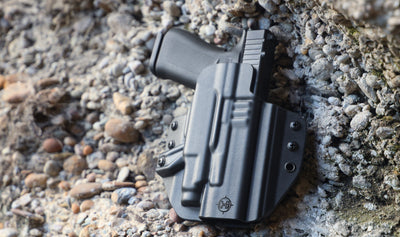
With OWB carry, the firearm rides outside the waistband, fully exposed or covered by an outer garment, with the belt supporting the holster body. It's the standard for uniformed law enforcement patrol, open carry, range training, and competitive shooting. In these roles, rapid draw speed and comfort outweigh concealment needs.
OWB offers three ride height configurations that make it far more adaptable for tactical applications:
- Standard: Trigger guard sits at the beltline.
- Duty drop: Grip sits at the beltline for easier draw under body armor and gear.
- Thigh rig: Holster mounts to the leg for maximum clearance from chest-mounted equipment.
Active retention systems are non-negotiable for duty OWB. Level II (thumb-release) and Level III mechanisms exist because officers face real gun-grab threats. The National Institute of Justice has developed updated standards specifically for duty holster retention capabilities, recognizing how critical secure weapon retention is for law enforcement. As our founder, a retired Law Enforcement Officer and Master Firearms Instructor, puts it: retention isn't a feature. It's a survival requirement.
Comfort is another OWB advantage that gets overlooked. Because the belt doesn't pull the holster tightly against skin, OWB is ideal for physically demanding jobs, full-duty shifts, trail carry, and hunting. Firearms equipped with weapon-mounted lights, compensators, or extended magazines are also more practically carried OWB, where the holster body can accommodate the added footprint without pressing hardware into your body.
IWB Holsters: The Concealed Carrier's Primary Tool
IWB carry positions the holster and firearm inside the waistband, below the beltline. Only the grip requires concealment by clothing, making IWB the dominant choice for civilian concealed carry. Roughly 58% of total holster demand is linked to concealed carry applications, and IWB is the primary vehicle for that demand.
The tradeoffs are real, and you should know them upfront. IWB typically requires pants one size larger to accommodate the holster and firearm. Kydex pressing against skin during extended wear can cause discomfort, especially in hot climates or during physical activity. These are solvable problems, but they require honest planning.
Appendix IWB (AIWB) carry at the 12 to 1:30 o'clock position deserves specific attention. It's favored by vehicle operators, truck drivers, and desk workers because the firearm remains accessible while seated. Strong-side IWB gets pinned between your body and the chair. AIWB doesn't.
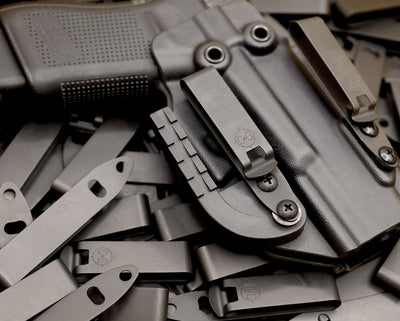
For carriers running weapon-mounted lights or red dots who still need concealment, optic-cut IWB holsters with concealment claws are a growing solution. It's a more complex setup than standard IWB, but it works when the holster is built to spec.
With 29 states now operating under constitutional carry laws, 157.6 million Americans can legally carry without a permit. Many new carriers entering the market are choosing IWB as their first holster, which makes proper fit and retention education more critical than ever. A poorly fitted IWB holster in the hands of a new carrier is a liability, not a tool.
Matching Carry Style to Mission: A Decision Framework
Forget generic pros and cons lists. Your mission dictates your carry style. Here's how to match them:
Mission 1: Uniformed LE/Patrol. OWB with Level II or Level III active retention. This is the only appropriate choice. Draw speed, retention security, and all-day duty comfort are non-negotiable. Period.
Mission 2: Civilian EDC/Concealed Carry. IWB or AIWB Kydex is the standard answer. Body type, wardrobe, climate, and how much time you spend seated should drive your position selection between strong-side and appendix.
Mission 3: Range Training and Competitive Shooting. OWB is strongly preferred. Unrestricted draw, comfort during extended sessions, and compatibility with competition rigs and timer-based drills make it the clear winner.
Mission 4: Off-Duty LE or Military Veteran EDC. IWB for deep concealment in plainclothes. OWB when you're in a permissive environment. This is where the "own both" strategy becomes the professional standard.
Mission 5: Trail Carry, Hunting, or Outdoor Work. OWB wins for comfort, accessibility, and compatibility with firearms carrying optics or lights in field conditions.
A note on modular holster platforms: about 22% of manufacturers launched convertible IWB/OWB systems between 2023 and 2025. While modular systems offer flexibility, dedicated OWB and IWB designs built to spec consistently outperform convertible compromises for mission-critical use. When your life depends on the draw, you want purpose-built gear.
The "Own Both" Strategy: Building a Two-Holster System
Experienced carriers, including LE officers, military veterans, and serious civilian shooters, increasingly maintain separate IWB rigs for daily concealed carry and OWB rigs for range, duty, or open carry around the same firearm platform.
Think of it as a system investment, not a single-item purchase. One pistol. Two precision-fit Kydex holsters. Zero compromises in either role.
Here's why this works: precision-fit Kydex holsters built on CNC aluminum molds ensure the draw stroke and muscle memory transfer between holsters. The fit and retention are consistent across both. For anyone who trains seriously, that consistency is everything.
C&G Holsters makes building a two-holster system practical. Our Quickship program ships in 5 business days, and our fully custom Kydex options cover nearly every handgun on the market. No long lead times. No guesswork.
This is the approach taken by the professionals who staff C&G Holsters every day: active and veteran law enforcement officers, competitive shooters, and military personnel who carry daily and refuse to compromise.
Choose the Right Carry Style — Then Demand the Right Fit
OWB vs. IWB is not a debate about which is better. It's a decision about which serves your specific mission, your body, and your firearm configuration.
Whatever carry style you choose, the holster must cover the trigger guard fully, retain the pistol securely, and deliver a consistent draw every time. No exceptions.
C&G Holsters was built by a retired Law Enforcement Officer and Master Firearms Instructor who understood that the holster is half the system. The people who carry for real missions deserve precision-fit gear built by people who've lived those missions. That's the standard behind every holster that comes off our CNC molds, driven by our commitment to Faith, Family, and Service.
For All That You Hold Close: identify your mission first, select the carry style second, then find the model-specific Kydex holster built to match. In that order.





Hinterlassen Sie einen Kommentar