


Why Your Hip Holster Is Working Against You in the Backcountry
A hip holster works fine at the range. It works fine on a grocery run. But strap on a 40-pound pack with a hip belt cinched tight, layer up for a cold morning in elk country, and that waistband draw you've practiced a thousand times becomes physically impossible. Your sidearm is buried under nylon, Gore-Tex, and compression straps. In bear country, that's not an inconvenience. It's a critical failure point.
The numbers back this up. Bear encounters on the Appalachian Trail jumped 75% in 2025, with 42 reported incidents compared to 24 the year before, according to Backpacker Magazine. Hikers account for 40% of non-fatal bear attack victims, per the World Animal Foundation. Accessibility of your sidearm is a life-safety issue, not a preference.
Chest carry solves the problem at its root. Your firearm rides above pack interference, stays accessible through heavy gloves, and can be drawn from a seated position in a tree stand, ATV, or UTV. Weight distributes across your upper body instead of grinding on your hips and lower back over a 12-mile day. The DENALI was purpose-built for exactly this scenario, engineered from the ground up for modern backcountry carry demands.
What Makes the C&G DENALI Different from Other Chest Holsters
Most chest holsters on the market are hand-formed nylon or ballistic fabric stretched over a semi-rigid frame. They work until they don't. The DENALI takes a fundamentally different approach. Every shell is CNC-machined to .003-inch precision from custom aluminum molds, the same manufacturing process we use for our duty holsters. That's a verifiable, repeatable tolerance that produces a consistent draw every single time.
Retention is solid and definitive. When your firearm seats, you get an audible and tactile click confirming it's locked in place. You know your gun is secured without looking down, which matters when you're moving through rough terrain or glassing a ridgeline.
The Kydex construction is built for punishment. Kydex is an acrylic-PVC thermoplastic that resists moisture, heat, and impact. It's antimicrobial and requires nothing more than a wipe-down with cool soapy water after days in the field. For multi-day backcountry exposure, the durability gap between Kydex and nylon competitors is enormous.
The DENALI's open-bottom design accommodates threaded barrels and compensators. The tall sight channel clears suppressor-height sights and popular red dot optics, including the Trijicon RMR, Leupold DeltaPoint, and Sig Romeo. Most traditional chest holsters can't say the same, forcing shooters running modern pistol setups to compromise.
Every DENALI is 100% American-made by Veterans and Law Enforcement professionals. Our founder, a retired Law Enforcement Officer and Master Firearms Instructor, built this company on the principle that gear for high-stakes environments must meet duty-grade standards. With over 4,200 customer reviews and a lifetime guarantee, the DENALI is no recreational afterthought. Explore both the Quickship version (black, ships in 5 days) and the fully custom version (your choice of color, orientation, and configuration) in the DENALI collection.
Step-by-Step: How to Set Up Your DENALI Chest Holster
Getting the DENALI dialed in takes about five minutes. Rushing through setup costs you comfort and draw speed for every hour you wear it. Here's how to do it right.
Step 1: Strap Adjustment. Set the harness height so the holster sits centered over your sternum. Pull it snug against your rib cage. A loose chest holster bounces when you move and shifts your draw angle. Snug is the word: not tight enough to restrict breathing, but firm enough that the holster stays put when you jog or climb.
Step 2: Back Swivel Placement. Center the swivel back piece on your spine between your shoulder blades. This is the anchor point for the entire system. If it drifts to one side, the holster will shift laterally during movement, pulling your draw off-center.
Step 3: Shoulder Orientation. Adjust which shoulder the strap crosses based on your dominant hand and preferred draw angle. The DENALI's strap system accommodates either side, so left-handed shooters get the same setup quality as right-handed ones.
Step 4: Retention Screw Tuning. Use the retention screws to match your draw preference. You want enough resistance to hold the firearm securely during physical activity (scrambling over deadfall, bending to cross a fence) while keeping the draw smooth enough for a clean, one-handed presentation.
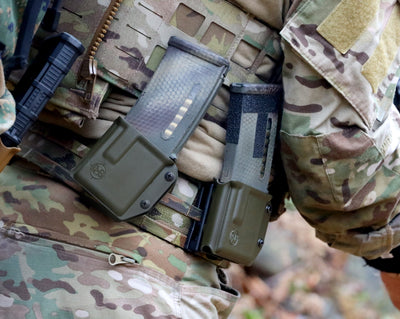
Step 5: MOLLE Configuration. Attach your field essentials to the integrated MOLLE webbing. A magazine pouch, compact flashlight, or fixed-blade knife can mount directly to the platform. Think of the DENALI as a modular chest system, not just a holster.
Step 6: Layering Compatibility. If you're running a bino harness, chest pack, or camera strap, slide the DENALI strap under the arm to coexist with your existing chest-mounted gear. The system was designed for this exact scenario, maintaining full draw access without competing for chest real estate.
Best Use Cases: When the DENALI Is the Right Call
Hunting. In a tree stand, running a spot-and-stalk, or riding horseback into a unit, hip holsters are often inaccessible. A stand harness blocks your waistband. A saddle makes a hip draw awkward at best, dangerous at worst. Chest carry is the dominant method among the roughly 3 million Americans who hunt with a handgun, and for good reason.
Backcountry Hiking and Backpacking. Bear encounters in the contiguous U.S. have risen roughly 15% over the past decade. For serious wilderness travelers covering miles with a loaded pack, accessible sidearm carry has become a practical necessity, not an afterthought.
Fly Fishing in Waders. Waistband carry is physically impossible in chest waders. The DENALI keeps your sidearm accessible above the waterline without interfering with your wading gear or casting motion.
ATV, UTV, and Vehicle Carry. Drawing from a hip holster while seated and belted in is awkward, slow, and often blocked entirely. Chest carry allows a natural, unobstructed draw from any seated position.
Mountain Biking and Cross-Country Skiing. Dynamic movement and constant body position changes make waistband carry impractical. A chest-mounted holster stays stable and accessible regardless of your posture or angle.
A note on limitations: Chest holsters are open-carry platforms built for outdoor and tactical environments, not concealed urban carry. If you need a discreet profile in town, a shoulder holster is the more appropriate tool for that job.
The MOLLE Ecosystem: Building a Modular Chest Platform
The DENALI's integrated MOLLE webbing turns it into more than a holster. It becomes a chest-mounted gear hub, and on extended backcountry trips, every attachment point matters.
Recommended attachments include a single-stack or double-stack magazine pouch for field reloads, a compact flashlight for low-light hunting or camp navigation, and a fixed-blade knife for field dressing or emergency use. These mount directly to the webbing without additional adapters.
One configuration principle to follow: keep the draw path clear. Mount accessories to the sides and lower webbing, never directly in front of the grip. A blocked draw path defeats the entire purpose of chest carry.
This modular approach fits how modern hunters think about their gear. According to Statista, there are roughly 16 million hunting license holders in the U.S., and 70% of modern hunters incorporate digital tools and systems-based thinking into their pursuits. The DENALI fits that mindset. It's a platform, not a single-purpose accessory.
Contrast this with nylon competitors: soft-sided holsters lack the structural rigidity to support MOLLE-mounted accessories without sagging or shifting under load. Kydex holds its shape, which means your attached gear stays exactly where you put it.
Is the DENALI Right for You?
The DENALI is built for hunters (especially handgun hunters), backcountry hikers, horseback riders, ATV and UTV operators, fly fishers, and anyone whose pack system conflicts with waistband carry. It's also well-suited for competitive shooters running optic-equipped or compensator-fitted pistols who need a chest rig that accommodates modern configurations.
It's not the right tool for concealed carry in urban environments or any situation requiring a discreet profile. We'd rather tell you that upfront than have you buy the wrong piece of gear.
With approximately 20.88 million concealed carry permit holders in the U.S. and 29-plus constitutional carry states, a growing number of Americans are legally carrying in the field. The DENALI serves that expanding outdoor carry audience with the precision, durability, and modularity the backcountry demands.
Every DENALI ships with a lifetime guarantee, backed by American craftsmanship and a team of Veterans, LEOs, and competitive shooters who build gear they'd stake their own safety on. That's the standard we set, and it's the standard we hold.
Sources
- Backpacker Magazine — Bear Reports Nearly Doubled on the Appalachian Trail in 2025
- World Animal Foundation — Bear Attacks Statistics
- RAND Corporation — How Gun Policies Affect Hunting and Recreation
- Statista — Hunting in the U.S.: Statistics & Facts
- NRA-ILA / CPRC — Concealed Carry Permit Holders Across the United States 2025





Hinterlassen Sie einen Kommentar