


You Think You're Armed. You're Not.
There's a difference between carrying a firearm and being ready to use one. If your gun is buried in a purse, stuffed in a backpack, or zipped inside a fanny pack, you may feel armed. Feeling armed and being effectively armed are two very different things.
Off-body carry means any method where the firearm is not physically attached to your body. With over 22.3 million active concealed carry permits in the United States, according to DataIntelo, millions of Americans are making this carry decision every single day.
This article, informed by the firsthand experience of C&G Holsters' founder, a retired Law Enforcement Officer and Master Firearms Instructor, is not a balanced pros-and-cons breakdown. It's an evidence-backed safety argument. Off-body carry creates a false sense of armed readiness that can get you killed. Here are the three critical failure points: control and retention, draw speed and muscle memory, and the "set it down" vulnerability.
The Retention Failure: How Off-Body Carry Disarms You
A firearm in a bag is only as secure as the bag itself. Bags are snatched, grabbed, and stolen constantly. A single purse-snatch doesn't just disarm you; it arms your attacker. That scenario is impossible with a properly retained on-body holster.
The scale of this problem is staggering. An estimated 253,491 guns are stolen from private gun owners per year (2019–2023 average), with the majority taken from cars and bags, according to The Trace and ATF data. Those stolen firearms don't vanish. They enter the pipeline of criminal use. Off-body carry is not just a personal risk; it's a community safety problem.
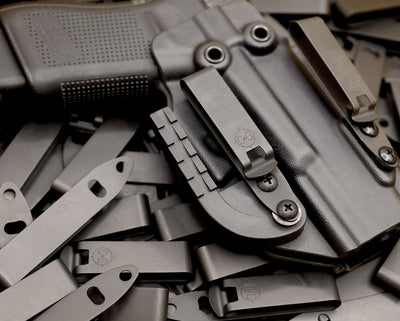
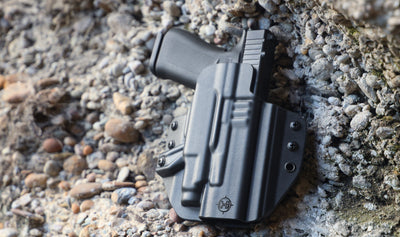
A precision-fit Kydex holster uses adjustable passive retention through friction and tension screws. You can tune the balance between security and draw speed to your exact preference. Compare that to a bag compartment or a soft generic holster stuffed inside a purse: zero meaningful retention. Nothing stopping the gun from shifting, falling, or being grabbed.
Full trigger guard coverage in a precision-fit Kydex holster is a non-negotiable safety requirement, not a nice-to-have feature. As noted in the GunTransfers.com 2026 Holsters Guide, rigid trigger guard protection prevents any object from contacting the trigger while holstered. A bag compartment offers nothing close to this level of protection.
The Draw Time Penalty: When Seconds Are Measured in Feet
The Tueller Drill established a benchmark every serious carrier should know: an average person can sprint 21 feet in approximately 1.5 seconds. That's the same window a trained on-body carrier needs to draw and fire. According to S2 Strategic Defense, trained carriers achieve draw-to-first-round times of approximately 1.5 to 1.77 seconds from an on-body holster.
Now consider the off-body draw. You have to locate the bag, orient it, unzip or unbuckle the compartment, find the grip, clear the firearm, and present it on target. That process adds multiple seconds of fumbling and repositioning — seconds that simply do not exist when a threat is closing distance at a full sprint.
There's a neuroscience dimension here that matters. Under adrenal stress, your brain doesn't reach for its most recently learned motor pattern. It reverts to its most practiced, most instinctive one. As ConcealedCarry.com explains, off-body carry defeats muscle memory because the bag shifts position constantly: on a shoulder, on a table, on a car seat, on the floor. The draw stroke is never the same twice. You cannot train a reflex-level response to a position that changes every time you sit down.
A fixed on-body Kydex holster solves this completely. The firearm is always in the same position relative to your body, enabling a consistent, repeatable, one-handed draw stroke you can train until it becomes automatic. Polymer and Kydex-based holsters now account for nearly 42% of modern holster designs, according to Business Research Insights. That market share is driven by retention stability and consistency advantages that soft holsters and bag compartments cannot match.
The "Set It Down" Problem: Every Time You Put the Bag Down, You Stop Being a Carrier
This is the most underexplored vulnerability in off-body carry. The moment you set the bag down, at a restaurant, a gym, a friend's house, or in your vehicle, you have surrendered physical control of your firearm entirely. You are no longer a carrier. You are a person who left a loaded gun unattended.
That unauthorized access window has real, documented consequences. Children have accessed firearms stored in purses and backpacks, with fatal results. One documented case involved a toddler unzipping a dedicated firearm pocket in a purse and fatally discharging the weapon. Between 2015 and 2021, 713 children aged 17 and younger died from unintentional gun injuries, and the rate of unintentional gun deaths among children under 18 increased 82% during that period, according to peer-reviewed research published in PMC. In 99% of accidental firearm deaths of children ages 0 to 5, the gun had been stored both loaded and unlocked, as reported by CBS News, conditions directly mirrored by an unsecured off-body carry firearm sitting in a bag.
The legal exposure is real, too. In many states, leaving a firearm accessible to a minor, even inside a bag, violates child access prevention laws, creating criminal liability for off-body carriers who set their bag down around children.
On-body carry with a precision-fit Kydex holster eliminates this vulnerability entirely. The firearm stays on your body, under your physical control, at all times. For carriers who cite comfort as their reason for choosing off-body carry, C&G Holsters' IWB COVERT lineup, available in both Quickship and fully custom configurations, is built to solve the comfort objection without sacrificing any of the safety advantages of on-body carry.
The On-Body Solution: What a Precision-Fit Kydex Holster Actually Gives You
On-body Kydex carry delivers four concrete advantages over off-body carry: continuous retention, consistent draw position, full trigger guard coverage, and safe one-handed re-holstering. That last point deserves attention. Unlike a collapsed soft holster or bag compartment, a Kydex holster holds its shape open, enabling safe one-handed re-holstering without sweeping your own body. That's a critical safety feature soft materials simply cannot provide.
Kydex maintains its rigid shape indefinitely. It doesn't warp in heat, sag from sweat, or stretch over time like leather or nylon. Your holster performs the same on day one as it does on day one thousand, in any weather, any climate.
At C&G Holsters, that performance is engineered by people who stake their lives on it. Founded by a retired Law Enforcement Officer and Master Firearms Instructor, every holster is crafted using CNC aluminum molds and American-made materials for a precision fit that eliminates guesswork. Now in their 6th generation of holster designs, C&G's team of U.S. Military Veterans, Law Enforcement Officers, and competitive shooters carries on-body daily. The safety claims in this article are not theoretical; they're grounded in decades of lived experience.
The comfort objection? A properly fitted IWB Kydex holster, selected for your specific handgun model and body type, eliminates the discomfort argument that drives people to off-body carry in the first place. The right holster disappears on your body. The wrong carry method can make you disappear from your family.
Carry Like Your Life Depends on It — Because It Does
Off-body carry is not a carry method. It is intermittent, conditional armed readiness that fails at the worst possible moment. You can be disarmed by a bag snatch. You cannot draw fast enough when seconds are measured in feet. And every time you set the bag down, you stop being a carrier.
If you carry for the people you love, carry with the seriousness that responsibility demands. Evaluate your current carry method honestly against the safety benchmarks covered here. If it falls short, change it.
The numbers tell the story: 22.3 million permit holders and growing, with IWB holsters holding 45% of the market, according to Verified Market Research. More people are choosing on-body carry because the evidence is clear. The only question is whether you'll make the same choice before it matters.
Sources
- DataIntelo Holster Market Research Report
- The Trace — Missing Pieces: Stolen Guns and Violent Crime
- GunTransfers.com — Best Holsters for Concealed Carry in 2026
- S2 Strategic Defense — Open Carry vs Conceal Carry
- ConcealedCarry.com — Off Body Carry: What Do You Have To Overcome
- Business Research Insights — Concealed Gun Holsters Market Report
- PMC — #NotAnAccident Index of Unintentional Shootings by Children
- CBS News — Hundreds of Young Children Killed Playing with Guns
- Giffords Law Center — Child Access & Safe Storage
- Verified Market Research — Gun Holsters Market





Hinterlassen Sie einen Kommentar