


What LEOSA Actually Authorizes — and What It Doesn't
LEOSA (18 U.S.C. § 926C), commonly known as HR-218, was signed into law on July 22, 2004. It authorizes qualified retired law enforcement officers to carry a concealed firearm nationwide, overriding most state and local concealed carry restrictions. That single sentence carries enormous weight, but it comes with strict conditions.
To carry under LEOSA, a retired officer must meet four requirements: a minimum of 10 years of law enforcement service, separation from the agency in good standing, a photographic ID issued by the former agency, and proof of annual firearms qualification completed within the last 12 months. According to the US Concealed Carry Association, LEOSA does not grant any law enforcement authority. A retired officer carrying under HR-218 is legally equivalent to a civilian with a nationwide concealed carry permit.
LEOSA also does not override restrictions on federal buildings, school zones under current law, private property that prohibits firearms, or aircraft. These remain off-limits.
The LEOSA Reform Act of 2025 (H.R. 2243) passed the House on May 14, 2025, and was referred to the Senate Judiciary Committee the following day. Its Senate companion bill, S. 679, remains pending. If enacted, H.R. 2243 would expand carry to school zones, national parks, certain federal facilities, and public transportation property.
The Holster Qualification Problem Most Retired Officers Don't See Coming
Here is the part that trips up experienced officers: there is no single national holster standard under LEOSA. Holster requirements for qualification are set at the state or agency level, creating a patchwork of rules that retired officers must navigate on their own. What passes qualification in one state may get you turned away in another.
Connecticut offers a clear example. The Connecticut State Police explicitly ban cheap nylon or leather inside-the-pants holsters for LEOSA qualification. Their rules require that the holster used at qualification must be the same holster carried daily. The holster must secure the pistol without any risk of it falling out, and the shooter must be able to draw and re-holster with one hand without the holster collapsing.
These are not suggestions. They are pass/fail criteria. The wrong holster can cost a retired officer their qualification card. Without a current card, LEOSA carry rights lapse entirely. There is no grace period.
The practical takeaway is straightforward: research your state's specific qualification holster rules before you purchase carry gear, not after. Showing up to qualification day with a holster that doesn't meet the standard means you leave without a card and without the legal right to carry.
This is especially critical for officers who retired years ago and may not have kept up with evolving state-level requirements. Standards change. Your gear needs to reflect the current rules, not the ones that applied when you turned in your badge.
From Duty Rig to Concealed Carry: The Transition Retired LEOs Must Make
Most retiring officers spent their entire careers in Level II or Level III OWB duty rigs. That muscle memory runs deep. But LEOSA carry in civilian environments typically demands a shift to IWB or AIWB concealment setups. The duty belt stays in the closet.
OWB holsters remain valid for open-carry contexts and range qualification sessions. For everyday concealed carry under LEOSA, IWB is the dominant choice. According to Pew Pew Tactical, the shift from OWB duty carry to IWB concealment is one of the most significant gear transitions retired officers face.
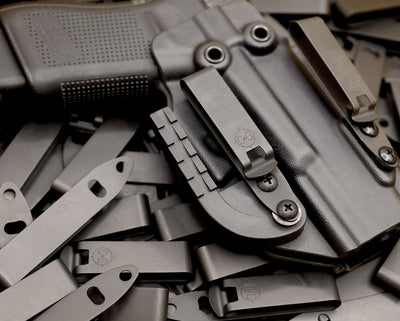
Appendix carry (AIWB) is gaining traction among retired LEOs who spent decades on strong-side OWB. Key holster features that make AIWB safer and more comfortable include a claw attachment for improved concealment, adjustable cant for draw angle preference, and a full sweat guard that covers the slide and protects against skin contact.
Kydex has become the preferred material for this transition. Kydex holds its shape over time, does not absorb sweat or moisture, provides a consistent audible click on re-holster, and offers full trigger guard coverage. These are not convenience features. They are safety properties critical for officers retraining muscle memory from decades of duty carry.
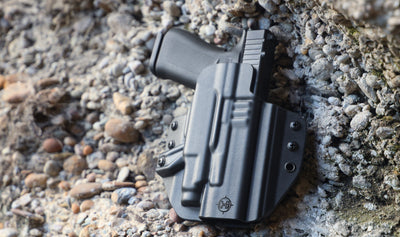
C&G Holsters' COVERT/ALPHA Kydex Holster collection, available in both OWB and IWB configurations with Quickship and custom options, is built for exactly this transition. The retention consistency and one-handed re-holster capability align directly with what LEOSA qualification standards demand. Our founder, a retired Law Enforcement Officer and Master Firearms Instructor, designed these holsters with the same requirements he faced himself. Our team of U.S. Military Veterans, LEOs, and competitive shooters tests every design from a practitioner's perspective.
The community navigating this gear shift is substantial and growing. According to the Council on Criminal Justice, there were approximately 770,000 sworn law enforcement officers in the United States in 2024, roughly 30,000 fewer than the 2017 peak. A U.S. GAO report found that retirements spiked nearly 30% from 2019 to 2020 alone. That wave has not slowed. Every one of those retired officers faces this same OWB-to-IWB decision.
Optics, Weapon-Mounted Lights, and Modern LEOSA Carry Gear
Weapon-mounted lights (WMLs) and red dot sights (RDS) are now standard on defensive handguns. If you upgraded your carry pistol after retirement, your old holster almost certainly does not fit anymore. A standard holster will not accommodate a WML-equipped or optic-cut firearm. You need a holster specifically molded for your exact pistol model, light, and optic combination.
Light-bearing Kydex holsters are now widely available in both IWB and OWB formats. Generic-fit holsters create retention and safety risks that no retired officer should accept.
This matters for qualification, too. If you added a red dot to your carry pistol, replace your holster before qualification day, not after you discover the problem at the range. An optic-cut holster that accommodates your specific RDS is not optional; it is a prerequisite.
If the LEOSA Reform Act clears the Senate and expands carry to national parks, public transit, and certain federal facilities, light-bearing IWB configurations optimized for deep concealment will become the practical choice for those environments. Retired officers should be building their carry setup now with that possibility in mind.
Your LEOSA Carry Kit: The Documentation and Gear Checklist
A complete LEOSA carry kit requires three things on your person at all times: photographic ID from your former agency, proof of annual firearms qualification dated within the last 12 months, and a holster that meets the qualification standard used to earn that card.
If the LEOSA Reform Act (H.R. 2243) is enacted, requalification could extend from annual to every 36 months. Retired officers should monitor Senate progress on S. 679 and prepare their gear accordingly, but until the law changes, annual qualification remains the requirement.
Holster checklist for LEOSA compliance:
- Full trigger guard coverage
- One-handed draw and re-holster capability
- No collapse on re-holster
- Retention that prevents the firearm from falling out during normal activity
- Compatibility with any WML or optic mounted on your carry pistol
One rule that cannot be overstated: if you qualify with a specific holster in your state, carry that same holster. Swapping gear between qualification and daily carry creates both legal and safety exposure. Your qualification card validates a specific setup. Honor it.
Keep a digital copy of your qualification card and agency ID accessible on your phone. A responding officer or federal agent may request documentation at any time, and fumbling through a wallet is not the impression you want to make during that contact.
Carry With the Same Standard You Served Under
You earned the right to carry under LEOSA through decades of service. The holster you choose should reflect the same standard you held on duty. This is not a minor gear decision. Your holster affects qualification eligibility, daily concealment, and your readiness in a threat scenario.
The key decisions are clear: know your state's qualification holster rules, make the OWB-to-IWB transition deliberately, ensure your holster fits your exact pistol configuration including lights and optics, and carry your documentation every single time you carry your firearm.
Treat holster selection as a mission-critical decision, not an afterthought. That mindset defined your career in law enforcement. It should define how you carry after it.
Sources
- US Concealed Carry Association – LEOSA / HR-218
- GovTrack.us – H.R. 2243 LEOSA Reform Act
- Rob Corbett Law – LEOSA Reform Act of 2025
- Connecticut State Police – LEOSA for Retired Officers
- Pew Pew Tactical – Best OWB Holsters
- Council on Criminal Justice – Policing: By the Numbers
- U.S. GAO – Law Enforcement Officers: Observations on Recruitment and Retention





Hinterlassen Sie einen Kommentar