


Most Holsters Were Designed for a Man's Body
Female gun ownership has more than doubled since 1980, rising from 10% to approximately 25% in 2024, according to Ammo.com. Women now make up 28.5% of concealed carry permit holders in states that track gender data, and permit growth among women outpaced men by 106.1% over the last decade, per the Crime Prevention Research Center (CPRC). The market has shifted. Holster design has not.
The core problem is straightforward: mass-market holsters are engineered around male body geometry — flatter hips, longer torsos, a narrower hip-to-waist ratio. Women's pronounced hip curves create a surface where a standard holster sits at an angle it was never designed for, causing discomfort, printing, and a draw stroke that breaks down when it matters most.
This article maps specific female anatomical variables to specific holster features, cant angles, and carry positions. Not vague "adjustable" advice. Concrete recommendations built on body geometry. C&G Holsters was founded by a retired law enforcement officer and Master Firearms Instructor, and our team of veterans, LEOs, and competitive shooters has spent six generations refining holster designs for real-world carry. Here's what we've learned.
Understanding Your Body Geometry: The Three Variables That Drive Every Decision
Variable 1: Torso Length
Short-waisted women face a specific problem: a standard-ride holster pushes the grip directly into the ribcage. Before selecting a ride height, measure your torso length. Stand in front of a mirror and note the distance between the bottom of your ribcage and the top of your hip bone. If that gap is less than about three finger-widths, you're short-waisted, and ride height becomes your first critical adjustment.
Variable 2: Hip-to-Waist Ratio
A pronounced hip curve means the holster shell sits at an angle the manufacturer never accounted for. This changes how cant angle translates to real-world grip accessibility. A 15-degree forward cant on a flat male hip produces a very different grip angle than the same cant on a curved female hip. Your hip curve profile determines whether the industry-standard cant works for you or fights you.
Variable 3: Bust Line Clearance
A high-ride holster on a short torso can push the grip directly into the bust line, blocking the draw stroke before your hand clears the holster. This is a biomechanical obstruction, not a comfort issue. If your knuckles contact your body during the draw, the configuration is wrong.
Why These Variables Interact
A change in torso length affects both the optimal ride height and the required cant angle. They cannot be selected independently. A short-waisted woman with a pronounced hip curve needs a different combination than a long-waisted woman with a straighter frame.
To self-assess: measure your torso gap as described above (short, medium, or long). Then stand sideways in a mirror and note how much your hip flares outward from your waist. That hip curve profile, combined with your torso length, gives you the two data points you need before choosing any holster configuration.
Cant Angle Explained: What the Degrees Actually Mean for Your Draw
Cant angle is the forward or rearward tilt of the holster that determines the angle of the grip relative to your body. Tilt the muzzle forward and the grip angles rearward. Tilt it back and the grip angles forward. Every degree changes the geometry of your draw stroke.
The FBI cant (15° forward, grip angled rearward) is the industry default. It was designed for male strong-side hip carry at the 3–4 o'clock position, as noted by Cloudster. For most women, it's the wrong starting point. Women carrying strong-side IWB typically need a 20° forward cant to work with natural hip curves and align the draw stroke with a shorter arm's reach arc, according to Gunvera.
There is also the front-rake (muzzle-forward) cant, which is more ergonomically appropriate for women carrying forward of the hip. Police1 has documented this distinction, yet it is almost entirely absent from civilian holster guides.
Cant angle is a biomechanics optimization, not a comfort preference. The wrong angle forces wrist deviation during the draw and increases draw time under stress. Your wrist should be neutral when your hand meets the grip. If it's not, the cant is off.
Starting point recommendations by carry position:
- Strong-side 3–4 o'clock IWB: 20° forward cant
- AIWB (appendix): 5–15° reverse cant
- OWB competition rigs: zero cant (straight drop)
Appendix Carry (AIWB) and the Body Geometry Case for Curvy Frames
Appendix carry is often dismissed as unsuitable for curvier body types. The opposite is frequently true.
Consider the "valley effect." AIWB positions the firearm in the natural concave space between the bust and hip, rather than on top of the hip curve where printing is worst. For women with pronounced hips, this valley provides natural concealment that strong-side carry cannot match. MK-Tek Holsters and other industry sources have documented this advantage extensively.
Short-torso carriers benefit most from AIWB because it dramatically reduces the elbow lift arc required to clear a strong-side holster. When your torso is short, your elbow has to travel farther and higher to clear a holster at 4 o'clock. AIWB cuts that arc significantly because the hand drops straight down to the grip in front of the body.
AIWB adoption surged in 2025 and 2026, driven by purpose-built wedge systems and claw attachments that accommodate diverse body types, according to PopularEDC. This is an engineering evolution, not a passing trend.
Concealment wings (claws) on a Kydex AIWB holster press the grip inward toward the body, reducing printing under fitted tops and professional attire. For women whose wardrobes rarely include oversized cover garments, this feature is often the difference between concealed and exposed.
For seated carry, AIWB with a properly angled wedge distributes pressure more evenly across the lower abdomen during extended sitting (office work, driving) than a strong-side IWB pressing into the hip bone. If you spend most of your day seated, this matters.
Kydex Features That Solve Female-Specific Fit Problems
A rigid Kydex shell maintains full trigger guard coverage during dynamic movement: sitting, bending, driving. Soft holsters and belly bands cannot guarantee this. For carriers whose primary motivation is self-protection (27% of women cite personal protection as their only reason for gun ownership, trigger guard coverage is non-negotiable.
Sweat guard height: A full-coverage sweat guard protects the slide from body moisture and prevents skin irritation during extended carry. This is especially relevant for women carrying against bare skin under fitted clothing, where a metal slide against skin for eight hours creates both discomfort and corrosion risk.
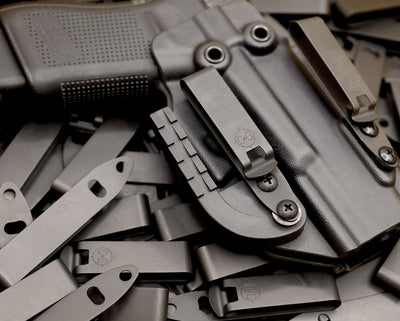
Clip spacing and placement: Narrower clip spacing on a Kydex IWB holster sits more comfortably on a shorter waistband span. Single-clip configurations work particularly well for AIWB on shorter torsos, reducing the footprint on the belt line.
Beltless carry: For women who carry in clothing without a dedicated gun belt (leggings, dress pants, skirts), a beltless attachment option like the UltiClip UltiTuck allows secure IWB carry without requiring a reinforced waistband. It clips directly to the fabric, opening up carry options that traditional belt clips cannot accommodate.
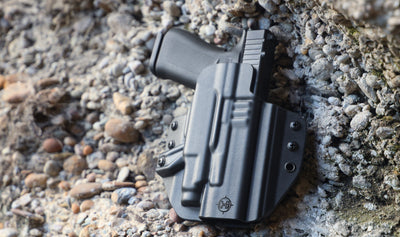
CNC-precision molding: Kydex shells formed on CNC-machined aluminum molds (rather than generic thermoformed shells) produce a consistent fit every time. This matters most for body types that deviate from the male default, because a precision fit means consistent retention and a repeatable draw regardless of body position.
Building Your Draw Stroke Around Your Body, Not the Other Way Around
The draw stroke is the end product of every cant angle, ride height, and carry position decision. If any variable is wrong, the stroke breaks down under stress.
Short-torso drill: Practice the draw from your selected position and note whether your elbow clears your ribcage naturally or requires an exaggerated upward arc. If it does, your ride height or cant angle needs adjustment. Don't train around a bad setup.
Wardrobe compatibility check:
- High ride + forward cant: works for tucked blouses and professional attire
- AIWB + claw: works for fitted athletic wear and leggings
- Strong-side + 20° forward cant: works for jeans with a gun belt
Dry-fire consistency test: Run 50 repetitions from your chosen configuration in your most common daily clothing. If the draw is inconsistent, the holster geometry is the variable to change, not your technique. A repeatable draw means the setup is right.
Left-handed female carriers: Mirror all cant angle recommendations and verify that the holster's clip placement doesn't conflict with the left-side hip curve. This is a doubly underserved configuration. If you're a left-handed woman with pronounced hips, pay close attention to clip position and cant angle interaction, because the geometry compounds on the support side.
Choose the Holster That Fits Your Body, Not the Industry Default
Here is the decision framework: identify your torso length and hip curve profile first. Then select your carry position. Then dial in cant angle. Then verify your draw stroke with dry-fire repetitions. In that order.
The "holster tax" is real. Most women go through multiple holsters before finding one that works. A body-geometry-first framework eliminates most of that expensive trial and error.
The case for a precision-fit custom Kydex holster is strongest for body types that deviate most from the male default template. If you're short-waisted with pronounced hip curves, a generic shell will never fit the way a CNC-molded custom will. C&G Holsters' 6th-generation designs, built by veterans and law enforcement professionals with American-made materials, exist for exactly this: a holster engineered to your firearm and your carry needs, not a compromise shaped around someone else's body.
Use the body geometry framework from this article as your starting checklist. Measure your torso, assess your hip profile, test your draw stroke, and select a holster configuration built to match what your body actually needs.
Sources
- Ammo.com — Gun Ownership by Gender in 2026
- Crime Prevention Research Center — Concealed Carry Permit Holders Across the United States: 2025
- Cloudster — Understanding Holster Cant and Why It Matters for CCW
- Gunvera — Best Concealed Carry Holsters for Women 2026
- Police1 — Firearms and the Female Officer: Concealment Holsters, Front and Center
- PopularEDC — Best Appendix Carry Holsters of 2026





Hinterlassen Sie einen Kommentar