


The Thigh Rig Gets a Bad Reputation — Some of It Earned
Roughly 60% of law enforcement officers experience low back pain, and the duty belt is commonly cited as a contributing factor. That statistic reframes holster placement as a biomechanical decision, not a style preference.
The tactical community is split on drop leg holsters. Gear enthusiasts praise them as the ultimate platform; patrol veterans dismiss them as range-toy nonsense. Both camps have valid points, and both are wrong when they claim universal superiority for either option.
Neither platform wins every scenario. The right answer depends on your role, your kit, and your mission profile. By the end of this article, you will have a clear decision framework: use a drop leg when your belt line is obstructed, and use a belt mount when weapon retention and integrated load-bearing matter most.
Why Drop Leg Holsters Exist: The Original Use Case
Drop leg holsters were not designed as a general-purpose duty solution. They were engineered for a specific problem: personnel wearing heavy body armor, plate carriers, or chest rigs that physically block access to the belt line. When a ballistic vest sits over your waistband and you cannot reach your sidearm, a thigh-mounted platform becomes a necessity, not a luxury.
Specialized law enforcement units adopted thigh rigs for exactly this reason. Gang Enforcement, Drug Task Force, K-9, motorcycle patrol, and tactical teams regularly wear outer ballistic vests that make belt-mounted draws impractical. For these operators, the drop leg holster solved an access problem that no belt configuration could fix.
The rise of plate carrier use in training environments is driving renewed interest in drop leg platforms, even among civilian shooters and firearms instructors. When you run drills in a chest rig, your belt line is obstructed. The same logic that put thigh rigs on SWAT operators now applies at the training range.
One critical distinction gets lost in most content: a mid-ride drop (roughly a 2-inch drop with a leg strap) behaves very differently from a full drop-leg platform positioned 6 to 8 inches below the belt. Most articles treat all thigh rigs as equivalent. They are not. Proper drop leg positioning places the top of the platform approximately 6 to 8 inches below the belt. Worn too low, near the knee, the rig bounces, shifts, and destroys draw consistency. According to AET Tactical, a poorly positioned drop leg holster significantly hampers running gait and degrades reliability under movement.
The Biomechanics Case: What Peer-Reviewed Research Actually Says
Opinions are cheap. Peer-reviewed data is not. A study of 221 military police officers published in the Revista Brasileira de Medicina do Trabalho found that belt holster wearers showed a 74.2% prevalence of low back pain and a 70.1% rate of pain chronification. The mean Oswestry Disability Index was higher in the belt holster group than in drop leg wearers. These are not marginal differences.
A systematic review on low back pain prevention in police officers identified drop leg holsters as a potential solution, noting they redistribute load from the lumbar spine to the lower limbs. Better weight distribution of duty gear reduced pain in 87% of officers with complaints and reduced pain intensity in 62%. For professionals who carry gear eight to twelve hours a day, those numbers matter.
A Swedish police study measured hip rotation and found it was more similar to a no-holster control condition when officers wore a thigh holster. In plain terms, the thigh rig imposed less rotational restriction on the hip during normal walking than a belt-mounted holster did.
On draw speed: research cited by Campbell et al. (2013) shows draw performance is statistically comparable between belt and thigh platforms when operators are properly trained. The platform is not the variable; training volume is. Sub-1.2-second draw times have been recorded for trained operators using properly fitted drop-leg holsters, according to field testing reported by Marine Approved, times comparable to duty belt holsters costing significantly more.
When the Thigh Rig Is the Right Tool
Vehicle operators, aviation crew, and motorcycle officers: Seated draw access from a thigh rig is biomechanically superior when hip-line gear is blocked by harnesses, seatbelts, or seat geometry. In these positions, a belt holster is physically obstructed. The thigh rig is not a preference; it is the only workable option.
Plate carrier and chest rig training: When the belt line is occupied by a chest rig or plate carrier, a thigh platform becomes the sole viable option for sidearm access. This applies to tactical teams, firearms instructors running armored drills, and civilian shooters training in realistic kit configurations.
Range and competition use: Level 1 passive retention (Kydex tension only) is appropriate for controlled environments where draw speed matters and weapon-grab risk is low. A drop leg rig with passive retention keeps the firearm accessible without the added manipulation of an active retention device.
Mounted units and tactical entry teams: Any environment where the belt line is consistently obstructed by mission-specific equipment benefits from a thigh-mounted platform.
Stability matters: In field testing, a modular drop-leg platform remained stable through 200-plus sprints, prone positions, and vehicle transitions when dual thigh straps were used. Single-strap systems showed higher migration rates. Strap configuration is not a minor detail; it is a performance variable.
When the Belt Holster Is the Right Tool
Standard patrol duty: The belt holster integrates with the full duty belt system, supports higher active retention levels, and provides better weapon security during crowd control or physical altercation scenarios. The duty belt is designed as an integrated load-bearing unit, and the holster is a core component of that system.
Weapon retention in close quarters: The lower position of a thigh holster makes elbow-coverage defense against gun-grab attempts harder. The holster can also snag on vehicle door frames or seatbelts during rapid exits. For patrol officers who regularly interact with the public at close range, these are not theoretical concerns.
Level 2 retention (rotating hood): Belt-mounted configurations more naturally support Level 2 active retention for duty environments where weapon security during a struggle or in a crowd is a priority. The geometry of a belt-mounted holster allows a more natural hood-release motion during a stress draw.
Foot patrol, crowd management, and scenarios involving close physical contact with the public: The belt position allows faster elbow-guard retention defense than a thigh-mounted platform. For standard patrol, the belt holster remains the dominant and recommended platform. This reflects how duty belt systems are engineered to function, not opinion.
One Holster, Two Missions: The Modular Solution
The "drop leg for training, belt for duty" framework creates a practical problem: do you buy two separate holsters? Not if the holster is built for modularity from the ground up.
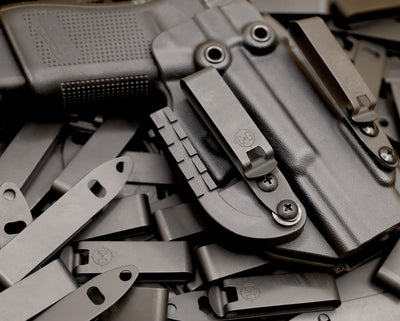
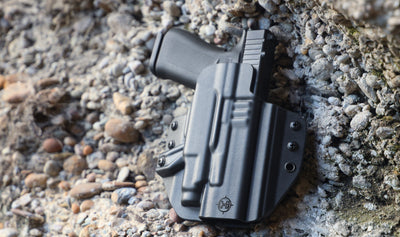
The C&G TRINITY GEN6 is a single holster body that transitions between belt-mount and drop-leg configurations without replacing the shell. Its advanced mounting back layout accommodates Tek-Lok, DOT, QLS (Safariland), RTI Hanger, Paddle, and drop-leg systems. If you already own a TRINITY body, you add a new mount rather than buying a new holster.
Retention is configurable. The TRINITY ships with Level 1 passive Kydex tension out of the box. A rotating hood add-on upgrades it to Level 2. Parts kits are listed on the C&G website, making the transition field-practical. Run Level 1 at the range on Saturday and Level 2 on duty Monday morning, same holster body.
The engineering behind this flexibility is concrete: CNC-machined to tolerances as tight as 0.003 inches using 3D scanning and CAD modeling, constructed from 0.125-inch Kydex. That precision ensures the same repeatable draw regardless of which mount is installed. Available in both Quickship (5-day) and fully custom color configurations, the TRINITY gives professionals a fast path to a duty-ready or range-ready setup.
Every TRINITY is 100% American-made using locally sourced materials. The people who designed this holster (U.S. Military Veterans, LEOs, and competitive shooters) have worn both belt and drop leg rigs on actual missions. That operational experience is built into the mounting ecosystem and retention configurability.
The Decision Framework: A Clear Answer for Your Role
- Standard patrol officer: Belt holster with Level 2 retention
- Tactical/SWAT/plate carrier operator: Drop leg for active missions
- Vehicle operator, pilot, motorcycle officer: Drop leg for seated access
- Range and competition shooter: Belt or drop leg based on course design
- Firearms instructor running plate carrier drills: Drop leg when belt line is obstructed
Keep the mid-ride vs. full drop-leg distinction in mind. Most users who dislike thigh rigs wore them incorrectly: too low, single strap, wrong retention level. Proper positioning and dual-strap configuration resolve the majority of complaints.
Training volume is the true equalizer for draw speed. Whichever platform you choose, consistent repetitions with that specific mount configuration produce sub-1.2-second draws. The platform itself is not the variable.
The modular approach eliminates the false choice. Own one precision holster body, own multiple mounts, and deploy the right configuration for the mission rather than buying separate holsters for each role.
Bottom Line: Match the Mount to the Mission
Drop leg holsters are a specialized tool that excels in specific, well-defined scenarios. They are not a universal upgrade over the duty belt, and the duty belt is not obsolete. Both platforms serve distinct operational needs.
The professionals who get the most out of both platforms train with both and own a modular system that lets them switch without buying new gear. C&G Holsters was founded by a retired Law Enforcement Officer and Master Firearms Instructor who has worn both platforms under real conditions. The TRINITY GEN6 reflects that experience in its mounting ecosystem and retention configurability.
Configure your retention level, choose the mount that matches your mission, and train with it until the draw is automatic. That is how professionals operate.
Ready to gear up? See our QUICKSHIP kydex holsters, ready to ship.
Sources
- ResearchGate — Low Back Pain in Law Enforcement Officers
- PMC — Low Back Pain in Military Police Activity: Analysis of Prevalence, Associated Factors, and Ergonomics
- PMC — Driving the Prevention of Low Back Pain in Police Officers: A Systematic Review
- PubMed — Effects of Thigh Holster Use on Kinematics and Kinetics of Active Duty Police Officers
- ScienceDirect — Campbell et al. (2013) Draw Speed Research
- AET Tactical — FAQs About Drop Leg Platforms
- Marine Approved — Best Drop Leg Holsters Field Testing
- C&G Holsters — TRINITY Collection





Hinterlassen Sie einen Kommentar