


Why Your Weekend Carry Setup Fails at the Office
Most concealed carry content assumes you're standing, walking, or moving through open terrain. Office workers spend six to eight hours a day seated, and that changes everything. A standard IWB holster that feels fine on a Saturday errand run can become genuinely painful after two hours in an office chair.
The 4 o'clock strong-side position that works on the range becomes a pressure point against a chair back. With approximately 20.88 million active concealed carry permit holders in the U.S. and constitutional carry now law in 29 states, millions of carriers are navigating workplace carry for the first time without guidance built for their environment.
This guide tackles the two core problems head-on: printing when you stand up and pain when you sit down.
Know the Law Before You Carry Through the Door
Constitutional carry now covers 46.8% of Americans across 29 states, according to the NRA-ILA. That's 157.6 million people who can legally carry without a permit. State law, however, is only the first layer. Employer policy and building lease restrictions can override your state-level carry rights on private property.
New York's Concealed Carry Improvement Act (CCIA) is a sharp example. Under the CCIA, concealed carry on private business premises is illegal unless a physical sign is posted expressly permitting it. Your permit means nothing without that sign on the door.
Before you carry at work, review three documents: your employee handbook, your building's lease terms, and your state's preemption statutes. The legal hierarchy runs from state statute to local ordinance to private employer policy. Understanding that stack protects both your rights and your job.
Disclaimer: This article does not constitute legal advice. Laws vary significantly by jurisdiction. Consult a qualified firearms attorney for guidance specific to your state and workplace.
Holster Selection for the Office Environment
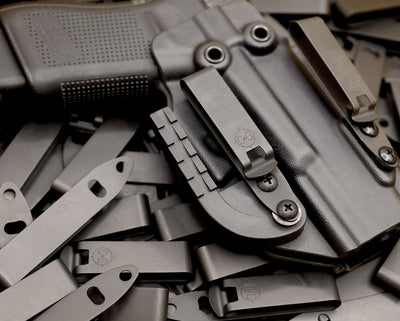
Tuckable IWB holsters are the primary solution for anyone working under a formal or business-casual dress code. These holsters use low-profile clips that let your shirt tuck between the holster body and your waistband. The only visible hardware is a pair of small clips that most people read as shirt stays or belt hardware. This setup is what makes concealed carry under a tucked dress shirt actually feasible.
Appendix inside-the-waistband carry (AIWB) is the fastest-growing carry position in the CCW community, and for good reason in an office context. AIWB provides easier access when seated at a desk or buckled into a vehicle during your commute. Strong-side 4 o'clock carry, by contrast, presses into the chair back during extended sitting and slows seated draws considerably.
Firearm size matters here, too. Full-size pistols with 4.5-inch-plus barrels create printing problems in fitted suits that tailoring alone cannot fix. Compact 9mm pistols are the consensus optimal choice for office carry.
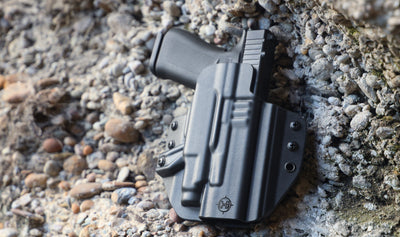
Our founder, a retired Law Enforcement Officer and Master Firearms Instructor, designed the COVERT/ALPHA Kydex Holster line for exactly this kind of deep concealment. Available in both Quickship and fully custom configurations, these holsters are CNC-machined from custom aluminum molds for a consistent, repeatable draw across an eight-hour workday. With over 4,200 customer reviews and broad gun-model compatibility, the line includes tuckable IWB options built to handle the demands of professional carry.
The Claw, the Wedge, and Ride Height: Solving the Printing Problem
If you've ever caught your reflection and noticed the grip of your pistol pushing your shirt outward, you've experienced printing. In an office where coworkers are within arm's reach, a slim holster alone won't solve that. You need accessories that actively manage how the firearm sits against your body.
A claw or wing attachment on an AIWB holster presses against the inside of the waistband, rotating the grip inward toward your body. It's the single most effective hardware fix for printing in close-proximity settings like open-plan offices and conference rooms.
A wedge attachment at the muzzle end angles the firearm away from your body, tilting the grip away from your ribs. The result is noticeably better comfort when seated. Many experienced office carriers run both a claw and a wedge simultaneously, and the combination outperforms either piece alone.
Ride height controls how high or low the firearm sits in the waistband. A lower ride height reduces grip exposure under a tucked shirt. Cant angle (the forward or rearward tilt of the holster) affects both concealment and draw speed from a seated position. A slight forward cant aids seated draws without sacrificing concealment.
The full claw-wedge-ride height setup is what separates a comfortable, concealed office carry from a painful, printing one. Going beyond "buy a slim holster" is where real results start.
The Gun Belt Problem: Looking Professional While Carrying Safely
A reinforced gun belt is non-negotiable: 1.5 inches wide with a polymer or steel core. Standard dress belts sag under firearm weight, and that sag causes both discomfort and obvious printing. It's one of the most common problems among office carriers, and it's almost always overlooked in favor of holster selection.
Tactical-looking rigger belts have no place in a professional office. The solution is a dress-appropriate belt with a leather or leather-look exterior over a rigid internal core. These belts pass as standard professional accessories in business casual and business formal environments without advertising your carry status.
Most carriers get the priority wrong: investing in a proper gun belt before optimizing holster accessories will produce more improvement in comfort and concealment than any other single change. The belt is the foundation. Everything else sits on top of it.
Clothing Strategy: Fabric, Pattern, and the Jacket-Off Problem
Patterned and textured fabrics are your allies. Plaids, checks, and herringbone break up the outline of a firearm under clothing. Solid-color fitted dress shirts, by contrast, highlight every bulge. This is a practical concealment decision, not a style preference.
Fabric weight matters, too. Heavier suit fabrics like wool reduce printing compared to lightweight materials that cling to a firearm's outline, as noted by Premier Body Armor. When choosing office attire, think about drape and thickness, not just fit.
Size your dress trousers one to two inches larger in the waist to accommodate an IWB holster. This prevents visible pulling across the hips and is a widely recommended practice among experienced formal carriers.
Then there's the jacket-off problem. A blazer or suit jacket removed at 9 AM leaves a tucked shirt as your only layer of concealment. This is exactly the scenario tuckable IWB holsters are designed to handle, and it's the most overlooked gap in most carry advice. If your setup only works with a jacket on, it doesn't work for a real workday.
Women face compounded challenges in professional attire. Fitted blazers, dress pants without belt loops, and thinner fabrics all demand purpose-specific solutions. When belt-based carry isn't possible, off-body carry options or belly band systems may be necessary. Women are the fastest-growing segment of concealed carry permit holders (permit growth 106.1% faster than men, per CPRC data), and that reality demands purpose-built solutions the industry must take seriously.
Behavioral Discipline: The Gray Man Mindset at the Office
Your holster and clothing can be perfect, and your behavior can still give you away. Avoid 2A-branded clothing, gun-related accessories, or anything tactical-looking at the office. The goal is to blend in completely.
Unconscious "gun checking" is one of the most common tells. Touching or adjusting the firearm at the waistband, even briefly, can reveal your status to an observant coworker. Train yourself to leave it alone.
In open-plan offices, be aware of sightlines when standing, sitting, or reaching. Movements that expose the waistband carry more risk than they would in a private office. Situational awareness in a professional environment means reading the room, not just scanning for threats. Know who is nearby when you stand up or remove a jacket.
The gray man principle applied to office carry: your setup, your clothing, and your behavior should all work together so that nothing about you reads as "armed" to a casual observer. This is a trained habit, drawn from the same law enforcement and executive protection practices our team of LEOs, veterans, and competitive shooters applies every day.
Build a Setup That Works From Commute to Conference Room
The ideal office carry setup performs across three environments: your vehicle commute (seated, seatbelt on), the open office (standing, moving, close to coworkers), and formal meetings (jacket on, close quarters). AIWB with a tuckable holster, claw, wedge, and a proper gun belt is the setup most experienced office carriers converge on because it addresses all three environments with a single configuration.
Before you commit, test your full setup (holster, belt, clothing) seated in an office chair for at least two hours. Discomfort discovered at home is far better than discomfort discovered at 10 AM on a Monday. Carry the most compact firearm you can shoot accurately and trust your life to. Office carry is not the place to push the limits of concealability with an unfamiliar platform.
The standard is not "good enough for the weekend." It's a setup you can wear professionally, draw reliably, and carry comfortably for a full eight-hour workday, every workday. That's the bar. Meet it before you walk through the door.
Sources
- CPRC: Concealed Carry Permit Holders Across the United States: 2025
- NRA-ILA: CPRC's Latest Report Outlines the Robust State of Concealed Carry in America
- EBC HCM: New York Conceal Carry Laws at Work
- Gun Carrier: Appendix Carry Holster – 2026 Ultimate Guide
- Premier Body Armor: Concealed Carry in a Suit





Hinterlassen Sie einen Kommentar