


Your Draw Is Only as Consistent as Your Holster's Mold
Every dry-fire repetition you run trains your nervous system to follow a specific draw path: your grip, your angle, your speed, your presentation. Thousands of reps build that path into reflex. But if your holster changes the path, even slightly, the training is compromised before you ever face a real threat.
Draw consistency is a hardware problem before it is a skills problem. Two manufacturing approaches dominate Kydex holster production: CNC-machined aluminum molds and hand-formed foam-press methods. The difference between them is measured in thousandths of an inch, and that difference matters.
For law enforcement officers, military personnel, and concealed carriers, an inconsistent draw under stress is not a performance issue. It is a life-safety issue. What separates these two methods determines whether your training holds up when it counts.
How CNC-Machined Molds Are Built, and Why Accuracy Starts Before the Kydex Is Heated
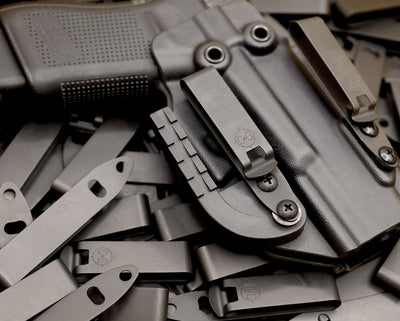
The precision of a CNC-molded Kydex holster begins long before a sheet of Kydex ever touches heat. The process starts with a 3D scan of the actual firearm. That scan is converted into a CAD file, which is then used to machine an aluminum mold on a CNC mill. The finished mold captures every curve, ledge, serration, and accessory rail of the specific firearm model with sub-thousandth-inch accuracy.
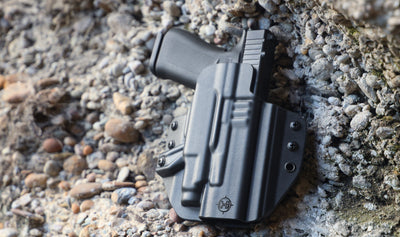
This is not an approximation. Top manufacturers machine their molds within thousandths of the real steel, producing holsters with repeatable retention across every single production run. The Kydex sheet is then vacuum-formed over this aluminum mold, and the result is a shell that mirrors the firearm's geometry with extraordinary fidelity.
One important distinction gets lost in marketing: "CNC-cut edges" is not the same thing as "CNC-molded." Post-molding trimming (cutting the Kydex shell to its final shape) can be CNC-guided, and those cutting programs run in 90 seconds or less per holster, performing a rough cut and a finishing pass. That is valuable for clean edges and dimensional uniformity. But the mold itself is where precision is either built in or lost entirely.
Speed and precision are not mutually exclusive. Modern CNC-integrated production systems can mold four holsters in 120 seconds. When the mold is right, every holster that comes off it is right.
The Hidden Problem With Hand-Formed Kydex Holsters
Hand-formed Kydex holsters use a fundamentally different process. A heated Kydex sheet is pressed over a firearm or a plug using a foam press, and the final shape is determined by hand pressure and foam density. It can produce a functional holster, but it cannot produce a consistently identical one.
The core flaw: foam density decreases with each press cycle. The foam compresses, softens, and loses its ability to apply uniform pressure. Holster number three and holster number ninety-eight from the same foam setup can have measurably different retention characteristics. This is batch-to-batch inconsistency that is completely invisible to the buyer.
Kydex is a thermoplastic with memory. In a hand-formed holster, retention points around high-contact zones like the trigger guard can soften or deform under repeated draw strokes or prolonged body heat exposure. Over time, the retention geometry drifts. The holster you bought six months ago does not perform the same way it did on day one.
Then there is the false retention click problem. A poorly molded holster can feel seated with an audible click, but the retention geometry behind that click is inconsistent. The gun appears secure, but it is not reliably so. There is no way to verify whether the holster you received performs identically to the one the manufacturer tested and approved.
The contrast is stark. CNC molds hold tolerances measured in thousandths of an inch. A foam press holds tolerances measured in how worn-out the foam is.
Stress, Muscle Memory, and the Millimeter That Can Get You Killed
Thousands of dry-fire reps train your nervous system to execute a precise draw path. Your hand finds the grip at the same angle. Your thumb breaks retention at the same point. Your presentation clears the holster on the same line every time. An inconsistent holster forces you to unconsciously compensate for equipment variance instead of building a clean, repeatable draw.
Inconsistencies that seem minor during dry fire (shifting tension, unreliable clicks, misaligned grip acquisition) compound dangerously under adrenaline and stress. Fine motor control degrades. Heart rate spikes. Decision-making narrows. The small equipment variance you could manage on a calm range becomes a critical failure point under real-world conditions.
A holster's angle, rigidity, ride height, and shell geometry directly shape draw speed and stability. Inconsistency in any of these parameters delays or misaligns grip acquisition. For shooters running weapon-mounted lights and red dot optics, the challenge intensifies. Hand-formed holsters struggle to maintain consistent retention geometry around complex accessory profiles. CNC molds solve this by design, capturing every accessory contour with the same sub-thousandth accuracy applied to the firearm itself.
Universal-fit or poorly molded holsters create shifting tension, unreliable clicks, and false retention signals. These problems feel manageable in practice. Under stress, they multiply.
For law enforcement officers and military personnel whose draw may happen once in a career under maximum physiological stress, the equipment variable must be eliminated entirely. You cannot train around a holster that does not perform the same way twice.
The Day-One Performance Standard, and What It Tells You About Your Holster
A precision-manufactured Kydex holster should deliver correct retention, smooth operation, and comfortable carry from the very first draw. No break-in period. No adjustments. No waiting for the material to settle. That is the day-one performance standard, and it separates serious holster manufacturing from everything else.
Leather holsters change shape through use. Hand-formed Kydex can drift in retention as thermoplastic memory is stressed over time. Properly CNC-molded Kydex does not stretch or deform under normal conditions. The draw stroke remains consistent across thousands of repetitions, which is exactly what reliable muscle memory requires.
At C&G Holsters, our CNC aluminum mold process and American-made Kydex materials have been refined across six generations of holster design. Built by a team of U.S. Military Veterans, active law enforcement officers, and competitive shooters, our holsters are engineered to deliver this out-of-the-box standard for duty, concealed carry, and competition use. With Quickship options shipping in five business days and fully custom builds available for nearly every handgun on the market, the day-one standard is not aspirational. It is the baseline.
The broader market reflects this demand. Kydex and polymer holsters now account for nearly 42% of modern holster designs globally, and the duty holster market is projected to reach $803 million by 2034. Precision, day-one-ready performance is driving that growth.
The Bottom Line: Precision Manufacturing Is a Life-Safety Argument
Your draw is only as consistent as your holster's mold. CNC machining eliminates the equipment variable that hand-forming cannot. Sub-thousandth-inch mold accuracy, batch-to-batch consistency across every production run, and thermoplastic stability that preserves draw geometry across thousands of reps are not features. They are requirements.
Law enforcement officers, military personnel, and serious carriers cannot afford to train around equipment variance. The holster must perform identically every single time.
At C&G Holsters, our founder built this company on decades of real-world law enforcement experience and a Master Firearms Instructor's understanding of what happens when equipment fails under stress. Choosing a precision-manufactured holster is not a gear preference. It is a commitment to the people and responsibilities that depend on your performance. For all that you hold close.
Explore our full lineup of CNC-molded Kydex holsters, built on American craftsmanship and real-world operational expertise.





Hinterlassen Sie einen Kommentar