


By: Christopher J. Burns
The Case for Going Belt-Mounted
IWB holsters serve a purpose. But there are specific missions where a belt-mounted OWB system is the only logical choice.
OWB holsters remain the standard for law enforcement duty carry, range training, and competitive shooting. That's not a preference. It's a performance requirement rooted in decades of operational reality. The global OWB holster market was valued at $1.10 billion in 2025 and is growing at an 8.60% CAGR, projected to reach $1.97 billion by 2032. Demand for belt-mounted solutions is accelerating, not fading.
The TRINITY is a system: three integrated components (holster body, rotating hood, belt attachment) designed to work as a unified platform. By the end of this article, you'll know exactly when a belt-mounted setup is the right call and why the TRINITY is engineered for those moments.
Who Actually Needs a Belt-Mounted Setup
Law enforcement on extended patrol shifts. OWB distributes firearm weight naturally across the belt, reducing fatigue over hours of sitting in a patrol vehicle. According to Houdini Holsters, this weight distribution makes OWB less restrictive and more comfortable for long-duration wear. For officers pulling 10- or 12-hour shifts, that's not a luxury; it's a necessity.
Range instructors and firearms trainers. Repetitive draw cycles across a full training day demand consistent retention and a draw stroke that doesn't degrade. An OWB belt-mounted system delivers that consistency rep after rep.
IDPA, USPSA, and 3-Gun competitors. Competition rules are specific. The IDPA 2026 rulebook requires OWB holsters to not protrude more than 3 inches from the belt, with the butt of the firearm at or above the belt top. USPSA rule 5.2.11 mirrors this requirement. A belt-mounted system is built to comply from the start.
Executive protection professionals. Open carry assignments demand speed, retention, and a professional profile simultaneously. A sloppy holster setup undermines all three.
Carry Optics shooters. Carry Optics now accounts for roughly 37% of USPSA division activity, making it the most common starting point for competition shooters. These shooters need optic-ready OWB holsters with wide adapter plate clearance.
One principle ties all of these users together: train how you carry. Professionals who use the same holster platform across duty, training, and competition reduce muscle memory errors under stress. One platform, multiple missions.
What Makes the TRINITY a System, Not Just a Holster
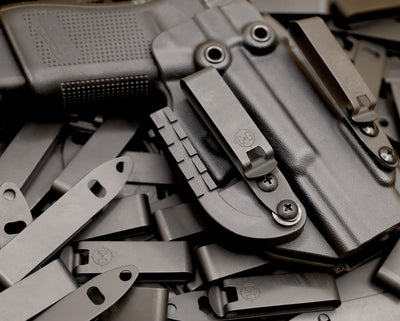
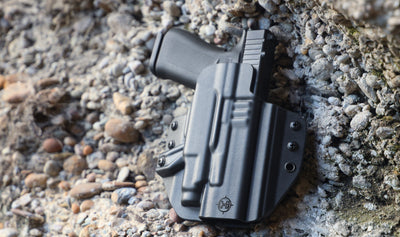
The TRINITY is built on a three-component architecture: the Kydex holster body, an optional rotating hood that provides Level II retention, and a precision-cut backplate attachment system that connects the holster to your belt infrastructure. Each component is engineered to work with the others, not bolted together as an afterthought.
Every TRINITY is CNC-engineered to 0.003-inch tolerance using 3D scanning and CAD modeling. This is not mass-produced gear. It is repeatable precision on every single unit, manufactured from 0.125-inch thick Kydex with Hyder ribs across critical stress areas. Those ribs prevent cracks and breakage under hard use, the kind of abuse that duty carry and competition put on equipment daily.
The tall sight channel accommodates suppressor-height sights. The open bottom fits threaded barrels and most compensators. This holster is built for how modern pistols are actually configured, not how they looked five years ago. Universal optic compatibility includes SROs and ACRO P-2s, with the holster wrapping over the slide in front of the barrel hood. Chamfered edges provide clearance for wide adapter plates.
Flared and chamfered edges on the holster mouth allow smooth, one-handed re-holstering under stress. That detail matters equally in a duty context and on a competition stage.
The TRINITY lineup includes both Quickship and Custom options. The Quickship model ships in black within 5 days for immediate deployment needs. The Custom model supports full color, attachment, and configuration options for shooters who want a tailored setup.
Choosing the Right Attachment for Your Mission
The TRINITY's precision-cut backplate supports six attachment systems with zero additional adapters. This is the system-level value that competitor holsters rarely match. Here's how to choose:
- BladeTech Tek-Lok (standard; fits belts up to 2.25 inches, MOLLE compatible): Best for range instructors and duty users who want secure, tool-free attachment and removal.
- Safariland QLS (Quick Locking System): Best for law enforcement and military users who rotate holsters across multiple platforms and need sub-second swaps between rigs.
- G-Code RTI Hanger: Best for battle belt users. According to Intel Market Research, demand for battle belt-compatible holsters has grown 22% in the duty segment, and RTI is the dominant standard in that ecosystem.
- G-Code Paddle with locking lugs: The locking lugs engage both the belt and trouser band to prevent rocking, with fully adjustable cant for proper grip acquisition. Best for plainclothes or plainclothes-adjacent carry.
- DOTS Belt Attachment (fits belts up to 2 inches, available at no additional charge): Best for competition shooters who want a low-profile, secure attachment on a competition belt.
- Drop-leg systems: Best for military and tactical operators who need the holster positioned below the duty belt for body armor clearance.
Match your role to your attachment, not the other way around. The TRINITY's backplate makes that decision straightforward.
Level II Retention: The Rotating Hood Explained
Retention levels matter and must be understood clearly. Level I is passive friction, appropriate for range use and competition. Level II adds an active retention device and is the standard for law enforcement duty carry.
The TRINITY's optional rotating hood meets IDPA Level II holster requirements, making it legal for competition while also satisfying LE duty carry standards in a single platform. The mechanics are straightforward: a push-button lever releases the spring-loaded hood forward, clearing the slide and optics before the draw stroke begins. No thumb break fumble. No optic interference.
Our founder, a retired Law Enforcement Officer and Master Firearms Instructor, designed this retention system around a specific philosophy: security should not come at the cost of speed. The rotating hood adds a deliberate step to the draw, but the spring-loaded mechanism is engineered to minimize the time penalty while maximizing weapon security.
Adoption of Level III retention in law enforcement has grown 18% annually, signaling that agencies are taking retention seriously. The TRINITY's Level II hood positions users to meet current and near-future agency requirements. For competition shooters, appendix carry has been legal in all IDPA handgun divisions since the 2022 rulebook update. For those who prefer OWB, the TRINITY's hood ensures full rulebook compliance without sacrificing competitive draw speed.
The Belt Beneath the System: Why It Matters
A belt-mounted holster system is only as stable as the belt it rides on. A rigid, purpose-built gun belt is not optional. It is part of the system.
Floppy or undersized belts cause holster cant to shift, draw stroke inconsistency, and accelerated wear on attachment hardware. All of those problems undermine the precision engineering built into the TRINITY. The standard Tek-Lok fits belts up to 2.25 inches; the DOTS attachment fits belts up to 2 inches. Belt width and rigidity must be matched to the attachment you've chosen.
For law enforcement and competition use, a reinforced or stiffened belt keeps the holster locked in position through dynamic movement, vehicle ingress and egress, and repetitive draw cycles. Our gun belt offerings pair directly with the TRINITY system, completing the belt-mounted setup without requiring a full gear overhaul.
When Belt-Mounted Is the Clear Answer
Four mission profiles where a belt-mounted setup wins decisively: extended LE duty carry, IDPA and USPSA competition, range instruction, and executive protection open carry.
The TRINITY's modular backplate means a single holster body can serve all four of these contexts by swapping attachments. You don't need four different holsters. You need one system.
C&G Holsters was founded by a retired LEO and Master Firearms Instructor. Our team includes active U.S. Military Veterans, law enforcement officers, and competitive shooters. The TRINITY was designed by people who have lived these exact use cases, not engineered in a vacuum. Over 4,200 customer reviews and broad gun-model compatibility validate that this system-level approach works across a wide range of shooters.
If your mission demands reliability, modularity, and American-made precision, the TRINITY is the belt-mounted setup built for it.
Sources
- OWB Holsters Market Size & Share 2026-2032 — 360iResearch
- OWB vs IWB Revolver Holsters — Houdini Holsters
- USPSA, IPSC & IDPA Holster Rules 2026 — Airsoft Shot Timer
- Competition Pistols for USPSA/IDPA — Gritr Sports
- Duty Holsters Market Outlook 2026-2034 — Intel Market Research
- OWB Holsters — Impact Guns
- C&G Holsters TRINITY Collection





Jätä kommentti