


Why Most EDC Setups Fail Before the Draw
Here's the pattern we see every day: someone spends $600 or more on a quality pistol, then pairs it with a $20 holster and a department store belt. That's not a carry system. That's a liability.
A complete EDC kit rests on three pillars: the holster, the gun belt, and the magazine carrier. These three components must function as one integrated platform, not three separate purchases thrown together. With 20.88 million active concealed carry permit holders in the U.S. and 29 constitutional carry states bringing millions of new carriers into the fold (many without formal training), the need for a system-first mindset has never been more urgent.
Every component choice constrains the next. Your carry position dictates your holster. Your holster dictates your belt width. Your belt dictates where and how your mag carrier rides. Build order matters. This is life-safety gear, not a fashion statement.
Start With the Holster: Fit, Material, and Carry Position
The holster is your logical starting point because your carry position determines every downstream decision. Your choice of AIWB (appendix inside the waistband), strong-side IWB, or OWB locks in your belt width requirements, your mag carrier placement, and even your wardrobe adjustments.
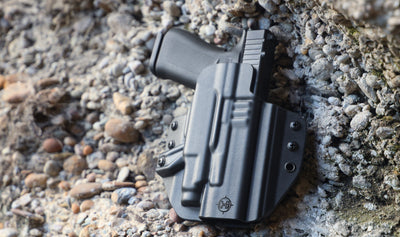
Kydex is the dominant material for duty and tactical holsters for good reason. It retains its shape after every draw, enabling safe one-handed reholstering. It's fully waterproof. It requires zero break-in period. Our founder, a retired law enforcement officer and Master Firearms Instructor with decades of real-world carry experience, puts it simply: leather can collapse at the holster mouth during reholstering, and that's a critical safety failure. Kydex eliminates that risk entirely.
Once you've chosen your material, focus on the two highest-impact adjustments: cant and ride height. Cant is the forward or backward tilt of the holster. Ride height determines how deep the pistol sits in your waistband. Small changes here produce significant results in concealment, comfort, and draw speed. A quarter-inch shift in ride height can be the difference between a clean draw and a fumbled grip.
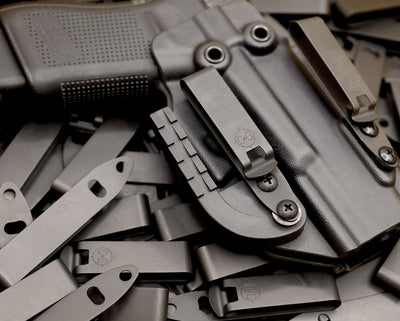
The appendix carry setup has become the default for many serious carriers, and 2026 holsters reflect that. Factory-integrated claws, foam wedges, and optic-ready cuts now ship as standard features, even at mid-range price points. At C&G, we've been refining these features across six generations of holster designs, each iteration driven by feedback from the LEOs, military veterans, and competitive shooters on our team who carry and train with this gear daily.
Precision matters at the manufacturing level, too. Holsters built on CNC aluminum molds to exact firearm specifications eliminate the slop and rattle that cause inconsistent draws under stress. A holster that fits your specific gun model (not a "universal" shell) is the foundation of a reliable IWB holster system.
The Gun Belt: The Unsung Foundation of Every EDC System
If your holster sags, shifts, or prints through your shirt, the problem is almost certainly your belt. The gun belt is the true foundation of every EDC system, and it's the component most carriers underestimate.
A department store dress belt collapses under the weight of a holstered firearm. The rig sags to one side, pulls your pants down, and prints through every shirt you own. Concealment and draw consistency are both destroyed before you even leave the house.
A purpose-built gun belt for concealed carry is fundamentally different. It features a rigid core construction that keeps the holster tight to your body regardless of movement, seated position, or activity level. That rigidity is what holds everything in place so the gun stays concealed and draws clean.
Belt width compatibility is a spec most new carriers miss entirely. Holster attachment hardware (clips, loops, UBLs) is sized to specific belt widths. A mismatch causes wobble at best and prevents mounting altogether at worst. Before you buy a belt, check the width spec on your holster's clips.
For AIWB carry specifically, a stiff belt is non-negotiable. A soft belt lets the entire holster setup flop forward when you sit down or bend over, destroying both concealment and your draw angle. A quality gun belt is the lightest upgrade with the highest system-wide impact on your EDC kit.
The Magazine Carrier: The Piece Most Carriers Skip Until They Need It
A spare magazine loose in your pocket is not a reload. It's a fumble waiting to happen under stress. Lint, pocket debris, and inconsistent orientation all conspire to cause failures during the exact moment you need a reload to work.
A dedicated magazine carrier EDC setup solves every one of those problems. It locks the magazine in a consistent position, protects it from dirt and debris, and presents it at the same angle every single time you reach for it.
OWB vs. IWB mag carriers come down to priorities. OWB carriers offer the fastest access and the most comfort. IWB mag carriers provide better concealment but require careful positioning to avoid digging into your body during seated carry. Both have their place depending on your carry position and daily routine.
Correct magazine positioning is on your support side (11 o'clock for right-handed shooters, 1 o'clock for left-handed) with bullets facing toward the belt buckle. This orientation gives you the most natural ergonomic reload grip, letting your support hand index the magazine and seat it without fumbling.
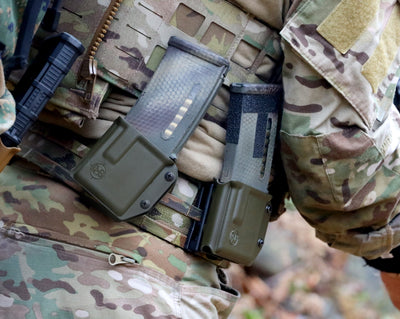
Kydex magazine carriers share the same advantages as Kydex holsters: fully waterproof, no shrinking or stretching over time, and minimal maintenance. They must be molded to the exact profile of your specific magazine. Generic carriers introduce dangerous inconsistency in retention. It's also worth noting that 14 states and D.C. restrict magazine capacity (most cap at 10 rounds), which directly affects your mag carrier selection and loadout planning.
C&G Holsters' precision-molded Kydex magazine carriers are built to the same manufacturing standard as our holsters, using CNC aluminum molds and American-made materials. If you're already running C&G gear, the mag carrier is a natural extension of your system, built by the same team of veterans, LEOs, and competitive shooters who designed your holster.
Tuning the Full System: Cant, Height, Belt Tension, and Mag Position Together
Here's the gap most guides skip: holster cant, ride height, belt stiffness, and mag carrier placement must be tuned as a unified system. Adjusting one in isolation throws off the others.
Follow this sequence. Set your holster cant and ride height first. Then confirm your belt tension holds the rig firmly in place through a full range of motion (standing, sitting, bending, reaching). Then position your mag carrier so the reload grip doesn't conflict with your holster draw stroke.
Carry position affects mag carrier orientation. AIWB carriers typically run their mag carrier at roughly 11 o'clock on the strong side, while strong-side IWB carriers shift the mag carrier further forward on the support side for a cleaner reload path.
Dry-fire before live-fire. The instructors and competitive shooters on our team at C&G train with their complete kits assembled, and they'll tell you the same thing: practice your draw and reload with the holster, belt, and mag carrier all in place. Each component affects the draw and reload stroke, and you need those reps before you hit the range.
If you already own a quality holster and want to upgrade your belt or add a mag carrier, you don't need to start from scratch. Run your compatibility checks (belt width, attachment hardware, carry position clearance) and integrate the new component into your existing setup. Precision-fit, American-made gear built to exact specs eliminates the cycle of cheap replacements that degrade system reliability over time.
Build Your EDC Kit the Right Way, From the Holster Out
The build order is simple: holster first (carry position and firearm fit), belt second (width compatibility and rigidity), mag carrier third (position and retention matched to the system). Every weak link in the platform degrades the whole. A great holster on a bad belt is still a bad setup.
Realistic 2026 cost benchmarks put a beginner EDC loadout at roughly $800, a refined setup around $1,100, and a premium build near $1,900. Investing in the full system upfront is cheaper than cycling through failures.
If you carry daily, you owe it to yourself and those you protect to build a system that functions under pressure. C&G Holsters builds precision-fit Kydex holsters and mag carriers right here in America, designed by veterans, law enforcement officers, and competitive shooters who carry the same gear they make. For all that you hold close, build it right.





Jätä kommentti