


Most holster companies will tell you their products are “fit-tested.” Fewer will show you what that actually means on the production floor.
At C&G Holsters, fit-testing is not a final glance before a holster goes into a box. It is a deliberate step that happens after the shell is molded, trimmed, and assembled. Every holster—Quickship or Custom—goes through the same checks before it leaves the facility outside Pittsburgh. The goal is simple: the firearm should seat the same way, with the same retention, and draw cleanly every time.
Here is the process.
1. Mold and Shell Verification
Each holster begins with a CNC-machined aluminum mold built to a 0.003" tolerance. After the Kydex is formed, the shell is checked against the mold for consistent wall thickness and overall shape. We look for any warping, thin spots, or incomplete forming that could affect retention later. Shells that fall outside the acceptable range are rejected before hardware is added.
This step is why GEN6 holsters feel more consistent from one unit to the next than earlier generations. The mold, not hand adjustment, sets the primary geometry.
2. Firearm Seating and Retention Check
A dedicated test firearm for that specific model is inserted into the holster. We verify three things:
- The firearm seats fully and evenly, with the trigger guard properly covered and no binding at the muzzle or ejection port.
- Retention is present but adjustable. The retention screws should allow a clear range of adjustment—from a firm hold that resists casual movement to a looser setting that still keeps the gun secure under normal handling.
- The firearm does not shift or rock once seated. Lateral or vertical play at this stage indicates a mold or forming issue that will only get worse with use.
If the test gun does not seat cleanly, the holster does not move forward.
3. Draw and Reholster Cycles
The holster is mounted on a belt or fixture that approximates real carry. We then perform a series of draws and reholsters. The draw should be smooth and consistent—no catching on the shell, no sudden release that sends the gun forward, and no resistance that requires an unnatural angle. Reholstering must be possible without looking and without forcing the firearm into the shell.
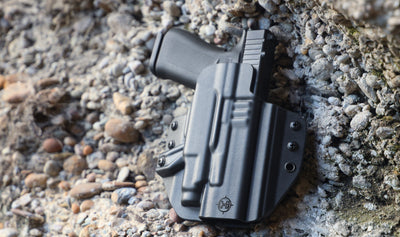
These cycles also reveal problems that a static fit check can miss: sharp edges that catch on the slide, incomplete clearance around a weapon light or optic, or retention that changes after a few repetitions. Holsters that fail this step are either adjusted or pulled from the line. For light-bearing models, this step also confirms clearance for platforms such as the TLR-1, TLR-7, and X300 series in our TACTICAL collection.
4. Edge and Finish Inspection
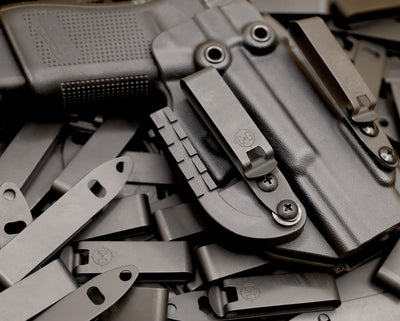
After the functional checks, every holster is inspected for edge quality. Sharp or unfinished edges are a common source of clothing snags and user discomfort. We round and smooth the perimeter so the holster will not cut fabric or skin during extended wear. Hardware (clips, wings, or mounting plates) is checked for secure attachment and proper orientation.
5. Final Verification and Documentation
Before the holster is cleared for packaging, it receives a final seating and retention check with the test firearm. Quickship holsters in standard black move through this process and ship within five business days. Custom configurations follow the same steps and ship within 15 business days. Both are covered by the same lifetime warranty against defects in materials and workmanship under normal use.
Why This Process Matters
A holster that looks correct on a workbench can still fail under movement, sweat, or repeated draws. Fit-testing with the actual firearm model, on a fixture that mimics carry, catches those issues before the customer does. It also reduces the most common reasons people return or stop using a holster: inconsistent retention, difficult reholstering, and unexpected printing caused by a shell that does not hold the gun where it should.
The same process applies whether the holster is an IWB COVERT, an OWB TACTICAL light-bearing model, or a MOD1 sidecar. The mold and the test firearm change. The standards do not.
If you want to see the result of this process on a specific platform, the Quickship collection ships the majority of popular models within five business days. Custom options are available when you need a different color or configuration. Both are built and checked the same way.





Hinterlassen Sie einen Kommentar